Syria
Chapter 7. Syria. The hushed clamour of an Eastern bazaar.
Ahead lies Syria, the land of fabled Damascus, the oldest of capitals. The bazaar in Damascus is more than a market for food and clothes. It’s a wonder out of a fairy tale, with five thousand years of tradition. A wonder of the world in its own right. You have to go there, immerse yourself in it. It was mostly Baghdad in the stories, of course, but alas, they aren’t issuing visas and the whole city is in ruins. Baghdad’s out of the question this time, at least. Still, Damascus is older, and a Damascus blade is a Damascus blade. What’s more, Syria too is teetering on the edge of the list of targets in the fight against terrorism. Now’s the time to go, or it’ll be too late. I managed to see Grozny and Gudermes in their day and it’s nice to be able to remember them now.
A theatre starts at the cloakroom. A country starts at customs and the rest of its border apparatus. The first surprise is the almost Soviet uniform. You expect a shout in a familiar voice, with a generous dose of swearing. But no. They smile. They speak a little Russian but prefer English. We still count as “other foreigners” here. There’s a special window for us “white people”.
No difficulty at passport control. You fill in a yellow card and keep it until you leave. It isn’t done especially quickly. There’s a long process. They examine all the stamps in case they find an Israeli one. They make a great many notes. For some reason they stamp the date of arrival on the first page of the passport, just where it says “citizen of the Russian Federation”. One nice thing is that they work briskly. Four men process our four passports in parallel.
The next stage is bringing in the car. Again we have to get a carnet de passage. They escort us to the office of a familiar company from Qatar. It was their people who fleeced us in Egypt. Things look alarming, though not too much so. First, the procedure is described by Lonely Planet. Second, lots of our fellow citizens visit Syria, so we know in advance what to expect. A carnet de passage costs about fifty dollars. Altogether the charges for getting the car in come to seventy dollars, including ten days’ insurance and the cost of photocopying our passports. It’s no good having your own copy, because they photocopy the fresh entry stamp. A very friendly insurance man helped us with our errands to all the various bosses.
You can change money at the exchange counter right there. Syrian money is properly called the Syrian pound, though people more often call it suri. The rate is forty-four to fifty suri for a dollar. There are coins worth up to twenty suri.
Nobody searched us. They didn’t even come out to see whether we really had a car. Everything was sorted out in the customs building. Only on the way out did they check that the passports had stamps for both the people and the vehicle. You’re meant to put the registration of the car you’re in on the yellow paper, by the way. That’s the car you must take through the exit gate. It doesn’t mean you have to leave the country in that car, though. You can even cross on foot, in which case you can leave the space for the registration blank.
The Syrian side of the border took half an hour altogether. It’s extremely well run. The one nuisance is the pit that disinfects the wheels. It’s fearfully bumpy and wasn’t designed with our poor fuel pump in mind. I have to plug the leak again, but it’s hardly the first time. In the dark, by touch, no trouble. There, done. Still, something has to be done properly. For days now I’ve promised myself I’ll fix it for good tomorrow in the morning light. Well, that’s still tomorrow…
Now we need to get farther away from the border and find somewhere to sleep. The highway is excellent and the kilometre posts go racing by. Only sixty kilometres to Damascus already. Better stop soon, before the suburbs of a huge city start.
We can’t seem to find a suitable spot. The side roads all lead to nearby villages, where they turn into ruts. There are deep ditches by every verge and the land all around is ploughed. However hard we look, every attempt ends in disappointment. Here it is midnight, nearly morning, and we’re still going up and down country lanes. At this rate the fuel pump will fall off altogether. It’s only on the highways that Syria’s roads are better than Russia’s. In the villages… It’s all as run-down as our old non-black-soil farming districts at home.
Eventually we found shelter on the actual platform of a station on the famous Damascus-to-Mecca railway, built in the early twentieth century to carry pilgrims to the hajj. Lawrence of Arabia blew that line up repeatedly. That stretch is practically abandoned now. I don’t know how long ago, or after which war, the station buildings came to look the way they do today. The tracks are rusty, but there are still signs of trains passing, perhaps one a week. They say there’s even a passenger train from Amman to Damascus. The local track gauge is 1,050 mm.
Camping at a station feels a little frightening. Syria is a military state. Imagine finding a tent full of American citizens on a railway station in Russia one morning in the thirties. This place looks abandoned to us, but to the local soldiers it’s bound to be a strategic site. There isn’t much choice. We’ll wriggle out of it one way or another.
We make camp quickly and go to sleep. The sensible thing would be to get up before dawn and pack away the tents without being seen, but we want to sleep as well. We decide to leave things to chance. A passing tractor wakes us. The local farmer is more than a little surprised, but he smiles and waves. We do the same and he drives on. Soon a few more people go by on various forms of transport, but nobody comes over to make our acquaintance. Hurrah! You can pitch a tent safely and peacefully here.
Now thoroughly emboldened and feeling ourselves back in the socialist past, we make a little fire out of the remains of the station, right on the platform, and cook some food. We’ve run out of camping gas anyway, and here there’s a pile of firewood just lying on the ground.
The sun begins to warm us. The first spring grass is green all around and the apple trees are in flower. The Golan Heights rise to the west. They turn out to be quite substantial, snow-covered mountains. We’re in no hurry. Our Syrian visa still has plenty of days left on it. For once we can relax and collect our thoughts.
The phone tries to pick up a Lebanese network, but it’s too far away. The signal reaches us from the mountains, but the GSM standard has a range limit of thirty-five kilometres and won’t let us connect. There are two local GSM networks in Syria, but no roaming. (Roaming has been available since November 2002.) In general, telephones are in a sorry state. You can’t just call abroad any more than you could in the old USSR. You go through an operator, and only if they decide you’re allowed. If that isn’t enough, Syria bans the internet. It doesn’t reflect true Syrian values, apparently, and gets in the way of building a bright future. Back home they say you can’t ban the internet. It turns out to be simple enough. (Almost all these restrictions have since been lifted.)
Syria has a KGB of its own, holding the whole country in a state of perpetual terror. What the local secret police can’t do, though, is stand up to mobile network operators in neighbouring countries. Drive near the border and the phone picks up Lebanon, Jordan, Turkey and even Israel, which the local authorities detest. Radio waves couldn’t care less about border guards. Twenty kilometres out of Damascus on the road to Beirut and you can already make a call through Lebanon.
Beside our station there’s an old crater. Perhaps a shell did it, perhaps it was Lawrence’s work, perhaps an Israeli rocket. Perhaps somebody simply dug a hole on a socialist construction site. What matters is that it’s a little narrower than the Ford’s wheels and deep enough. There’s a pit for our repairs. I take the whole fuel pump assembly apart and remove the long-suffering high-pressure hose. It has to be crimped, but try as I may, I can’t get the cold hose onto the fitting. After a few experiments over the little fire, I manage to warm the tube and slip it quickly onto the fitting. It holds beautifully.
I fasten everything in place again, go over the whole car and check the suspension. Everything seems to be in order. The locals are still riding by in astonishment at the goings-on, but in silence.
At last the repair’s done and we set out for Damascus, or “Dimashq” in Arabic. First stop, a filling station. Syria offers the whole range of petrol, from 76 to 98, marked with numbers just like in Russia. Unleaded 95 in the green pumps costs 20.30 Syrian pounds a litre, or $0.46. The station looks respectable. The pumps are modern, with liquid crystal displays. An attendant in a company uniform fills the tank and takes the money.
We reach Damascus around eleven in the morning. The morning cold’s gone without a trace and it’s a summer day by Russian standards. As we get closer to the centre, the dense traffic turns into an endless jam. Practically every main street is jammed with cars. You can’t park just anywhere, mostly only on small side streets, and it’s hard to find a spot. After driving around the central districts, we unexpectedly find a space right outside the Yugoslav embassy. It isn’t quite clear if we’re allowed to park there, but it strikes me that no cop will dare touch a Russian car at the Yugoslav embassy, and car thieves and other criminals will be afraid to come anywhere near it.
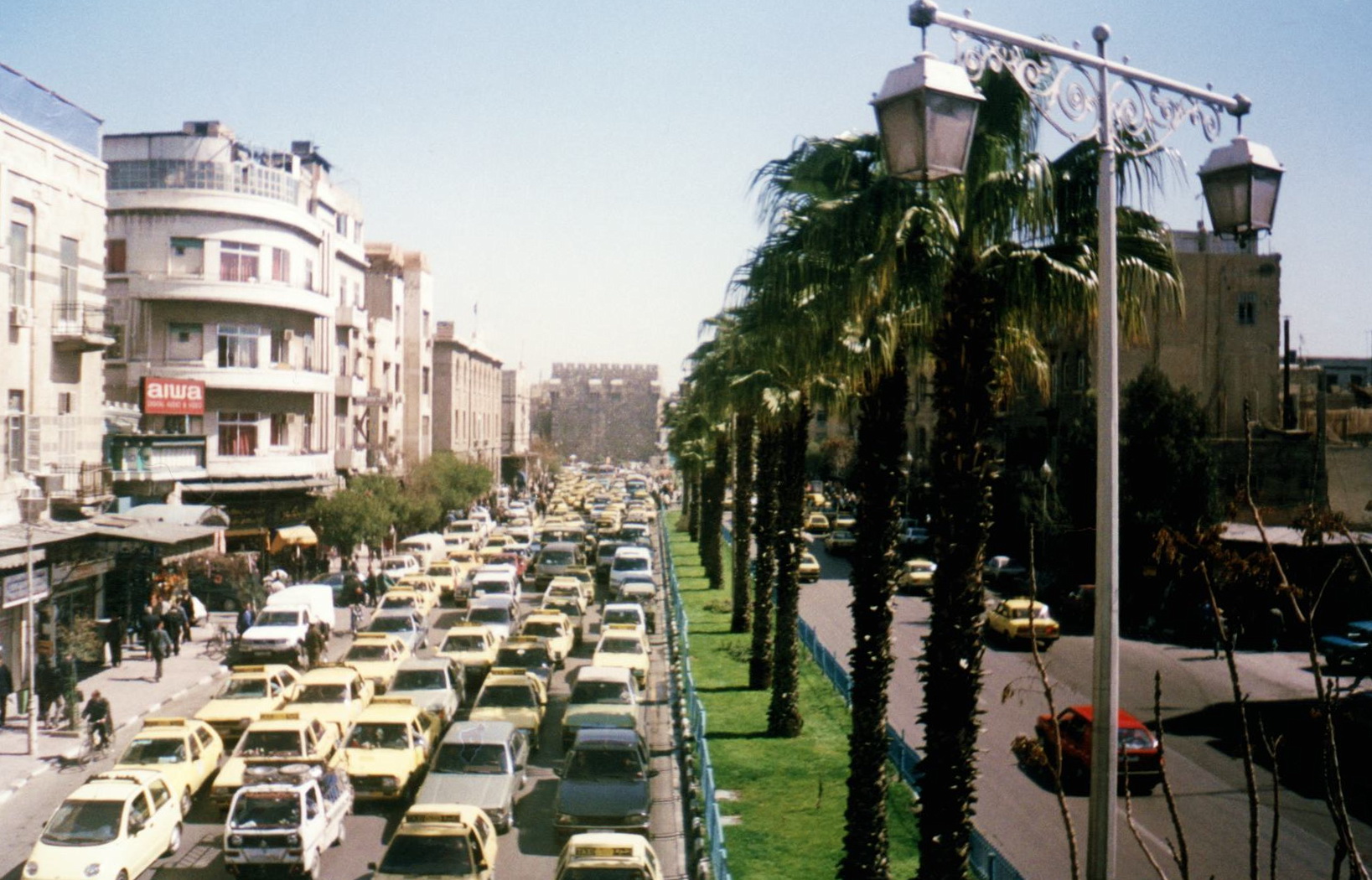
Once we leave the car, we’re free to move about. After all that manoeuvring it’s a true pleasure to walk past a no-entry sign the wrong way down a one-way street and overtake cars sitting dead in traffic. Most of the city traffic is taxis. Perhaps only one car in three doesn’t have a chequerboard stripe. Syria’s stock of cars is rather modest. They’ve all seen better days, though you do come across magnificent, powerful American cars from the fifties.
Damascus is a great Arab city, but alas, it’s far from the best days of its history. It isn’t in ruins, but everything looks grey and grimy. Even the sellers in the bazaar stand there looking gloomy. No Eastern glint in their eyes, none of the old liveliness. Normally buying something is a theatrical performance. The seller acts out a tragedy with a happy ending. In Syria it’s all very quiet. Don’t want it? Don’t buy it.
Put it all together and it reminds me of Russia at the end of the Brezhnev years. The dictatorship isn’t what it was. By and large people have stopped fearing it. The new president, it seems, wants to build a normal, open country. Syria is no longer looking for a fight with Israel. But thirty years of socialist reform have left their mark. You can feel the apathy and indifference in the people. It’s easier for Syrians than it was for us. There are plenty of nearby countries where everyone speaks their own Arabic. No barriers. All it takes is a visit to neighbouring Jordan, for instance, or even Lebanon, to see that life is a good deal better there and that the government’s tales about a special path and national peculiarities are just bluff.
From 1971 to 2000, President Hafez al-Assad ruled the country. Assad is “lion” in Arabic. He’s often called a little Stalin, and perhaps that’s right. He dealt with the opposition by any means at his disposal. In 1980, when oil got cheaper and the USSR was no longer able to help, the country ran into economic trouble. The unrest that followed was harshly put down. In Hama, 25,000 people were killed in the course of restoring order. It’s frightening to imagine what a tragedy that was for a small quiet town. If I remember rightly, Ceaușescu killed twelve thousand in Timișoara. In Novocherkassk it was hundreds. Here it was twenty-five thousand. The authorities are trying to forget it, tearing pages out of books and fearing their own people. It seems they’ve already imagined the words of the sentence that will sooner or later take real form. Now, after the elder Assad’s death, Hafez’s son Bashar al-Assad rules the country. I wonder how they managed that, since Syria is a republic rather than a kingdom, with no provision for handing power down to a son. They pay lip service to the old man’s programme, but changes have begun. Freedom and common sense are gradually getting the upper hand.
The whole country is hung with portraits of the Assad family. Plenty of likenesses have been immortalised in mosaic. A stooped middle-aged man looks down at you from the elder Assad’s posters. His eyes look tired and fatherly, perhaps even shy. They promote the image of a caring, cuddly head of state. Grandfather Lenin, who loves little children, in other words. The younger man looks wholly unremarkable.
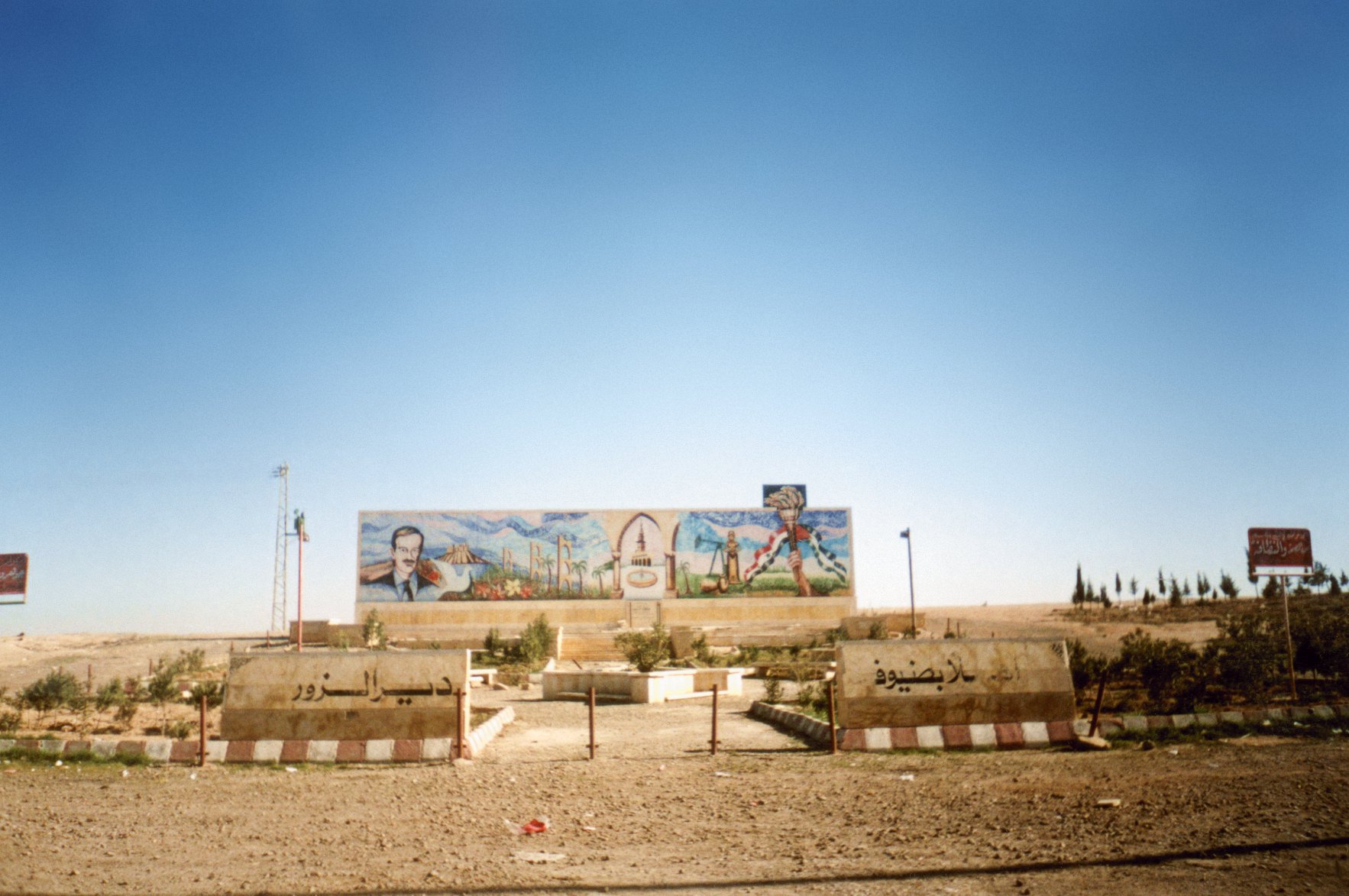
In all, three people are allowed to appear in the portraits. As well as the two Assads I’ve mentioned, there’s a fellow in dark glasses and camouflage, who looks like Raduyev. This is Bassel, another son of Assad the elder. He was the official successor as the eldest son, but when it came to the point he died in a car crash. The ruling Ba’ath Party had to appoint the younger son instead.
We begin our walk around Damascus by looking for somewhere to change money. You can’t draw cash out of a machine here. The machines only serve local banks. Apparently it’s part of the broader difficulty of communicating with the outside world, thanks to the secret police and their secrecy. But numerous shops display the familiar logos of Visa, Mastercard and others in their windows. They do it on paper. They take only real cards, not electronic ones that have to be authorised. The slip you sign is taken to Lebanon and the bank there pays the merchant what he’s due, less two dollars commission. It’s a system that lets you buy a few souvenirs with a card you’ve already run out of money on. Your bank will shake the money out of you, of course, but when will that be? The merchants for their part don’t like the trouble of cards. They’re willing to knock something off the price to get their hands on cash.
Given all this, you should bring our beloved American dollars into Syria. But even those aren’t simple. Only banks change money in Syria, and only by the very highest authority. Local citizens need permission. Foreigners have it easy, of course, but you still have to go to one counter for a slip and queue at the till with it, among the enterprising boys who want to buy ten or twenty thousand dollars. The official exchange rate is forty-four to one. The black-market rate is better, but illegal currency dealings are worth three years in prison, and the difference isn’t much. One other thing about currency. You’re strictly forbidden from taking suri out of the country, and it’s hard to sell them anywhere outside Syria anyway. Nobody’s going to turn out your pockets at the border, of course. You can take a few little coins home as souvenirs, those with Hafez al-Assad on them, for instance.
At last we’ve got enough local money and can walk around the city.
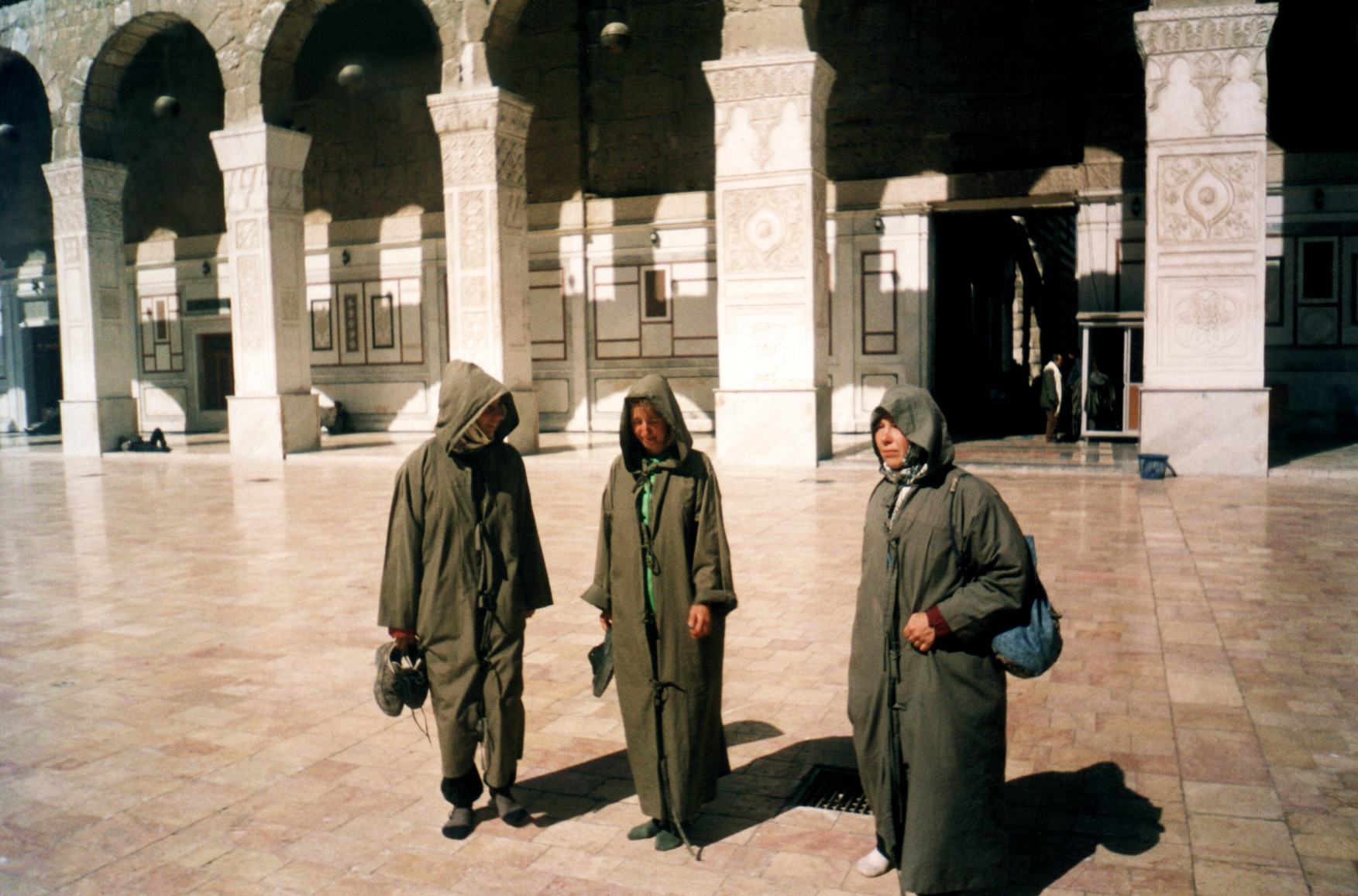
Damascus’s principal sight is the Umayyad Mosque, built in 705 on the site of a Christian church. It’s a holy place to the Muslim world, third in importance. Perhaps it is, though at least two of the other mosques we’ve seen claim that honourable third place. The rules for going in are quite liberal. Muslim worshippers go free. Tourists pay fifty suri. For that, women and badly dressed men are given a special loose robe. I ought to mention that well-dressed men, myself for instance, aren’t issued a robe, but they still take the money. Lena came to the Muslim world with full kit. We’ve already travelled through nearly all of it and so far it’s been no use. Now she’s determined to use her camouflage. Around the corner by the entrance she carefully changes. The very picture of a devout Syrian lady. Alas, only to my eyes. The experienced attendant caught her in a flash. There you are. Clearly we need plenty more practice before attempting to get into Mecca.
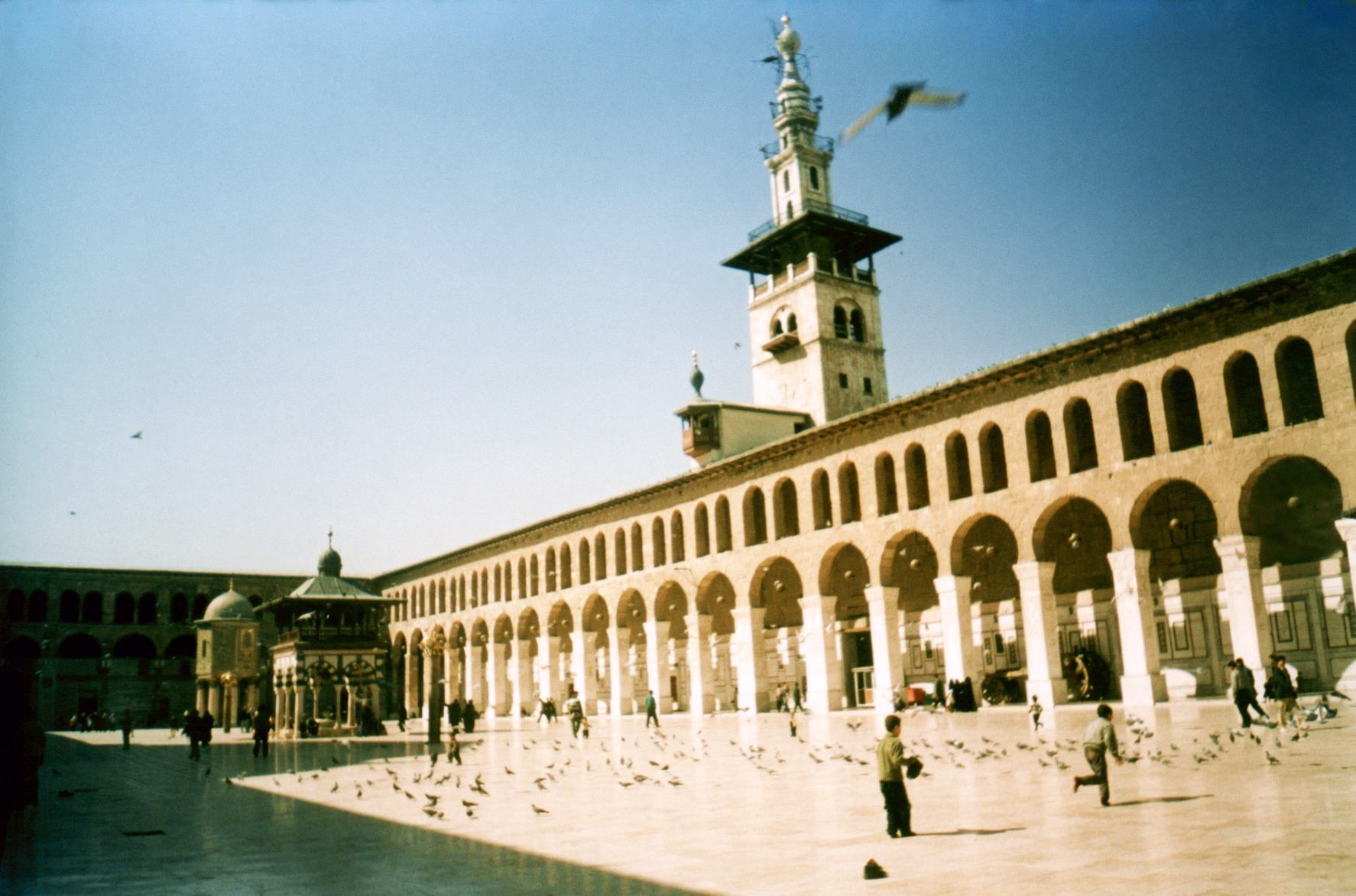
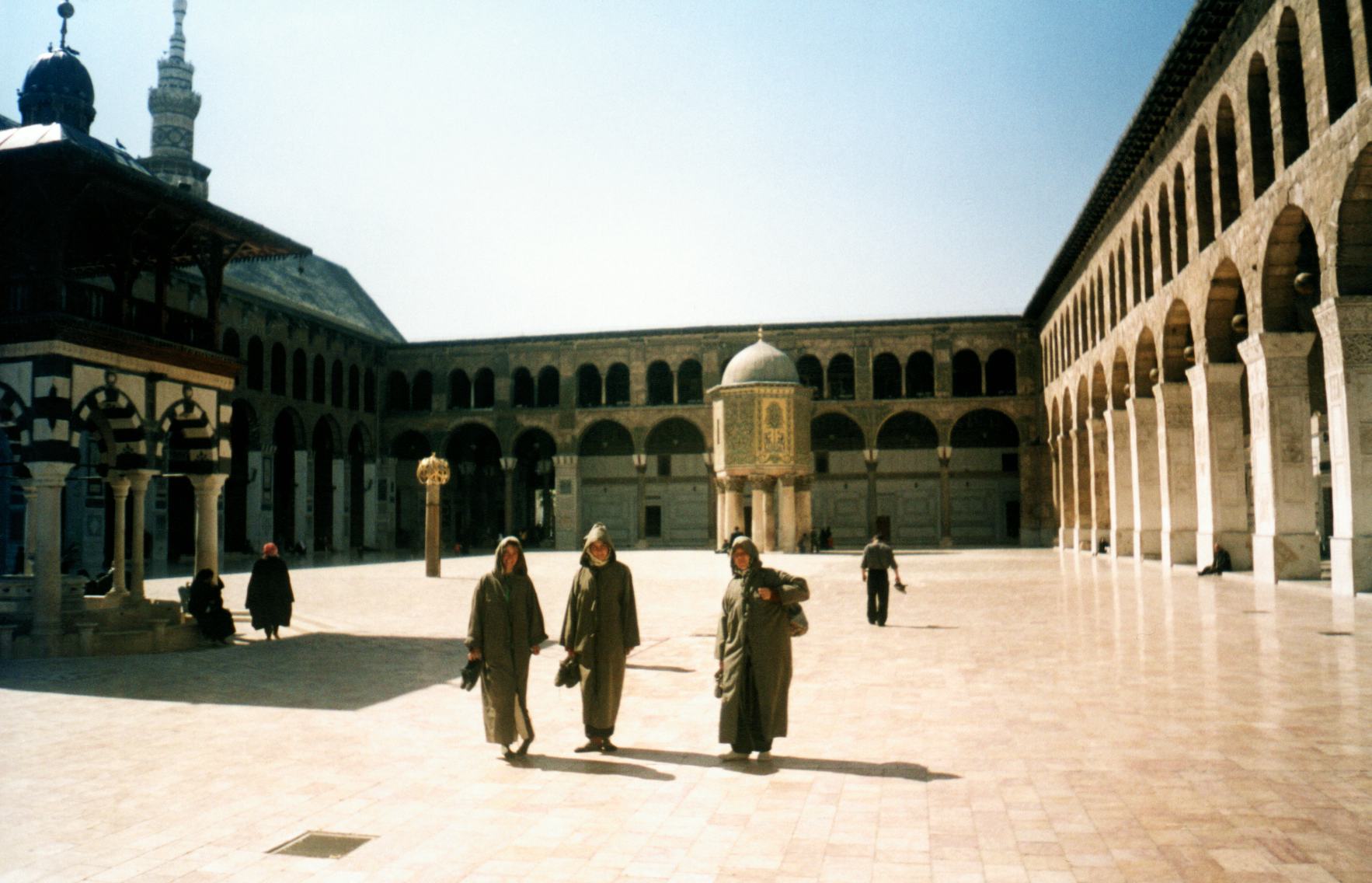
A pity. We have to go for tickets. A well-mannered man issues a ticket that doubles as a guide, and the robe already mentioned. It’s all civilised and there’s no queue, so you hardly mind the money. You feel it’ll be put to good use. And now the girls look entirely exotic. It isn’t really a Muslim veil. It looks more like something worn by European monks. Dressed like this you can walk anywhere you like in the mosque, take photographs and sit on the floor. The local Syrians even talk on their mobiles. Mosques are generally much stricter.
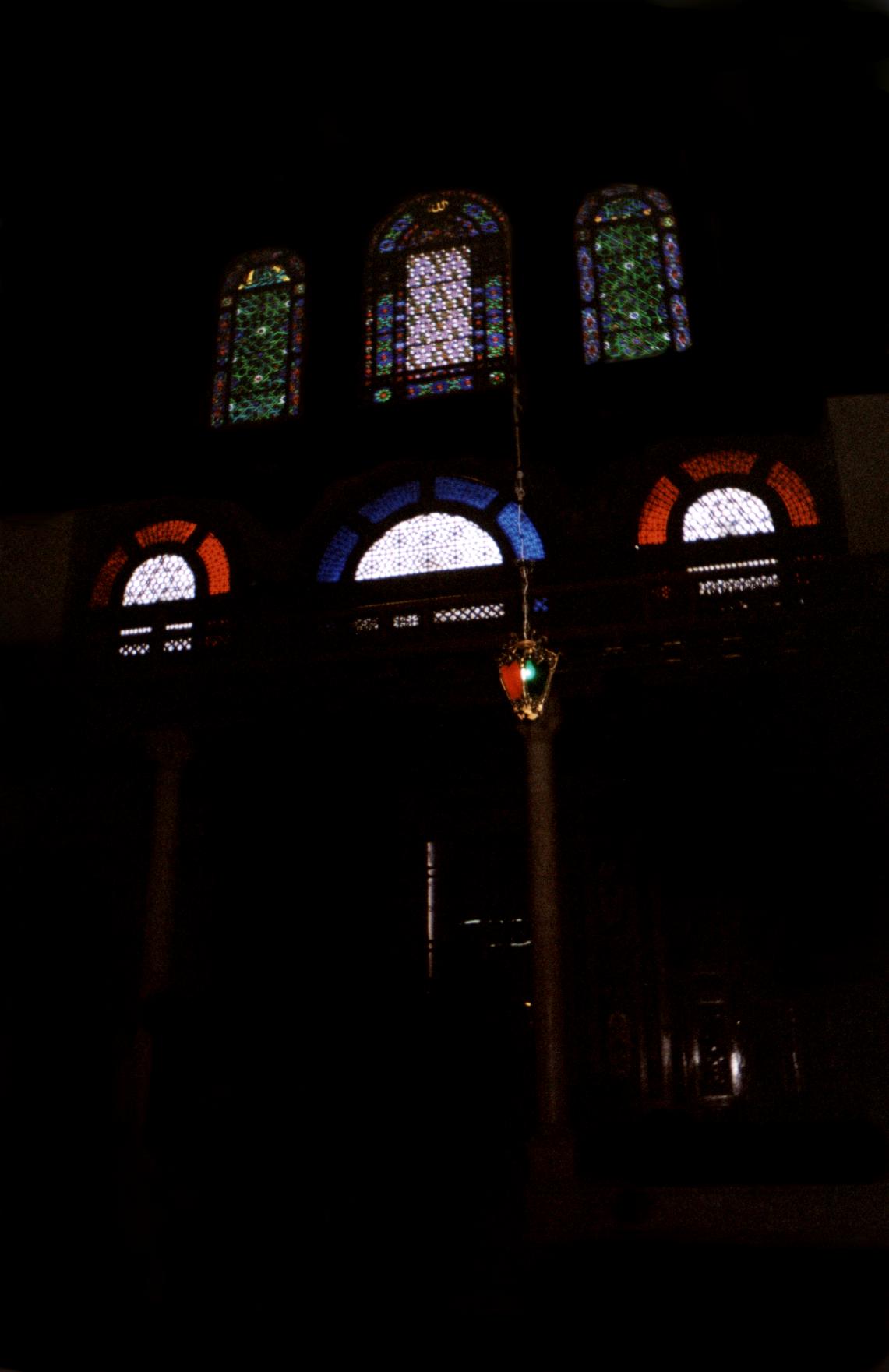
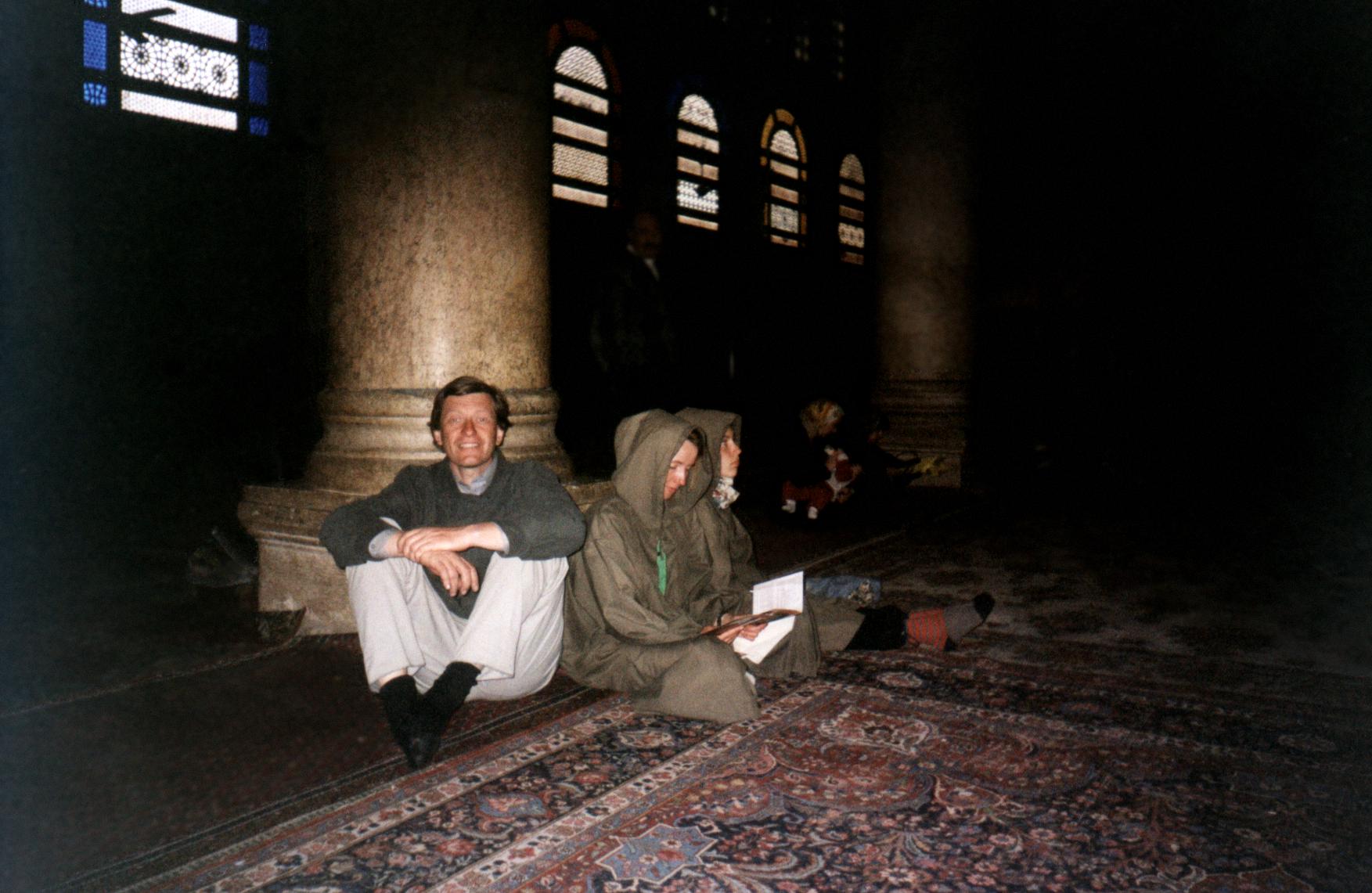
In the middle stands a little transparent shrine containing a holy relic, the head of John the Baptist. In English he has that funny name, “John the Baptist”. Turn that back into Russian as if every word were a name and you get “Saint Jin Baptist”. I didn’t make that up. I saw it with my own eyes. To get back to the head, they keep it here as a holy thing shared between religions, rather than a trophy wrested from the Christians in battle. Christian saints are revered here alongside Muhammad, who is first among equals. In several places I saw a huge poster with the family tree of mankind. Adam at the bottom, with “made from mud” in brackets, and above it a profusion of little branches flowering with Moses, Abraham, Noah and Jesus. The biggest flower is Muhammad’s, of course. Muslims are generally very tolerant of Christians, even respectful. It’s enough to make you ashamed of our own intolerance.
We spent more than an hour in the Umayyad Mosque. Quiet, comfortable, soft carpets. You could live here!
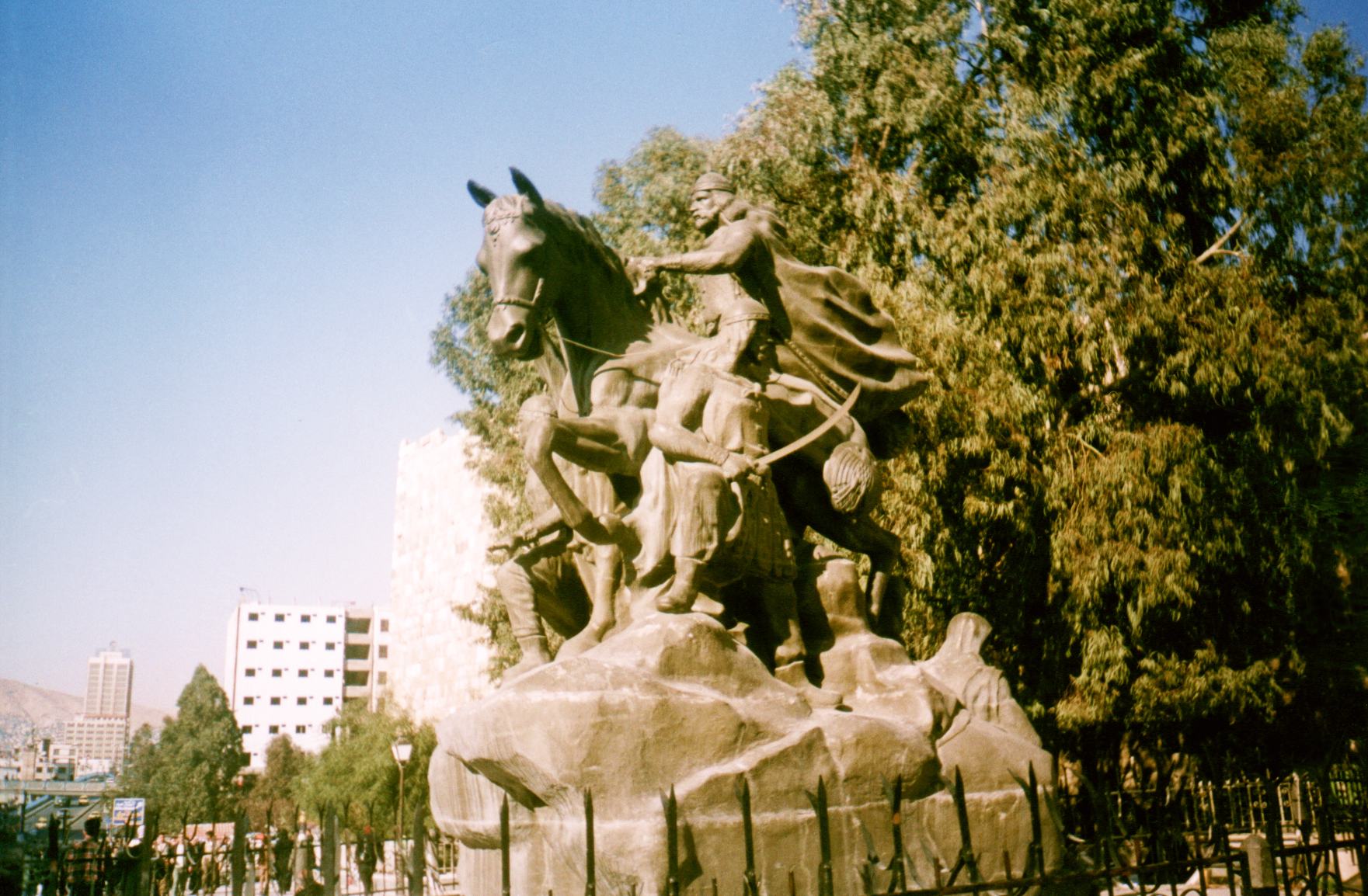
Beside the mosque is the mausoleum of Salah ad-Din. A national hero, the man who freed the country from the Crusaders. In European books he’s often called Saladin. There’s a monument before the entrance to the old city. I look at it and can’t believe my eyes. The very image of a prince of Kyivan Rus’. I even think I’ve seen him before somewhere with “Yaroslav the Wise” written underneath. If only Fomenko could see this. Perhaps it was a gift from the fraternal Soviet people. Perhaps it’s a standard design, or there simply wasn’t another mould and the five-year plan was running out. I didn’t get to the bottom of it. Lonely Planet has nothing to say on the matter.
There are plenty more mosques in Damascus, but I couldn’t manage to write a guidebook to the city and can’t say they made much impression on me.
After having our fill of holy places, we went looking for something to eat and some souvenirs. The famous Damascus market, like other Eastern markets, looks quite different from ours in Russia. You simply can’t separate it from the city. The whole central part is a tangle of narrow roofed lanes with shops opening onto them. You can’t say for sure where one building ends and the next begins. You hardly know whether you’re in the street or in a passageway, whether it’s a shop or the shopkeeper’s home. The whole chaotic place swarms with thousands of people, vendors pushing their stock on carts. Every so often a car noses its way through the crowd. It’s an astonishing sight. So much beautiful merchandise. I particularly like the spices. They look so appetising, you want to buy every one right there and then. An abundance of Eastern sweets. We’re almost on our way home, and it’s time to buy presents. Damascus is just the place. It’s such a pleasure to say, “I bought this in the bazaar in Damascus!” The sweets are reasonably cheap. We took a huge bag for 225 suri. We bought a little knife for our Denis. A small one, so he wouldn’t go stabbing someone by accident, but a genuine Damascus blade. I got them down from 800 to 500 suri, though with great difficulty. As I said, the market in Damascus is rather sleepy. It isn’t especially exotic, but on the other hand nobody will pester you. The children don’t beg for baksheesh. You can walk about in peace and choose whatever you like. The shops themselves vary enormously. Some are still in a primitive state, others redecorated in the European manner with halogen lights. One may be selling paraffin and the next, for example, Western cosmetics. Local cosmetics are more common. You can smell them and try them. They can fill an aerosol can with the fragrance you’ve chosen right in front of you. At first I wondered why cylinders of Freon were on prominent display in this feminine kingdom. Then I saw the filling being done with my own eyes.
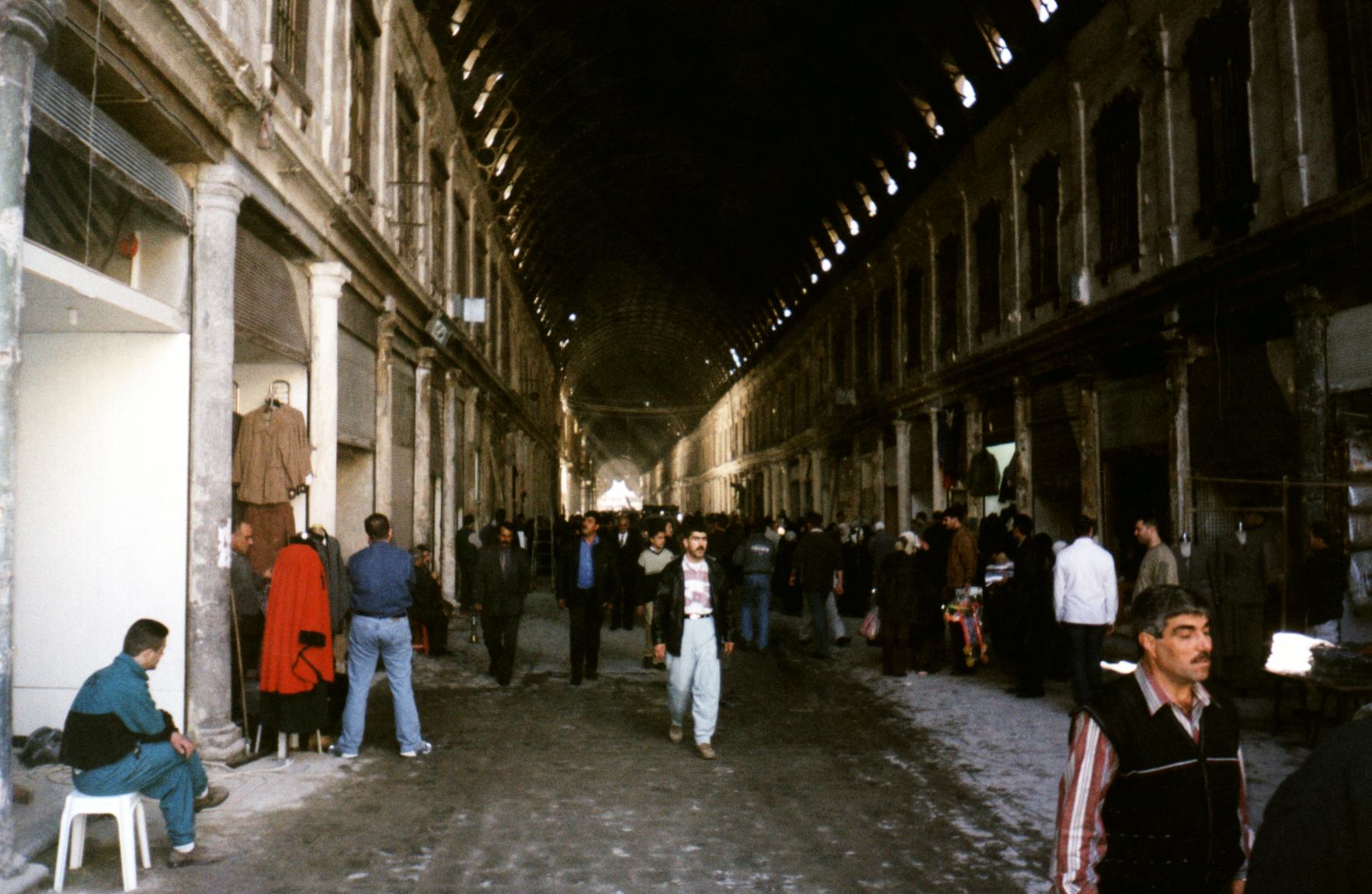
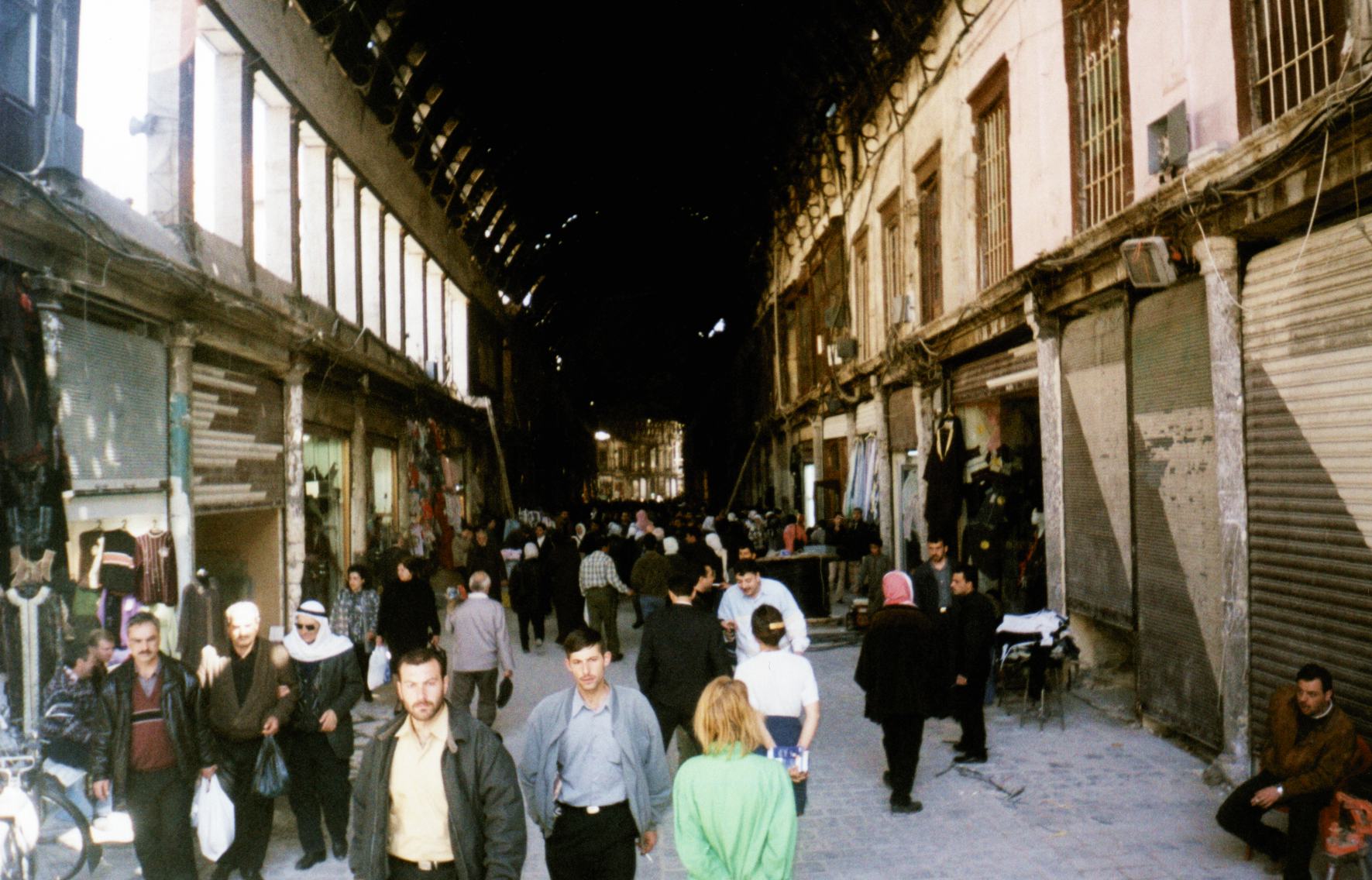
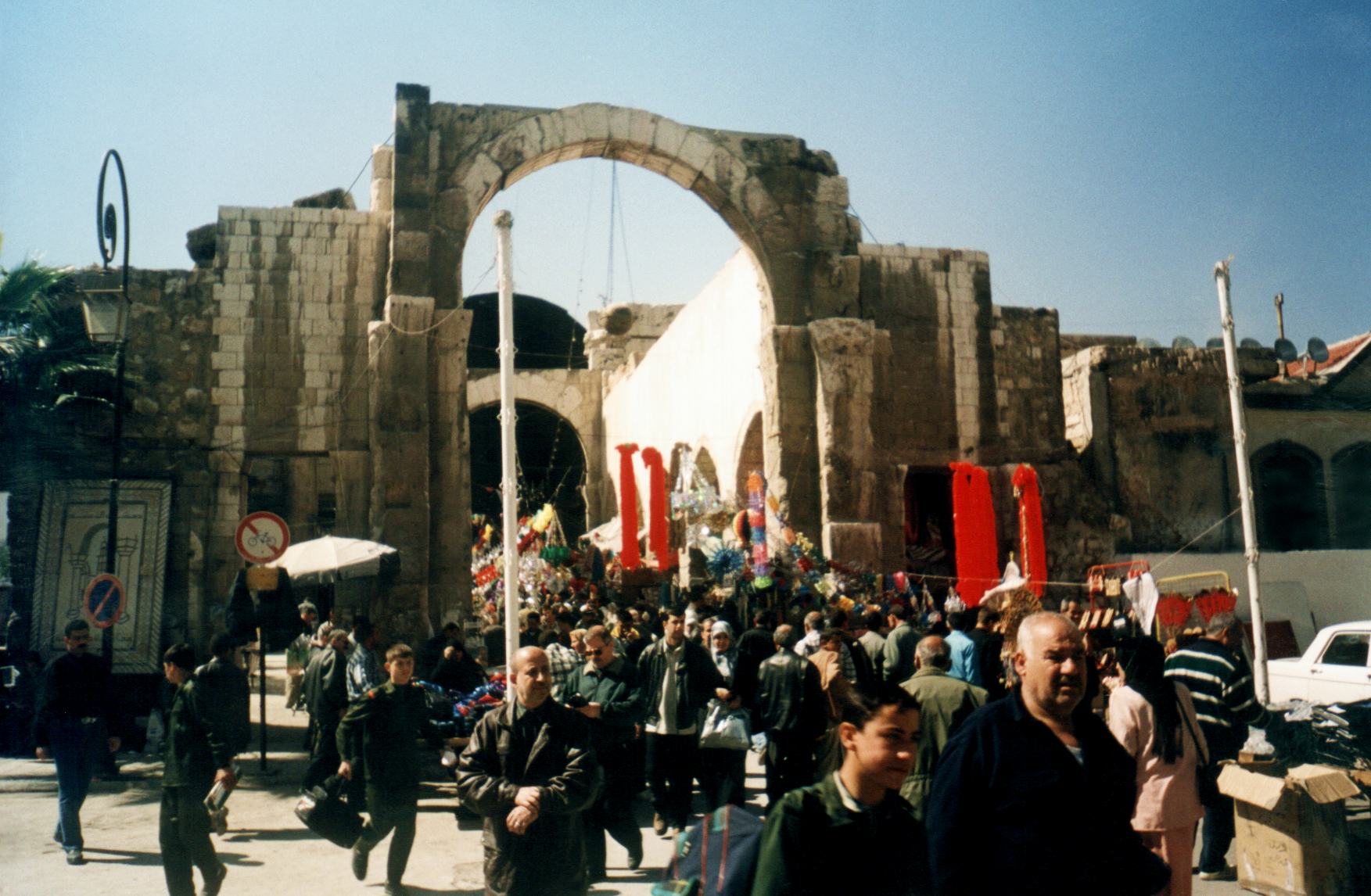
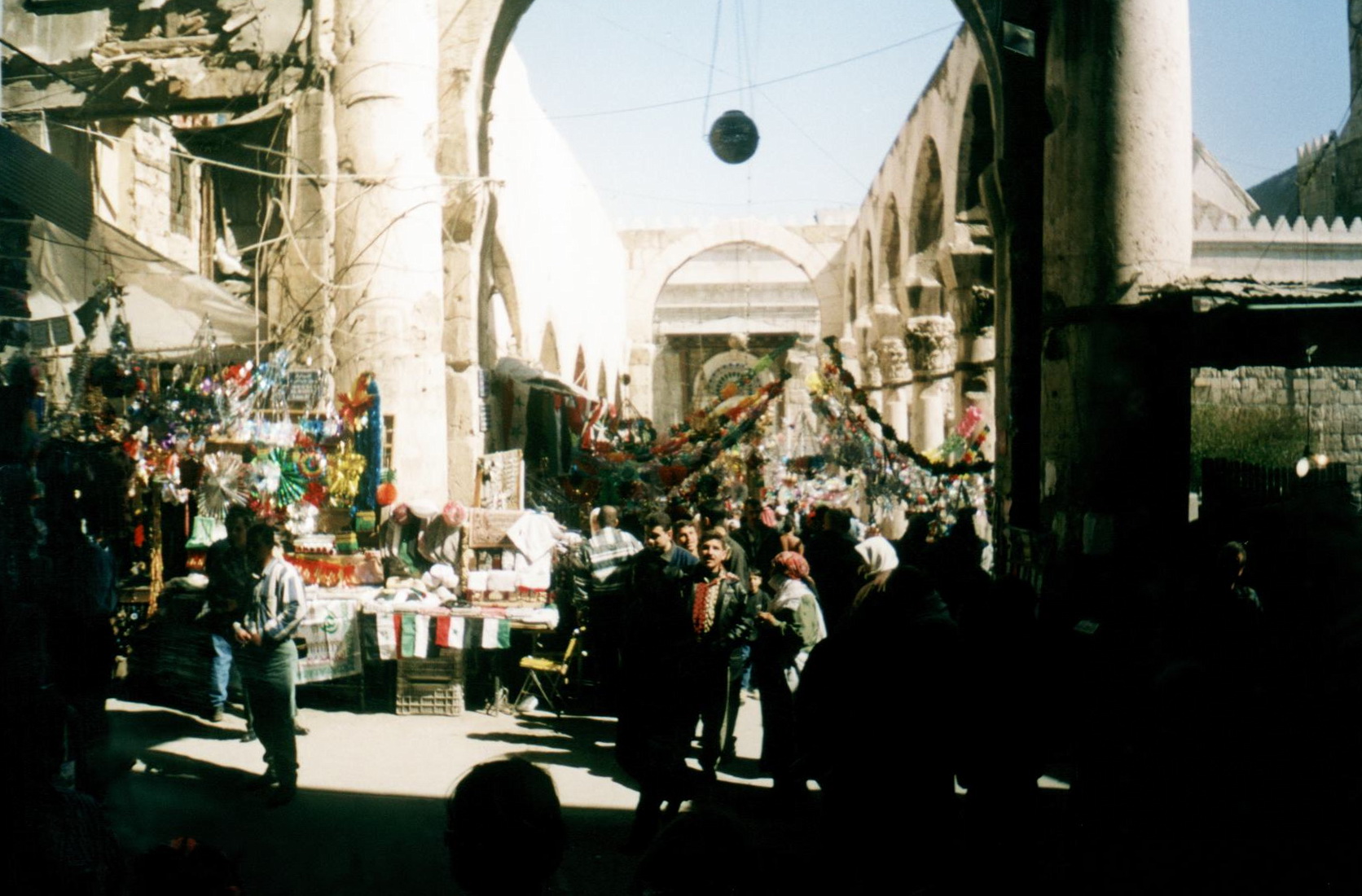
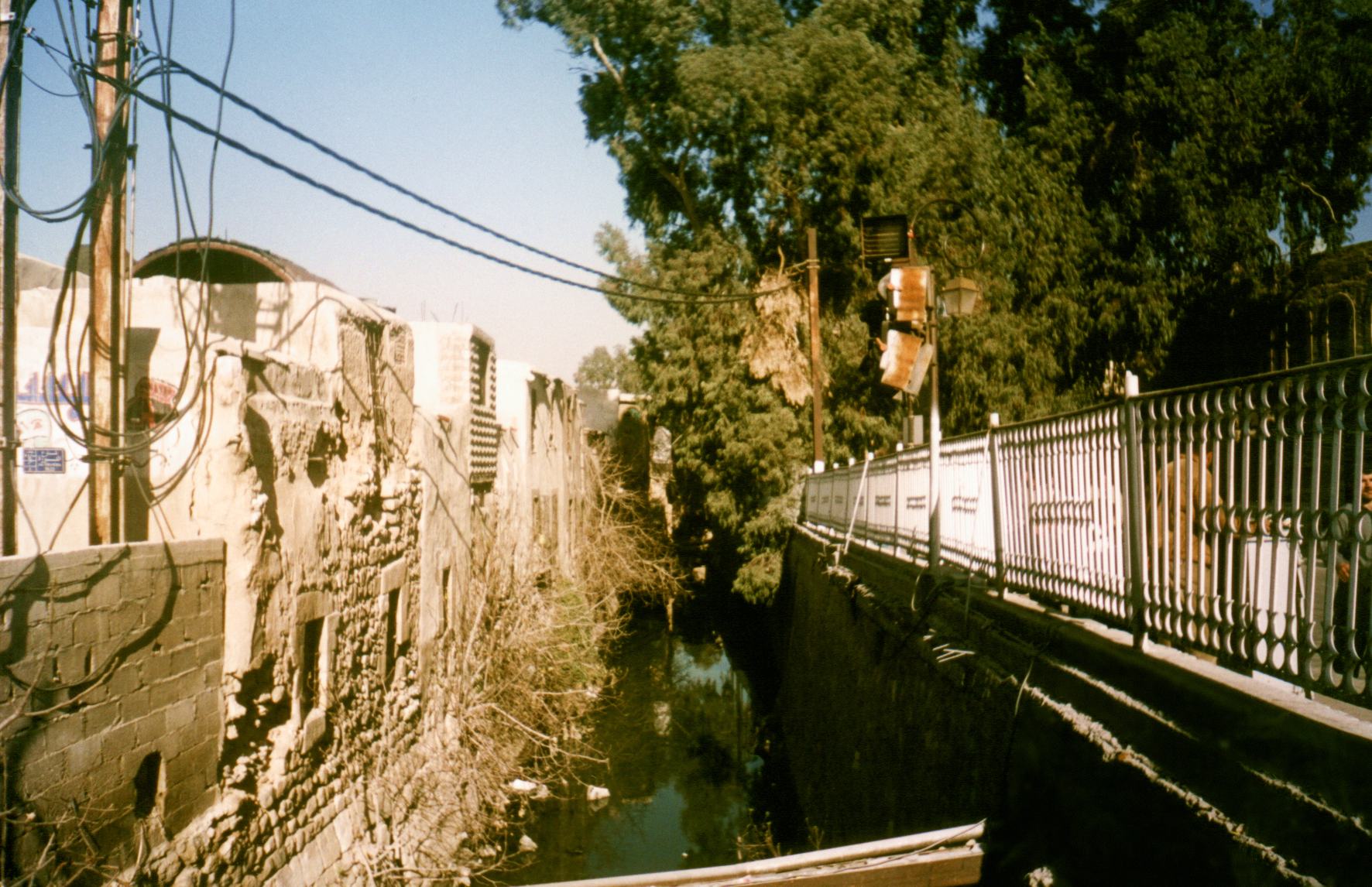
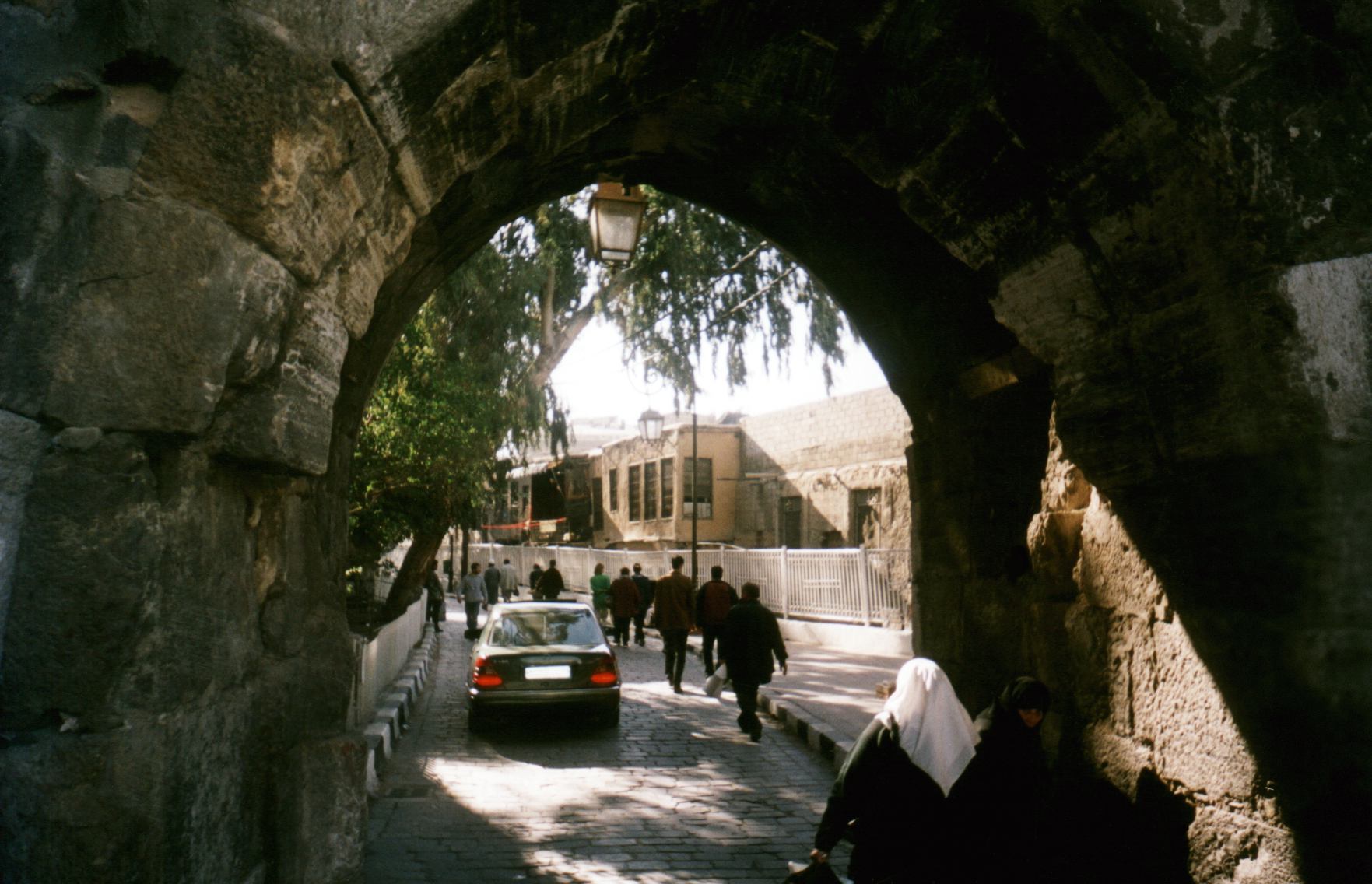
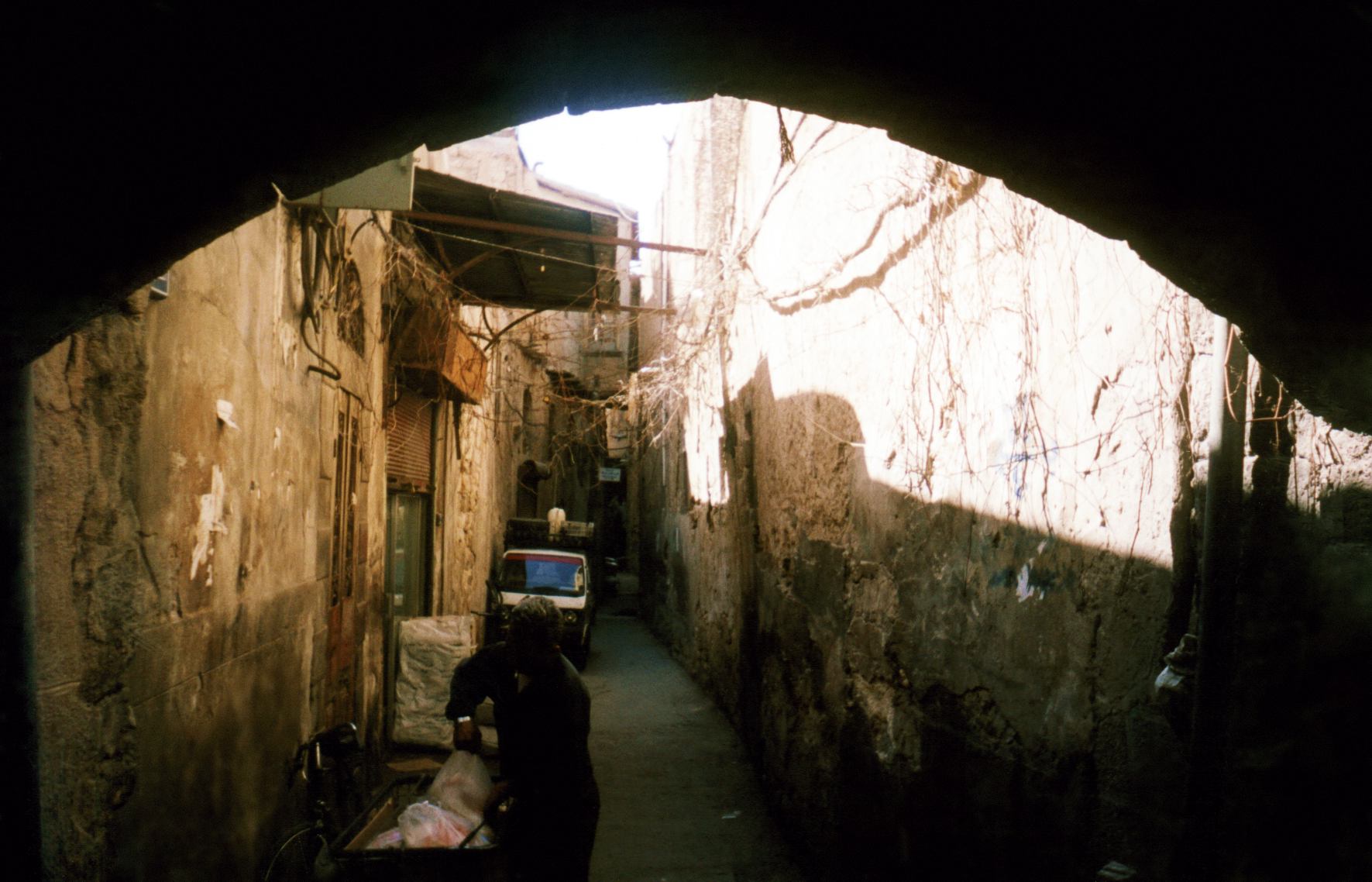
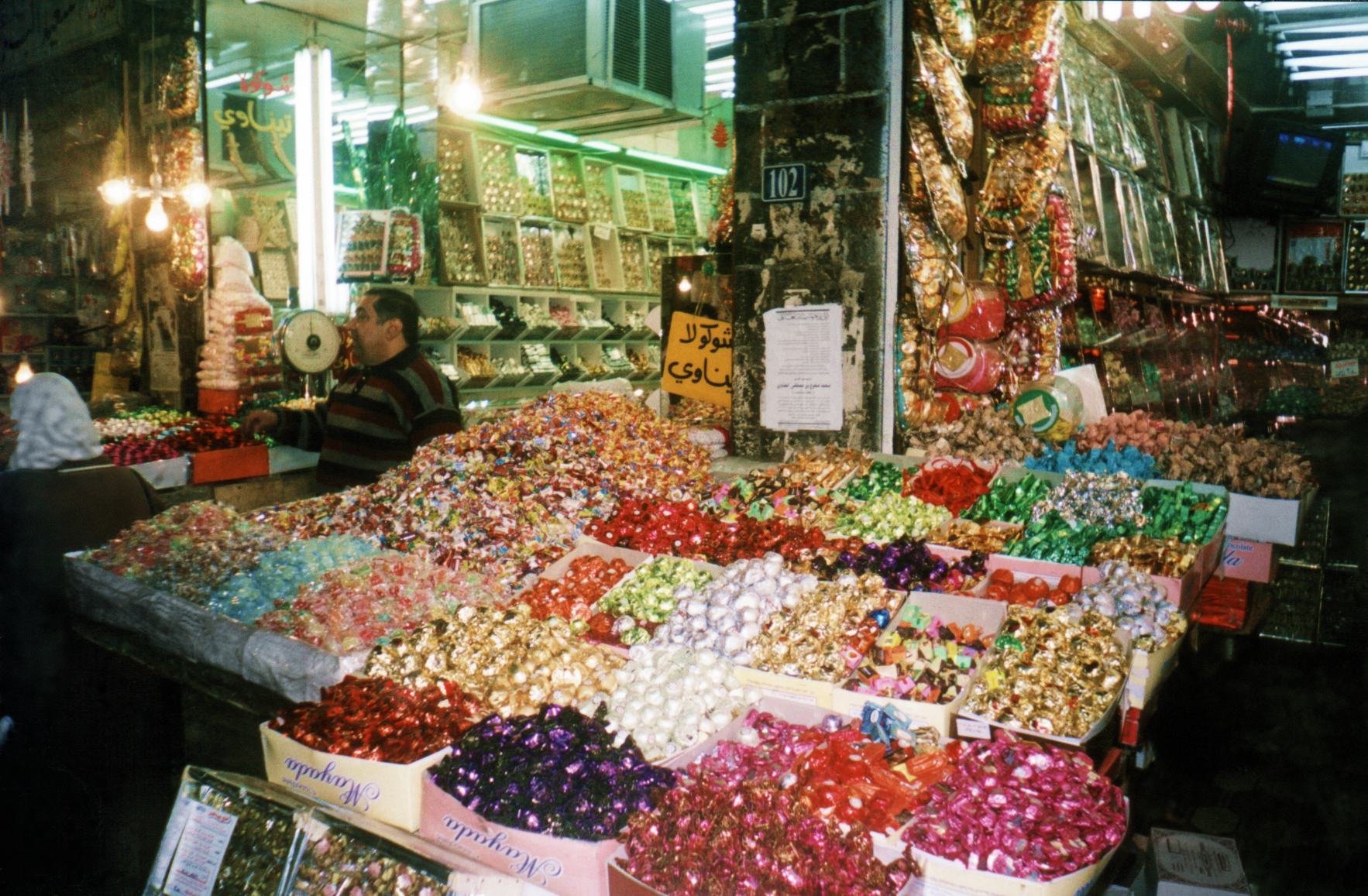
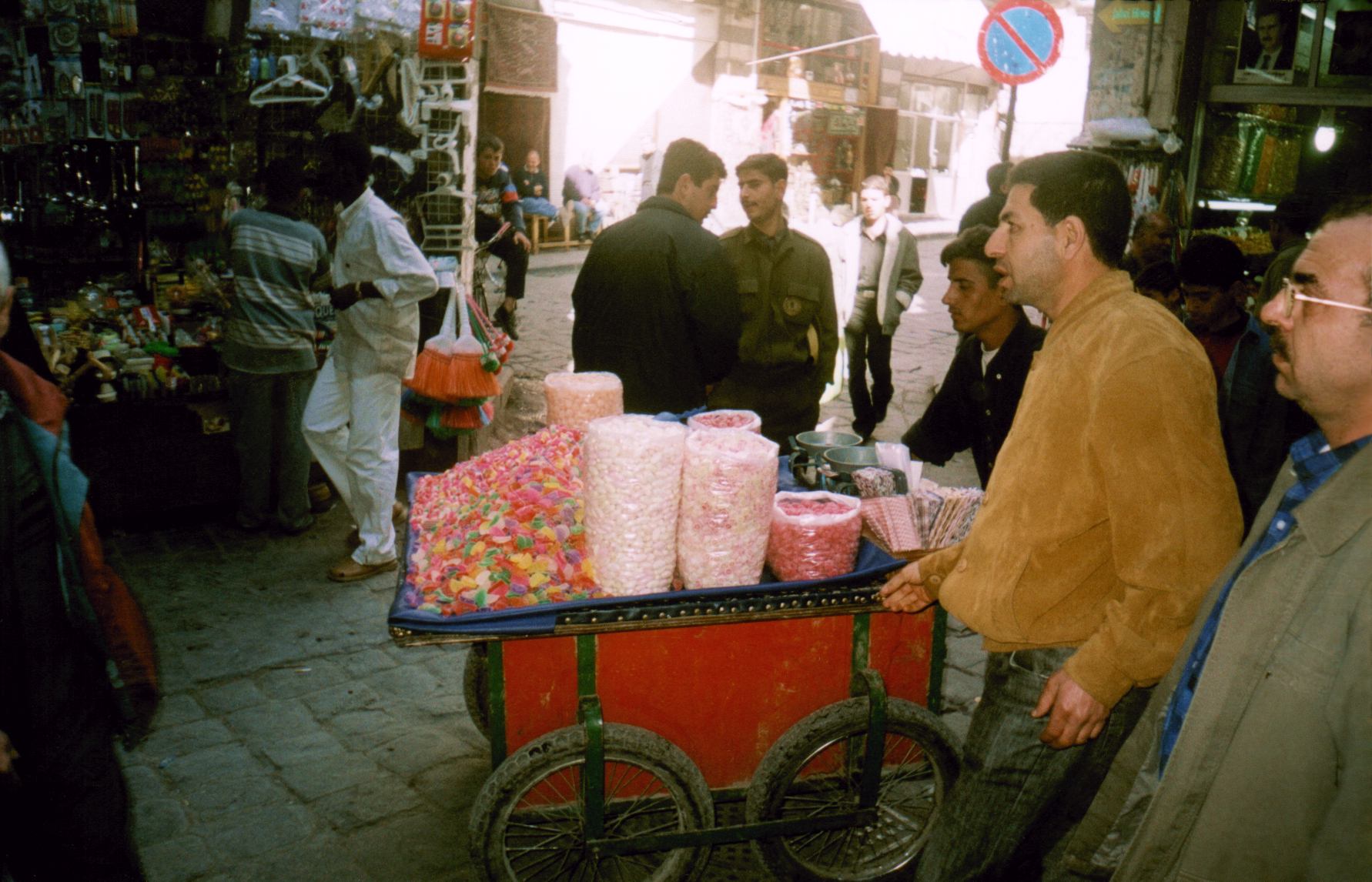
At a market there are usually plenty of places to eat, but here a comfortable spot takes some finding. We were tired from running around and it took us a good while to find a place where we could sit down.
Damascus is famous for shawarma, or rather shaurma as it would be pronounced here, instead of Saint Petersburg’s shaverma. The difference is in the thing itself as well as the name. Syrian shawarma is meat with very little sauce, tightly wrapped in a tube of flatbread. You can bite into it like a bread roll without a flood of mayonnaise running out.
We stop at a little shawarma place with a single table right between the shop and the noisy covered street. We order two shawarmas each and a bottle of Coca-Cola to wash them down. For some reason there isn’t any other liquid provided to go with a dry roll. This is true of little Arab eateries generally. They haven’t any tea. You can order some, of course, but they’ll bring it from the tea shop next door.
Besides tea, you can drink freshly squeezed orange juice in the street. For ten suri they take a dozen blood oranges and make a glass of juice before your eyes. Sometimes they don’t squeeze oranges but mangoes. Tanya still remembers how delicious that was. For fifty suri they sell elaborate fruit concoctions with ice cream, strawberries and bananas.
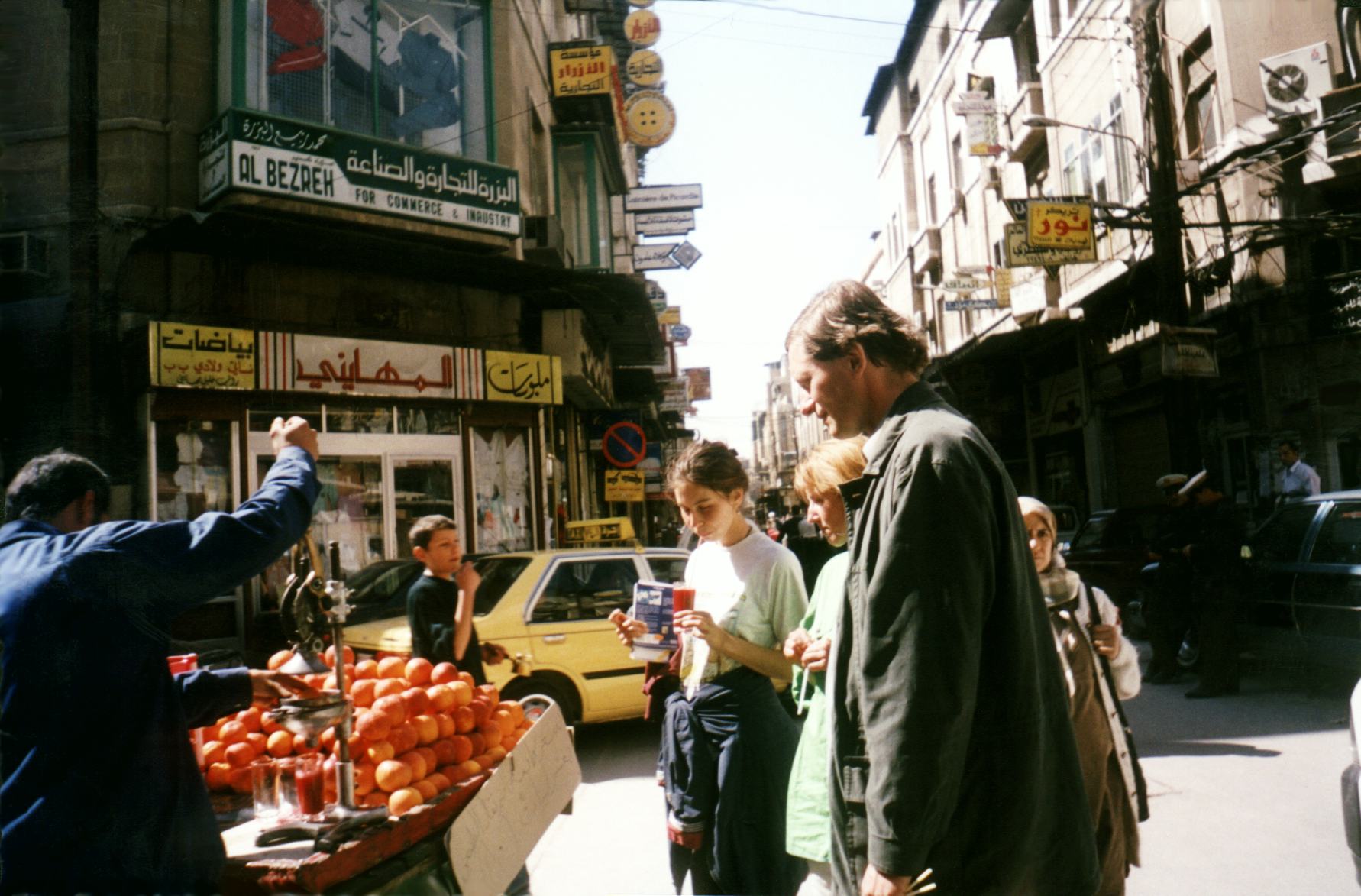
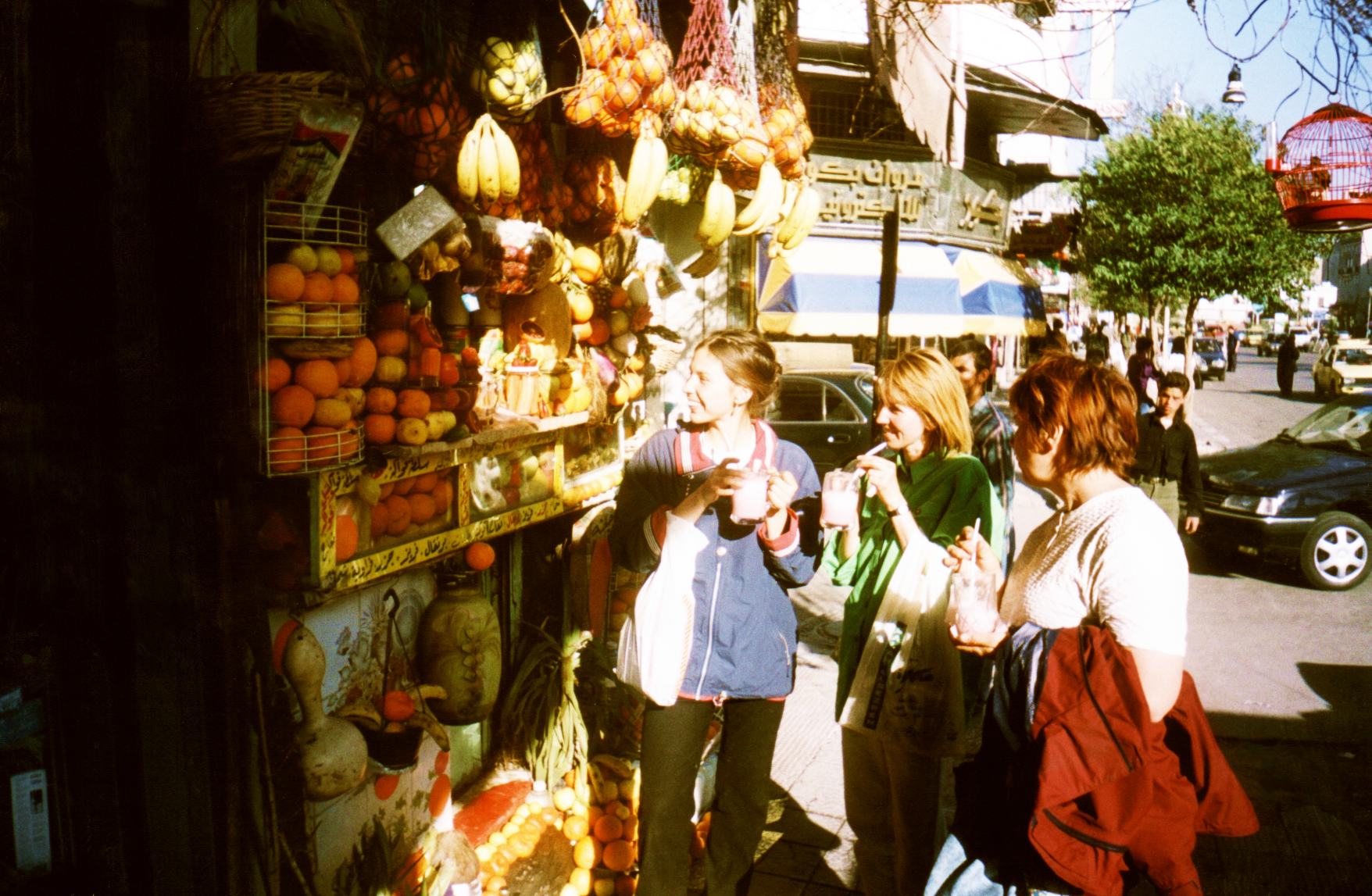
After Damascus we’re planning to go to Lebanon. We’ll finish seeing Syria on the way back. The border is very close, only sixty kilometres along the motorway.
The border guards tell us that if we leave with the car we’ll pay another fifty dollars to come back in. We’re short of money and decide to go to Lebanon without the car. The stamp in my passport saying I imported a car isn’t a problem as long as our ten days of insurance in the country don’t run out. Leaving Syria on foot is quick and easy. The only snag is that the Syrian border post is twenty-five kilometres from the Lebanese one. You could walk it, of course, but it would take all day. There are lots of taxi drivers offering their services at the customs exit. After a long bargain we agree on five dollars.
Chapter 9. Syria, part two.
Since we entered Syria on a scheduled bus, nobody was going to hold it up for us. To speed things along they sent us to the diplomats’ window, where they stamped everything without looking, without even pretending to check for an enemy visa. We went through customs on foot, clinking with all our bottles of Lebanese wine. This made us very uneasy. We hadn’t brought our guidebook to Syria, so there was nowhere to read the rules for bringing in alcohol. To put everyone at ease I announced that smuggling in Syria carried twenty years in prison. People believed me. They were absolutely delighted that nobody took the least interest in us. The car was in the car park, unharmed but very dirty. It was already eleven at night and we had to find a campsite. Probably not a good idea right on the border. The first turn was for a town with the soulful name of Zabadani. We drove around it but found nowhere. Mountains, soldiers or villages wherever we went. We were quite downhearted until we saw a quiet dirt track going directly uphill from the motorway. Nothing special, but a perfectly good little spot among the planted trees (34°51.692′N, 36°13.866′E). We pitch the tents. Only now do I notice the rather disagreeable neighbours. A few antennas and little lights. In a word, I smell soldiers. The moon is in its last quarter and we’re invisible until morning. We’ll see then. If things get difficult I can always blame a broken fuel pump. Here in the foothills of the Anti-Lebanon range, it’s about freezing at night. All those warm clothes come in useful after all.
In the morning my suspicions about the military are confirmed. The barbed wire is only twenty metres away. Sentries are pottering about close by. They take no interest in us. All right then. We’ll cook some food on a little fire. Pasta and tinned stew is the business! If the others don’t agree, so much the worse for them and so much more for me.
Today we want to see the Crusader castle of Krak des Chevaliers. It means “fortress of the knights”, though if the French cheval puts you in mind of horses instead, the romance goes out of it. The castle is worth seeing all the same. It isn’t far, but it turns out not so simple to get there. It starts on the Damascus ring road, if you can call it that. A vast motorway ends unexpectedly. We’re not ready for that trick and go straight on without thinking. Soon we’re on a little street with speed bumps, horses and other livestock. Not a sign anywhere. The people are friendly and keen to help, but their directions are confusing. Straight on, left at the fourth or fifth junction, then left a block or two farther, then the third or maybe the fourth road off the roundabout… You can stop listening there. There’s no remembering it. We ask them to show us on the map, but no luck. We’re out of the central area set aside for tourists. We know only that we’re in suburban Damascus and it goes on for ever. Wandering at random is our only chance of getting back to the motorway. We drove around those dusty, broken streets for an hour or so before we finally met a sensible man who pointed us the right way. It’s a pity to lose the time, of course, but nothing in the world is entirely one thing. We won’t get the time back, but at least we saw how an ordinary Syrian working man lives. We saw it and didn’t rejoice for him. There are many countries in the world, but perhaps Syria’s the only one where I can confidently say they live no better than in Russia. The same abandoned houses, the same roofs caved in and the same peeling paint.
The motorway to Homs is in very good condition. Desert and monuments to Hafez al-Assad all around. By the road there are palatial filling stations and restaurants. We could do with a meal now. We turn off towards one of the enormous buildings. It’s fairly new, with architecture vaguely like McDonald’s. Inside it’s a Soviet-era canteen, self-service. You carry your own plate from the counter and take your own dishes away afterwards. What’s striking is the utter absence of advertisements or other decoration. They give you a lot of food but there isn’t much choice. We’re not choosy. The important thing is the price, which pleases the eye, or rather the purse. A good filling lunch for four was 665 suri.
Homs is a new, modern town. According to the book there’s nothing to do there. We don’t even go in, turning towards the sea instead. We miss our turn again, or rather take the turn for the castle earlier than we should, and find ourselves driving around sparsely populated countryside looking for the road and seeing how people live. The first thing that strikes us is the children in military uniforms. They aren’t soldiers, of course. Those are their school clothes. But it’s sad to see. The child is still at school and already being given to understand that he’s a soldier, meant to kill and be killed.
The one good thing is that the children, who haven’t seen other countries, don’t know you can live differently and don’t take any of this state policy seriously. Girls with uncovered faces come out of school laughing and eating buns. Choose between an army uniform and a veil and the answer isn’t obvious. They seem to educate them well, and sooner or later a new generation with a decent education will make its country rich and happy. Speaking of schoolgirls, they’re unusually bold here. They run up to foreigners, laugh, make faces and shout “Hello!” Whether they’re making eyes, teasing or taking the mickey, there’s no telling.
The country people have no idea there’s a castle nearby. They give a puzzled shrug when we ask. By now we’re thoroughly lost. Narrow roads over the local hills lead to a military base or an out-of-the-way village. It seems there are more soldiers than civilians, a Soviet radar installation from the sixties on every hill and a tank park in every hollow. The soldiers are friendly but can’t help us. According to the books almost all officers ought to speak Russian. Either we’re unlucky or that isn’t true. However often we ask the way, we don’t find a single Russian speaker.
We have two maps, one out of Lonely Planet and the other issued by the Soviet General Staff. We have GPS as well. What more could you want, you’d think? Here’s the catch: the actual country has nothing in common with the maps. Plenty of signs for places that aren’t on either map. The other way round, you have a fair-sized town on paper and nothing but a bare hill in life. You don’t see such a mess even in Russia.
One last hope. There’s a narrow road going towards the sea. It isn’t where we want to go, but at least it’s one definite direction. We aren’t going in circles.
As we get nearer the sea, the hills give way to a plain. The collective farmers’ hovels are displaced by the villas of the new Syrians, huge stone houses with Mercedes parked outside. The tarmac grows smooth. At last we pass a filling station, just as well since the fuel light has been on for ages. Beside it is a shop where the women buy an enormous bag of food and a bucket of fermented milk. Apparently they’ve lost all hope and expect to live here for a week.
It’s three in the afternoon and the castle we’re after hasn’t been found. Sometimes we can see it somewhere on the horizon. We’d all but given up, but all things must end, and we found ourselves back on the motorway we’d left hours before. In ten minutes we came to a road sign for the castle, and soon we were in the car park at the entrance, having gone up a narrow mountain road (34°45.479′N, 36°17.719′E).
Admission is three hundred suri per person. A pile of money. At first Tanya and I thought we’d be content with looking at it from the outside and finding a hole in the fence. There actually is a hole, but to reach it you have to clamber up the wall and get dusty in the process. If you sent one person up with a rope, though, you could all get up with no difficulty.
After walking around and looking at the walls, we gave in. We’re terribly short of money, of course, but we can’t simply leave without seeing a wonder like this. Our last bits of money go on tickets and there we are, walking down a magnificent stone gallery. A sign for a toilet. Having paid for admission, we ought to get our money’s worth. On the way out a man rushes up, asking for money and offering tissues to dry our hands. “Monsieur, monsieur, fifty pounds, monsieur. Ah, monsieur, monsieur…” In the end we run away without paying, saying we already paid at the ticket window, where the man put it in his pocket, incidentally, without issuing tickets.
Krak des Chevaliers has survived almost undamaged, and what’s more, it’s been restored again and again. Restoration usually means trying to make new work look old, but here they do the opposite. The builders proudly press “1935” or even “2002” into the concrete. Perhaps that’s bad for historians, but the castle looks almost as it did when it was new. Give it another few decades and everything will be as it was eight hundred years ago. Even Lawrence wrote that it was the finest castle in the world, and now it’s simply a marvel. Stairways, rooms and towers everywhere. You can climb all over it. You could spend a whole day there. It looks like a great child’s toy, a Lego castle enlarged to full size. The scene around it is idyllic, with sheep and cows grazing the fresh spring grass. There’s nothing warlike about the feeling here. It’s a childhood dream made real, rather than a place of senseless bloody battles.
It’s also pleasant that there are no tour groups at all. Only the occasional couple who’ve found their own way here, French for the most part. We met the people who’d been next to us at the hotel in Beirut. Our spirits rose. We hadn’t spent half a day looking for it for nothing. A pity we haven’t more time. There are another dozen castles in Syria. Next time, we really must see them. To sum up, I’d call it Syria’s most remarkable sight. Nowhere else in the world has a castle survived like this.
There’s a café in the castle so you can eat without going outside. There’s a hotel in the valley nearby, and the phone picks up a Lebanese network. You could live here.
On the less pleasant side, there’s a wild mob of local extortionists at the entrance, shamelessly demanding baksheesh, including payment to ensure your car is safe. We didn’t pay and nothing happened. No punctures, no stolen windscreen wipers.
We know the way now and can get out without any trouble. Before the road joins the motorway there’s a perfectly ordinary sign for London and Johannesburg, giving some enormous number of thousands of kilometres and adding, “For advanced drivers”. Evidently the local traffic police are a merry lot. They ought to put up a dozen or two signs in Damascus instead.
Our next stop is Hama, a small town sixty kilometres north of Homs. It’s famous for the wooden waterwheels. Enormous, ten metres or so across, they stand in a little river that’s almost dry, right in a city park. It’s genuinely a lovely park. Birds sing, ducks swim and children run around. Girls in black robes sit on a bench eating shawarma. We listen more closely and find they’re speaking Russian. Walking around town, I can’t shake the thought that a dreadful massacre took place right here twenty years ago. One in every ten inhabitants was killed while the unrest was being put down. Proportionately that’s more than Russia lost in the Second World War.
Time wears everything away. Now it’s a peaceful, pleasant city. We eat shawarma, buy a bottle of wine for thirty-five suri and have tea by the fountain in the park. It’s lovely sitting out on a warm evening, especially when you know another few days and you’ll be surrounded by snowdrifts at home again.
We left the town after dark, in the direction of Palmyra. The road into the interior is very narrow, with heavy fuel tanker traffic. It’s hard going. Until the last second you can’t be sure you’ll squeeze past the next growling monster. I wonder where they’re taking all that fuel, and why at night. A subversive thought creeps in. Perhaps they’re running it into Iraq in breach of UN sanctions. Syria didn’t support the States in the Gulf War in 1991, by the way.
After an hour of that I’d had enough and we turned off the road. By now the fertile land had come to an end and there was stony desert all around us. You can turn off almost anywhere and pitch a tent for the night. This time we found a handy hill that hid us securely from the cars going past.
We quickly make camp (34°34.448′N, 37°21.314′E, elevation 665 m). Dinner is a piece of flatbread and the bottle of local wine we bought in Hama. It turns out to be nasty plonk, but there’s no alternative. We have to drink it.
When we woke next morning, what did we find next to us, as usual, but tanks and soldiers? Only a few days in Syria and we’re used to it already. It seems they have them in every out-of-the-way corner. As on other nights they don’t care about us, and we carry on packing. That’s when we discover something very sad. Some unknown beast has eaten our stock of food, which we foolishly left outside. We hadn’t expected that in such a wild desert. Usually you can safely leave all your bags next to the car, but today the unthinkable has happened. The good news is that it wasn’t up to eating tinned stew, or instant mashed potatoes. Coffee, salt, sugar… No, we’ve still got something to keep us going.
After that curtailed breakfast we need to pack up quickly, get to the nearest bit of civilisation and have a proper meal at last. There are nearly a hundred kilometres to go to Palmyra, but we get through them very quickly. We were right to make camp earlier yesterday. It’s much easier to drive in the morning.
Palmyra is an enormous ancient city in the desert beside a little oasis. It’s unusually famous in Europe and Russia. Saint Petersburg is even called the Palmyra of the North. When I was very little, they decided to take me to the seaside. The train we took was called the Northern Palmyra. I’ve wanted to see the real one, the non-northern one, ever since. I could never make out what a cold city in a swamp had in common with ruins in a desert. Now I could compare them. I think it’s dawned on me. Both were built on a ruler’s whim in places about as unsuitable for life as you can get. Perhaps whoever first thought of “Northern Palmyra” expected it to sink into the mire as quickly as earthquakes, sand and thirst finished off the southern one. It must have been a subversive joke. But the court flatterers took it up and it went on and on, all the way to the Saint Petersburg–Adler train.
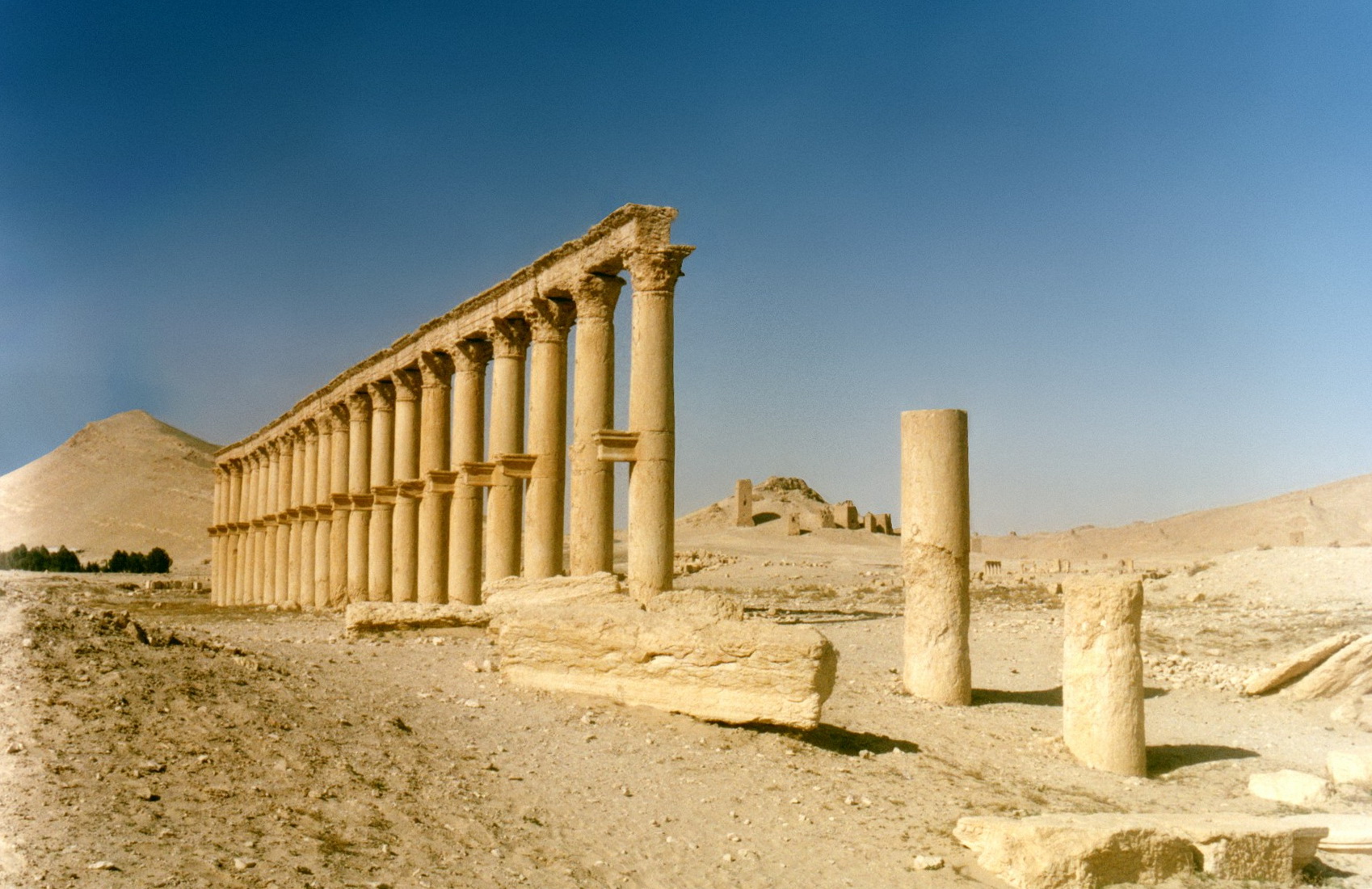
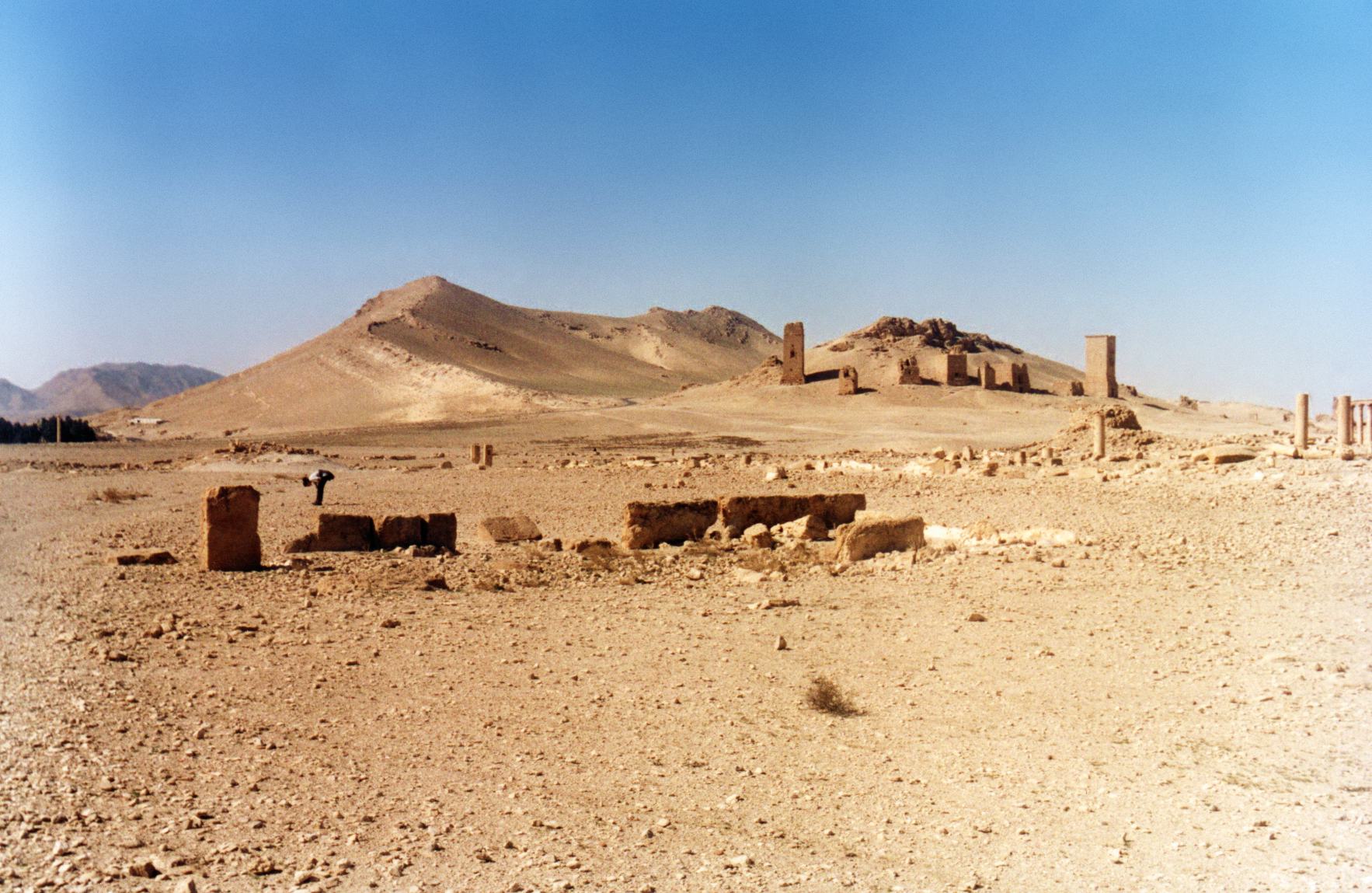
Palmyra is much loved in Syria too. Even on their money it takes turns with the beloved leader and guide, and that’s for good reason. Money is very easily made there. They divided Palmyra into a number of tourist sites and set a fee of three hundred suri at each of them. That came to quite a respectable sum. Even rich Westerners started watching their money and giving this bit of desert a miss. It soon became clear they’d overdone it with the price and had to back down. They kept an entry fee only at the Temple of Bel. We’re short of money, and 1,200 suri is very hard for us to find. We decide to buy two tickets and send in representatives. The ticket seller can’t understand why four people are asking for two tickets. Our certainty that two is exactly what we want makes him think we’re trying to put one over on him. Since he can’t make out what the trick is, he absolutely refuses to sell two tickets. Very well, then. We’ll look over the wall.
The high wall around the temple serves as a fence, but it has holes in it. We climbed up and had a look inside from the wall. We were right not to go in. It’s no better than it looks from outside. The Temple of Bel is merely one of the many ruins, and the others are free now. The city spreads over about a square kilometre. You can spend hours walking down streets abandoned centuries ago. The buildings aren’t in good shape. Rows of columns, with an arch surviving here and there, and temples that survive as bits of wall at best. The theatre has survived well, though it would be more accurate to say it’s been well restored.
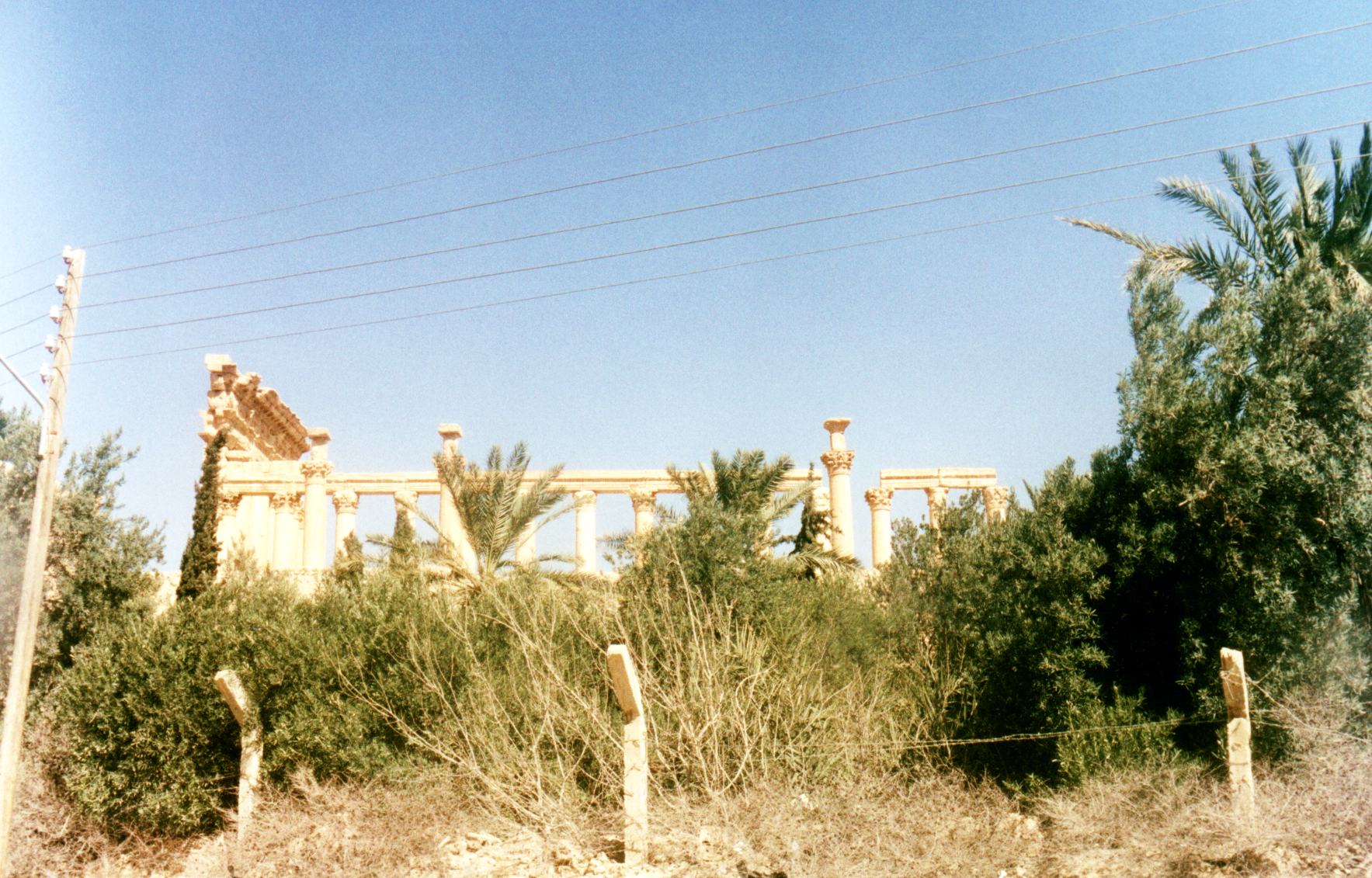
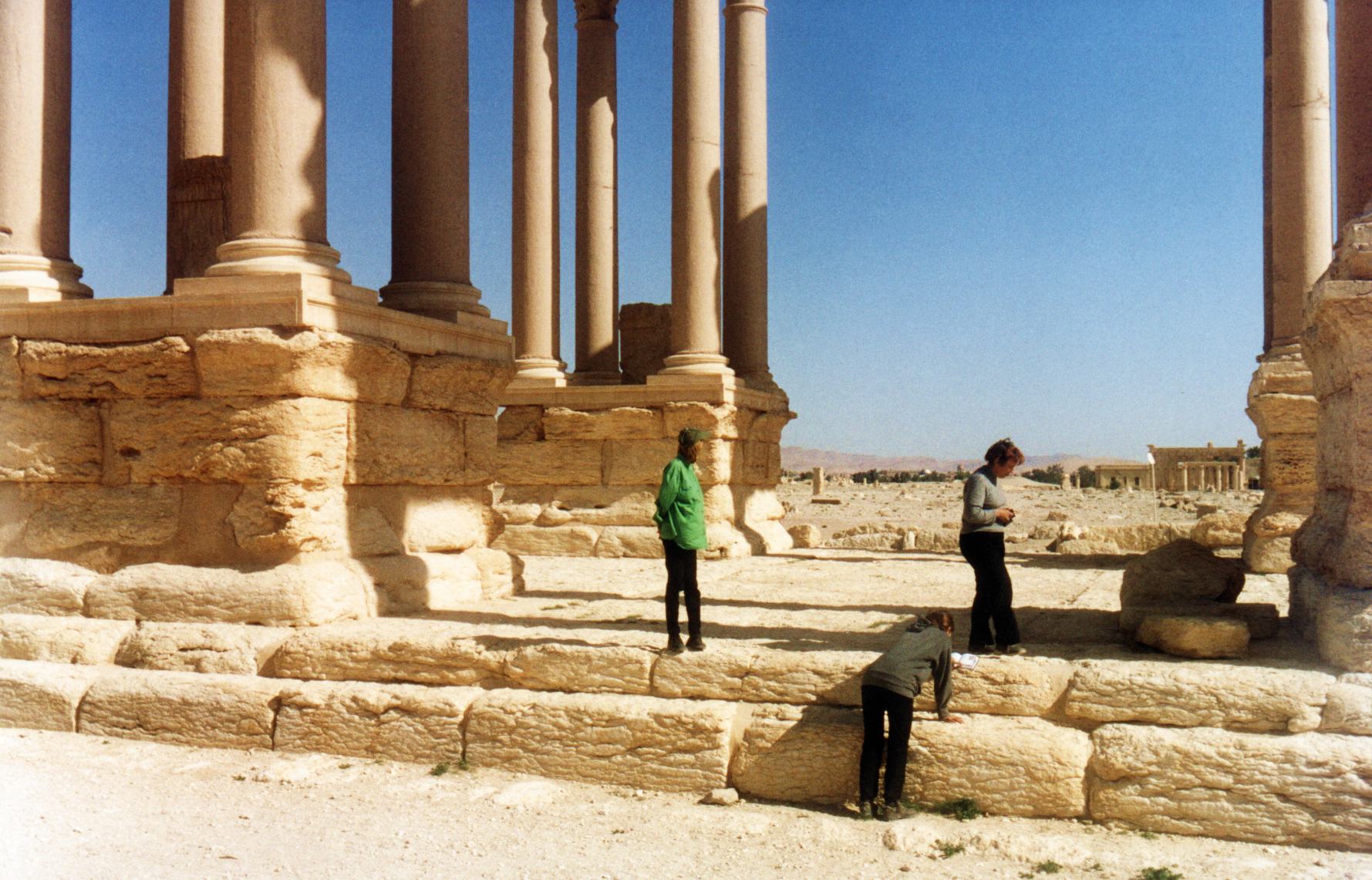
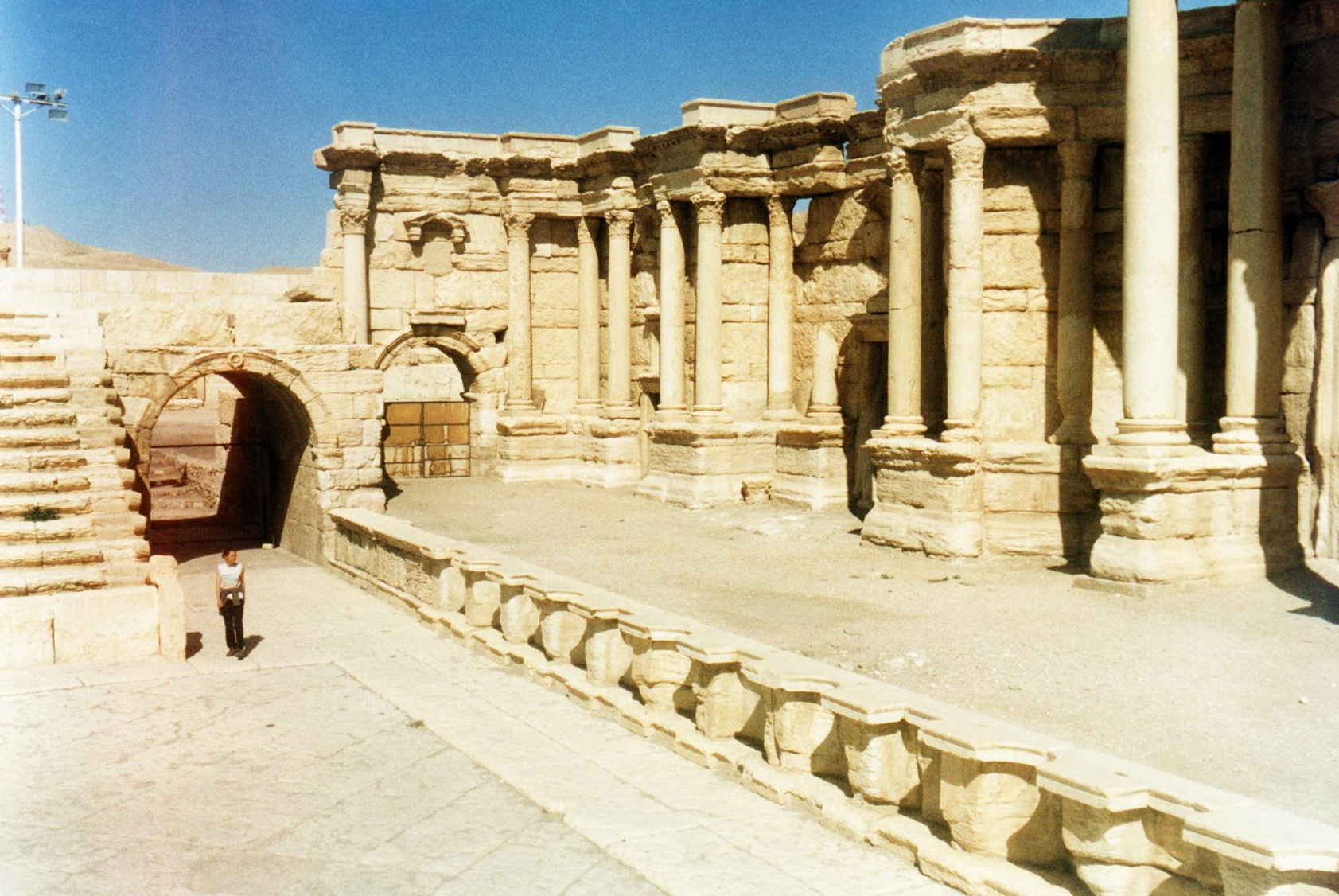
A great many children run around the ruins shouting things like “Give me baksheesh”. In the car park a set of dodgy-looking lads offer to keep an eye on your car. Frankly the atmosphere hardly warms the heart. After an hour or two we decide we’ve seen enough and go looking for food.
The town of Tadmor, with houses, hotels and restaurants, is about a kilometre from the ruins. As soon as we reach the car park some touts from the nearest restaurant run up. We successfully shake off their services and go looking for food ourselves. Lonely Planet has a list of places to eat for practically everywhere tourists often go. Some restaurants live on the fact that they’re in the most popular guidebook in the world. A great sign over the entrance says they’ve been tried and recommended.
Palmyra is no exception, but instead of the usual words of praise they have something nasty to say about each restaurant. Of all the evils we chose the Traditional Palmyra Sindbad Restaurant. The kind author from Lonely Planet had written, “The food isn’t up to much, but it’ll do if you’re desperate.” The owners weren’t in the least put out. Above the door an enormous sign proclaims “Recommended by Lonely Planet”. Come in and try our world-famous mansaf!
We went in, since they asked. They welcomed us warmly and gave us the distinguished visitors’ book. There are often books like that in campsites and restaurants. The proprietors are particularly keen to have lots of entries from distant, exotic countries like Russia. We’ve signed such books more than once and have worked out a standard drawing. A map of the world with the route we took in the Ford. Over Russia there’s a hare with a carrot, snowflakes, a fir tree and the caption −40°C. Africa has the sun, palms and +40. We started off by drawing a bear, but the association with a certain political party didn’t warm our hearts, and the hare, as drawn by Masha, turned out no less fierce or toothy.
In the Palmyra book you’re also meant to stick in a coin from your own country. I took the trouble to go to the car and find a Russian rouble. On the way I had to fight off the owners of the restaurant next door a second time.
While we amused ourselves with our drawing, they cooked up an enormous basin of mansaf for us. A sort of rice with nuts, meat and anything else you might find in the local shop. They brought us freshly squeezed orange juice. Marvellous! Delicious! At last we had a chance to eat to our hearts’ content. The girls don’t have the strongest stomachs, so I got more than a kilo of the food. To be honest, make it a little more and I wouldn’t have been able to eat the lot. Some would have gone to waste. To our usual entry in the book we added that this was the best meal on the entire fifteen-thousand-kilometre trip. The whole pleasure cost 800 suri for all of us.
We waddle to the car under the weight of what we’ve eaten. The most we hope to do today is leave Syria. Palmyra’s the last stop on our cultural programme. Ahead is a long road north. Soon the snowy Turkish mountains begin, then the cold Black Sea. Better not think about what comes after that. We’ve visited everything we planned to visit. Anything can still happen, but we did it, and nobody can take this bright piece of life and light in the middle of winter away from us. Not the gangsters, not the tax police. It will stay with us in memory for ever.
People generally leave Syria through the Aleppo–Kilis crossing, but that’s boring. I want to drive along the Euphrates and cross into Turkey at Tell Abyad. One last little stretch in a new direction, through Syria’s wildest eastern districts by the Iraqi border. If only they’d let us into Iraq, if only we hadn’t run out of money and time. Wherever I am, the thought eats away at me that over that mountain, beyond that horizon, is another unknown world. For now we’ll have to be content with something smaller, but that’s good too. Ahead lie 230 kilometres of desert road towards Mesopotamia and the city of Deir ez-Zor. It’s a new, prosperous city beside the oilfields. They bring up 400,000 barrels of oil a day here. The kilometres have done their work. This is a quite different Syria. The women wear colourful dresses. The valley of the great river, watered by millions of little irrigation channels, is covered with bushes, reeds and other greenery. The village houses are built of mud in the shape of haystacks. In Turkey they exhibit that sort of thing in museums. Here people live in them.
I’d very much wanted to see the Euphrates. I expected an enormous river and found it quite narrow here. Two channels, one a hundred metres across and one two hundred. The banks are overgrown with reeds.
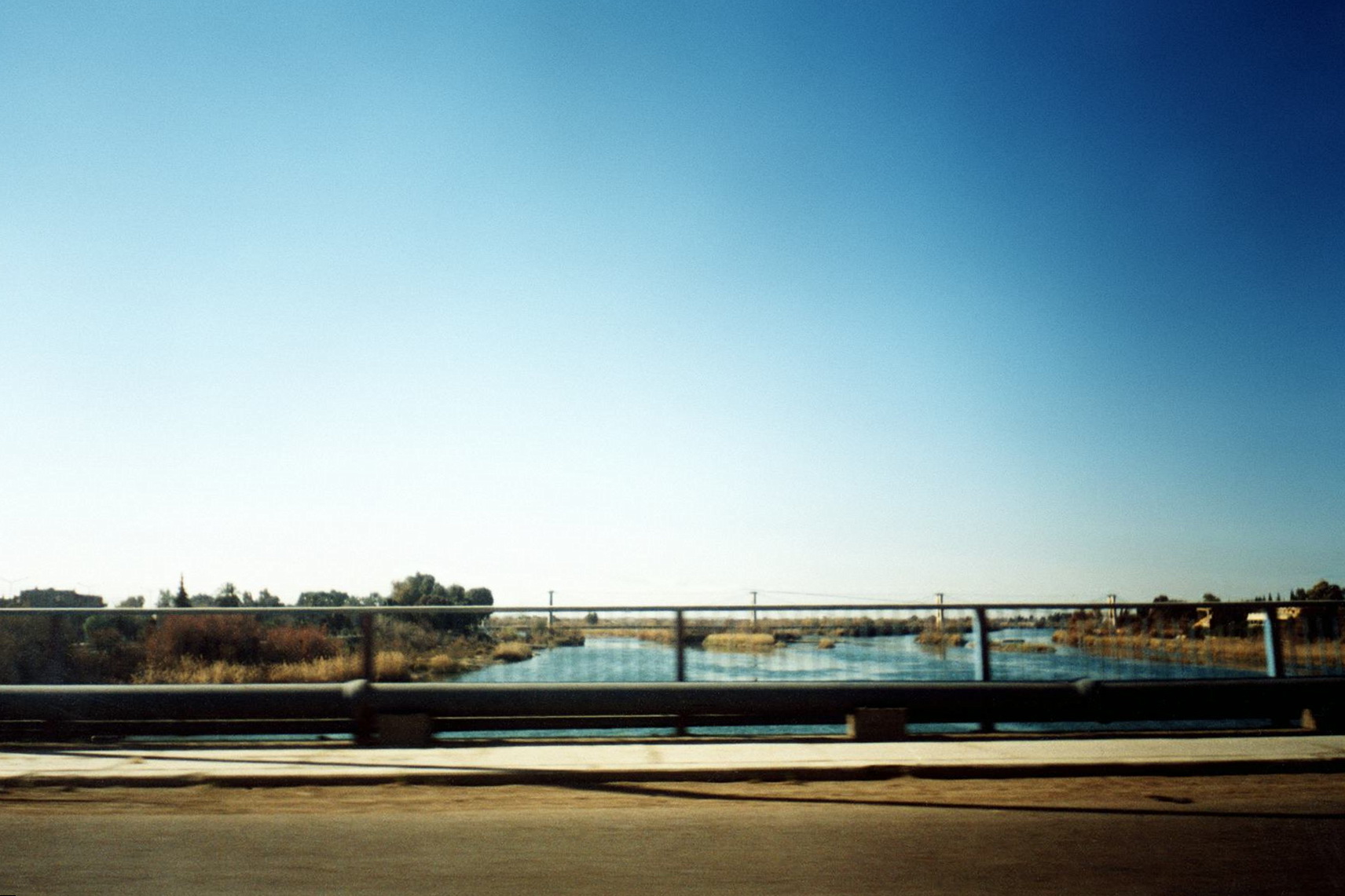
According to the map the only bridge over the Euphrates is in Deir ez-Zor, so we cross to the east bank and look for a road running along it. No signs to speak of, but not much choice either. A narrow country road goes through a great many little riverside villages.
We try asking the way. The local men don’t understand a word, but come over with great interest to talk. One comes up, leans halfway in through the car window, looks around and says he can’t understand a thing. He’ll call the neighbour over. He can help. The same thing happens again. Apparently the whole village just wants to take turns inspecting our women, who are quite well covered, incidentally. We realise we have nothing to rely on but our own judgement and GPS.
The road goes on for ever, winding around desert spurs and marshes. We’ve been driving three hours and it seems we’re only halfway there. It’s disappointing, of course, but we’ve seen the real Syria, the part the tourists don’t see. The red setting sun lights the hills and the fresh spring greenery. The others grumble, but I’m happy. This little piece of life hasn’t been wasted.
The sun was almost down when we finally reached Raqqa. It turns out there’s a bridge there too, and we could have got there quickly by motorway.
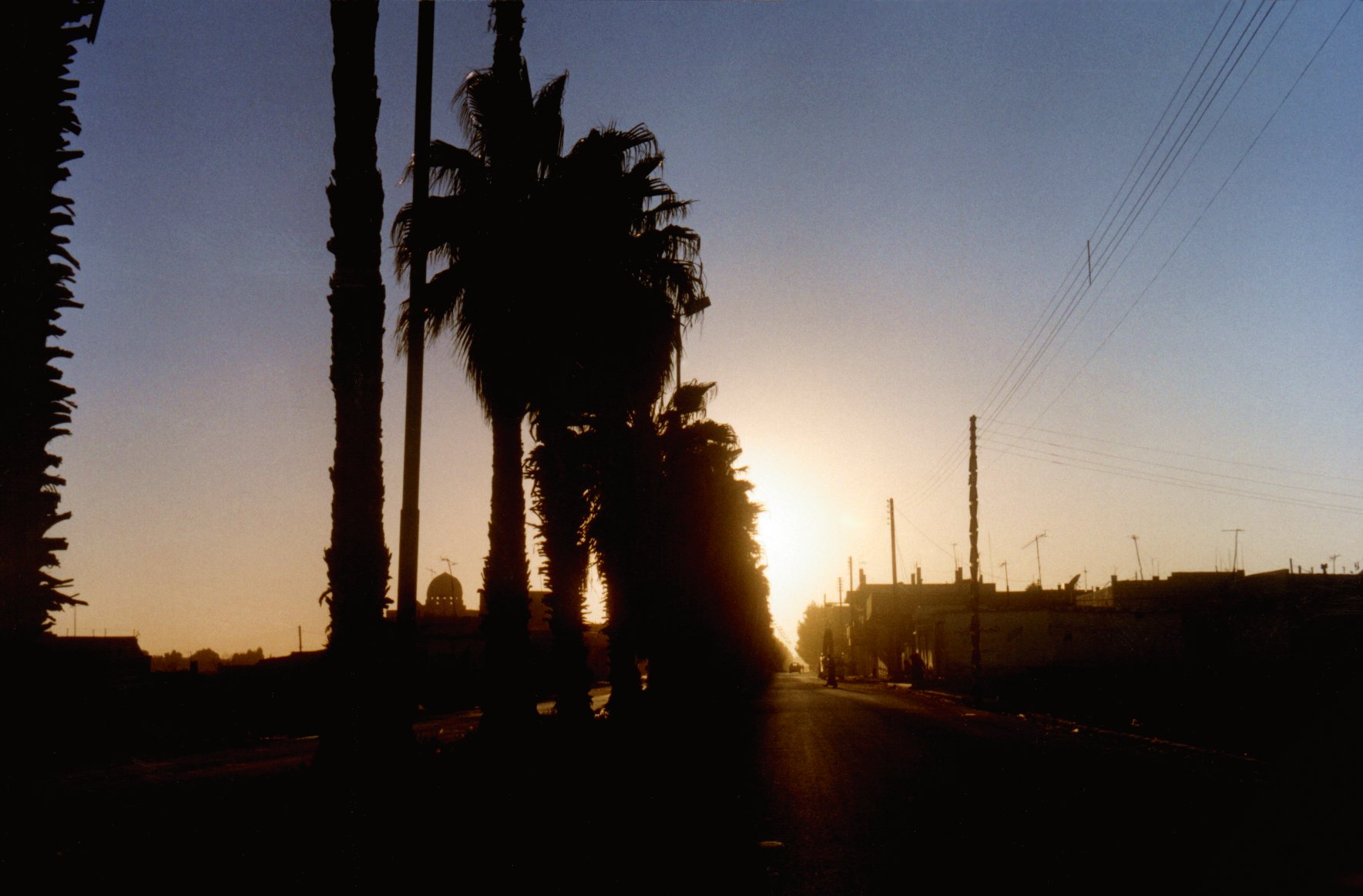
We have absolutely no local money left, our morning mansaf has long been digested and it would be a good idea to fill up, with petrol costing three times as much in Turkey. We try to change a hundred dollars. Alas, the locals are bewildered. The bank is shut and everyone else recoils from foreign currency as though it were fire. We scrape together all our small change and buy three apples. Ninety kilometres to the border. We’ll make it. While we’ve been walking around town it’s grown pitch dark. Now we have to find the road in the dark. There are a lot of forks ahead and I have a feeling it won’t be easy. After two hours we finally see a sign for Tell Abyad on the border.
The town is famous because Agatha Christie and her husband took part in excavations around here in the 1930s. Murder on the Orient Express was written here, and these are the places it’s about.
We drive into town around nine in the evening. In the centre there’s a sign, “TURKEY”. There’s a sign all right, but what a road. Hard to believe that’s the way. A driveway between houses with broken tarmac and open manholes. A hundred metres farther we turn left. Ahead are leaning gates, and some men are playing football on the other side. I go off to ask where the border is. “Yes, this is the border, only it opens during the day. Come back tomorrow around ten or eleven.”
We’ll have to sleep in a field nearby. We drive back and look for a spot. Everything’s been ploughed. We find a very awkward place right beside a huge puddle, on a dirt track to the next village (36°35.908′N, 38°55.383′E, elevation 369 m). People driving round the puddle have worn a lot of detours through the crops. We stop for the night on one of them. Frogs croak everywhere. The last of the farmers stumble across us on their way home, but we don’t much care. We’ll sleep here, especially since pieces of board and car parts from attempts to get out of this swamp are lying by the puddle. Firewood! The phones come alive with messages. “Welcome to Turkey. We are glad you have chosen our network.” We aren’t quite welcome yet and didn’t choose the network, but very nice all the same.
We wake in the morning to the sound of a peaceful farm tractor. People go back and forth, wave but don’t come over to talk. Tomorrow in Turkey it won’t be like this. The whole village will rush out to open negotiations. We’ve woken at six and the border won’t open for four hours. There’s nothing for it but to wait. We make a little fire out of the scraps, cook breakfast and warm ourselves in the sun.
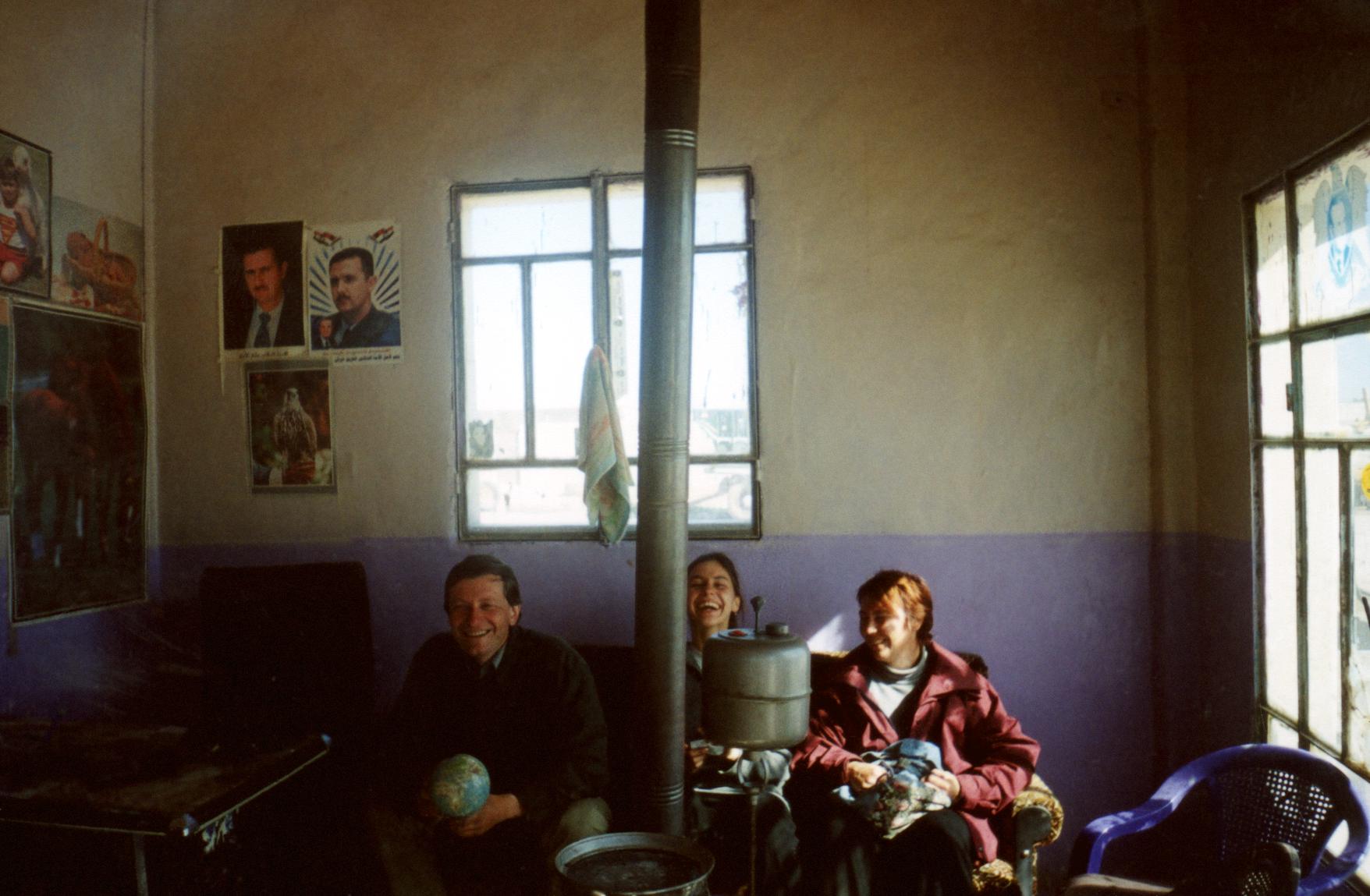
When we drive up to the border a second time, it’s still locked, but we manage to change some money. The guard sits Lena on the back of a motorbike and drives to Turkey. From his Turkish colleague they manage to get a bundle of suri, which incidentally you’re forbidden to take out of Syria. We go looking for petrol. The nearest filling station has nothing but diesel and tea. They invite us to drink some. In a little room with a potbelly stove they ask about life. We have to talk in Arabic, but we can now confidently say the requisite “Rusiya, Arabiya, same-same”, and no more is expected of us. Everyone is pleased and they pour another cup. I show them Russia and Saint Petersburg on a globe. Yes, it’s still a long way off. Africa is quite close, but we’ve a lot of driving to do yet.
After passing the time and filling the tank at the neighbours’, we make our way to the gates a third time. They take the passports, but one question remains. Will the Turks let us in when we’ve no visa? I drive to the border myself this time. The Turks don’t know either and ring their superiors. The answer isn’t encouraging. “Go to the crossing at Kilis. We haven’t any visa stickers here, and we can’t do the car paperwork either.” There’s nothing else for it. Kilis is three hundred kilometres away. The grass is green around us and it’s pleasantly warm. The road’s decent and it improves as we get closer to Aleppo. Aleppo is a city of two million, sunk in a cloud of black smog. It would take at least a day to see the city. Alas, we’re in a hurry and have to go on.
At the border the wide motorway has become a country road again. Hardly any traffic. They aren’t friends and don’t drive over to see each other at weekends. We might think Turkey and Syria are the same, but they’re nothing of the kind. The border divides two civilisations at least as different from one another as Turkey and Russia, for instance. First there’s a different language, second a hatred that goes back to the First World War, third a quite different culture, and fourth it’s the border between NATO and a pariah country. Hundreds of years as part of the Ottoman Empire. Occupation. “The Turks are beasts.” And so on.
In Turkey, when an officer wants to find out whether you’re trustworthy, it goes something like this. “Any weapons? Any drugs? You aren’t a Kurdish terrorist? You aren’t from Syria?”
The border looks the part. Towers, barbed wire, men with automatic weapons.
We were ready for a thorough search, but Syrian customs took no interest in us. A few minutes, a stamp in the passport, and off you go to your Turkey.