The start of the journey
I'll paint the whole world in my favourite colour. An orange sky, an orange sea, orange leaves, an orange camel. Orange mothers singing orange songs to orange children.
Africa 2005. South Africa, Lesotho and Swaziland
Chapter 1. The road to summer
Of course, geographers count Egypt as Africa too. But for me, the real Africa begins where the world's largest desert gives way to savannah and tropical forest, where hippos wallow in the rivers and elephants, lions, giraffes, rhinos and zebras roam the banks. There isn't room for the whole list. After Chukovsky's verses about Doctor Aybolit and King Solomon's Mines, any self-respecting child ought to dream of that extraordinary land on the banks of the great rivers. The ambition to swim in the Congo, or somewhere like it, was practically on the school curriculum. Remember the poem about stubborn Foma? After a day sitting at a desk in a neatly pressed grey uniform, with your hands folded just so and a page of penmanship to get through, can you still doubt that there's such a thing as real life? It's out there. The point of life is to get to it, to crawl under the barbed wire and give your schoolmistresses and the ever-watchful Party and government the slip. How many children were caught at airports because they had come hoping to find a plane to Africa and sneak aboard? I was put in a police lock-up for the first time in my life just for watching people board planes and fly off to faraway places.
And then there was that song about the orange sky, the orange children and the orange camel…
On top of that, the Orange Revolution had broken out in Ukraine. We spent the whole of December looking forward to seeing the people win out over the old Soviet ways we'd had quite enough of.
Right, time to go. It would be a shame to go through life without visiting southern Africa, swimming in the Limpopo and the Orange, scrambling around the Drakensberg, jumping off the world's highest bungee and seeing all those animals.
The political situation in South Africa also gave me some cause for concern. Best to go while things were peaceful. For all we knew, a war could flare up and go on for twenty years, like the one in the Congo.
South Africa was a hard place to get into on a Russian passport. An independent travel visa was practically impossible to get. South African citizenship, for that matter, was easier to come by. You could get it for $10,000. A visa, though, required an invitation, and any South African citizen willing to invite you had to make the rounds of the local authorities. There they'd be told all Russians were thieves and murderers, and that if we came to stay they'd lose their house and their money. Our attempts to get an invitation dragged on, and time was running short.
Tickets and a hotel booking weren't enough for a visa. You needed an invitation from an accredited South African travel agency. The invitation was registered in South Africa and given a number. The agency's name and the invitation number were entered in your passport. Needless to say, an agency with that sort of leverage didn't come cheap. I tackled the problem thoroughly and rang fifty agencies in Moscow. Most of them couldn't see what the difficulty was. Here were some package tours on such-and-such dates. What if we bought a package and slipped away to travel around the country on our own? They looked horrified and suspected we meant to work illegally, emigrate and steal diamonds.
Four firms made it to the second round of my vetting process. At TriS, a woman called Darya (m2_tris@list.ru) relented when I offered $1,000. I had serious doubts about her qualifications, though she certainly had confidence to spare. She claimed to know everything about South Africa. There were no deserts or waterfalls. We'd got it all mixed up. The waterfall was in Zambia, and there was just one mountain, in Cape Town. We knew nothing about the country, or about life in general, and still less about tourism. We couldn't get more than twenty metres from our guide, as the place was full of frightening Black people. We'd be lost without a trace, but for $1,000 she was prepared to make the paperwork look just right. I could have scraped together a thousand, of course, but I wasn't convinced Darya was someone I could rely on. I left it at that. Put yourself in hands like those and you might end up having to ‘lose’ a passport with a visa refusal stamped in it.
One man read our travel stories and even wanted to come with us. He promised to help for free and sort things out with the South Africans. It all seemed to be coming together, except that the reply from South Africa never came. The last time I rang, the firm told me he didn't work there any more.
There wasn't much time left, but I hate giving up. Two firms remained that were prepared to sell us a private tour, take payment for the hotels up front, then let us loose. Grand Tour Voyage wanted us to turn up at the hotels they'd booked as we made our way through the country, check in, and pay for at least one organised outing.
At Peremena (www.zambezi.ru), all they required was full payment for the accommodation. It was the lesser evil, so we agreed. I dealt with Irina (ivanova@peremena.ru) about the visas. She didn't really understand why we wanted to go on our own either, but experience had taught her that the customer is always right.
We wanted to visit Lesotho and Swaziland as well as South Africa, and Peremena offered to help with those too. We took them up on Lesotho and decided to get the Swaziland visas ourselves. We were right. Once you were there, it was a formality. Four hours later, the visas were in our passports.
Unfortunately, the accommodation the agencies book is very expensive, at least a hundred dollars for a double every night. In reality, you can get an excellent room somewhere lovely for no more than $40. At agency rates, though, thirty days came to over $3,000 for the two of us. Time was running out, and we had no choice. After all, we were prepared to pay that much for the flights. What's more, nobody else we'd heard of who wanted to get into South Africa and wander around freely had come up with anything that worked. Even the great hitchhiker Krotov and his companions had failed to get visas on their round-the-world trip.
We could have taken offence and cried out, ‘How long are we supposed to put up with this?’ It wouldn't have got us a visa, and what right had we to complain? Russia also greets foreign visitors with a host of charges and humiliations. We were getting exactly the same treatment back. We ought to start with ourselves and let anyone come to Russia visa-free.
It hurt to spend $3,000, of course. I consoled myself with the thought that we might actually use some of the hotels. We'd also booked bungalows in national parks, which really would come in handy. They were cheaper, about $50 a night. My advice for anyone getting a South African visa the way we did is to book nights in national parks. It costs less, and the money goes somewhere worthwhile instead of to a flashy city hotel.
The visa service itself cost us $170. The paperwork took five days, which counted as the expedited option.
Despite what the agencies said, a South African visa didn't run strictly from the first day of your booking to the last. Ours was valid from the date it was issued at the embassy to our requested departure date, plus a few days for good measure. You could apply early, pay for just a few days in a hotel, take off as soon as you got your passport back and stay a little longer. We'd heard it was also possible to extend the visa locally without much trouble. We didn't try that ourselves.
At the last minute I thought of a way to get difficult visas that later worked in practice. Ask the people who arrange immigration and jobs in South Africa for help. They know the invitation system inside out and are prepared to invite you into the country for a hundred or two. Few of them care if you never take up the rest of their services. Good luck finding you after that. But that was an idea for the future.
We bought Air France tickets for $1,381. We could have flown Lufthansa, but there was only a waiting list for our date. Time was running short and we wanted something definite.
There was all the last-minute fuss before the flight, and the year was coming to an end. Endless things to do, darkness outside. No life at all. Then the day came. We stuffed our things into our packs in a hurry, stopped on the way at one of my job sites, and made it to the airport. In my head, the holiday starts at passport control. A stamp in the passport and all is well. We've escaped the state's clutches. I always think of the scene with Stierlitz and the radio operator Kat at the Swiss border. Until the very last second, you expect they'll find you're on some blacklist, there's a warrant out for you, or you've been barred from leaving the country. You can tell yourself it's nonsense all you like, and it makes no difference. Then you're on neutral ground. You can relax. Whatever happens in Russia is somebody else's problem now. As usual, Tanya and I go for a coffee and a sandwich. The holiday has begun.
An Airbus took us as far as Paris, then a Boeing 747 to Johannesburg. It was pitch dark for most of the flight. All we saw out the window was Paris glittering with New Year lights, the Eiffel Tower among them. The sun came up over Botswana. Below us lay endless semi-desert with dried-up salt lakes. The closer we got to Johannesburg, the more roads and houses we could see. The airport is some way from the city. It's new, modern and safe. After all the trouble getting our visas, I expected the worst at passport control, but it was over in a flash. They asked no questions and barely looked at us before stamping the passports. As for customs, there might as well have been none.
A representative of the firm that had invited us was waiting at the airport. We needed him to get us our Lesotho visas. Russia had had diplomatic relations with that tiny country for years, but the only ambassador was honorary. This means there's an ambassador when vodka is to be drunk at banquets, but ask for a visa and suddenly nobody knows how. They say honorary ambassadorships are in fashion these days and you can buy one. Say I want to bring a Mercedes 600 into the country. The tax alone is so high that it's cheaper to buy myself a post as honorary ambassador and import the Merc duty-free for embassy business. One for my wife, my children and my mother-in-law, too. Make them first counsellor, second counsellor and military attaché, respectively. You could save enough to run a small African country for a month.
I'm not suggesting anything of the sort about the ambassador for Lesotho. He doesn't issue visas, though. Lesotho has embassies in South Africa and several European countries. You can also go through any British consulate, but it can take over a month. The embassy in Pretoria, on the other hand, can do it in a few hours. All you need is a photograph and a completed form. Even knowing that, we went through an intermediary because we wanted the visas on 29 December, in the middle of the Christmas holidays. We meant to spend New Year in Lesotho. If the consulate held things up, our plans could fall apart. We handed over our passports and got some cash from an ATM. The South African currency is the rand. On our trip, one US dollar bought 7.7 rand. The country's monetary system is stable, with low inflation, and the rand is effectively the currency of southern Africa. You could find an ATM in any little town and take out 2,000 rand at a time. English appeared on the menu after a string of African languages: Zulu, Sotho, Swati, Tswana, Tsonga and, of course, what I thought of as the country's main language, Afrikaans, which sounded to me like a mix of German and Dutch. You could change foreign cash, but it cost you a chunk of money, you had to queue, and they wanted to see your passport.
Johannesburg is a dangerous city. Millions of Black people had moved there hoping for big money working in the gold mines, and most ended up in poverty. The crime rate was off the scale. In most of the world's cities, if you're careless, you stand a chance of being robbed. In central Johannesburg it seemed a certainty. Since the end of white rule, the city centre had become, for practical purposes, a no-go area for white people. There were other districts for them, such as Sandown, where we'd booked our hotel. It was all paid for, so it would have been a shame not to use it. There was a bus from the airport, of course. It went into the very part of town we'd been warned to avoid, which left a taxi, at 260 rand into town. There was little point bargaining. All the taxi drivers were Black. That was nothing to be alarmed by. In my eyes, there had been plenty of changes since Mandela came to power, but in practice people still lived apart. The most obvious change was that there were no ‘Whites only’ signs. Millions of Black people lived in desperate poverty and squalor in townships such as Soweto. We were advised to stay away. There were still wealthy white suburbs, though more and more affluent Black people were moving into them. I felt I could trust those people and put the airport taxi drivers in the same bracket. In any case, check that your driver is accredited by the airport. He'll show you his pass and take you to his car in the official taxi area. The drivers have agreed on a price, so don't expect a discount. Get into some car you can't place and you don't know what will happen next, although chances are you'll still be fine.
You can also rent a car. It's very common, and a day's rental can work out cheaper than taking a taxi there and back. Just make sure the hotel has parking. You can leave a car on a Johannesburg street overnight, of course. The catch is that it probably won't be there in the morning. Remember, too, that South Africans drive on the left. Traffic in the big cities is heavy, so this isn't a good place to try left-hand traffic for the first time.
We were flying out to Lesotho the next day, so we stuck to taxis.
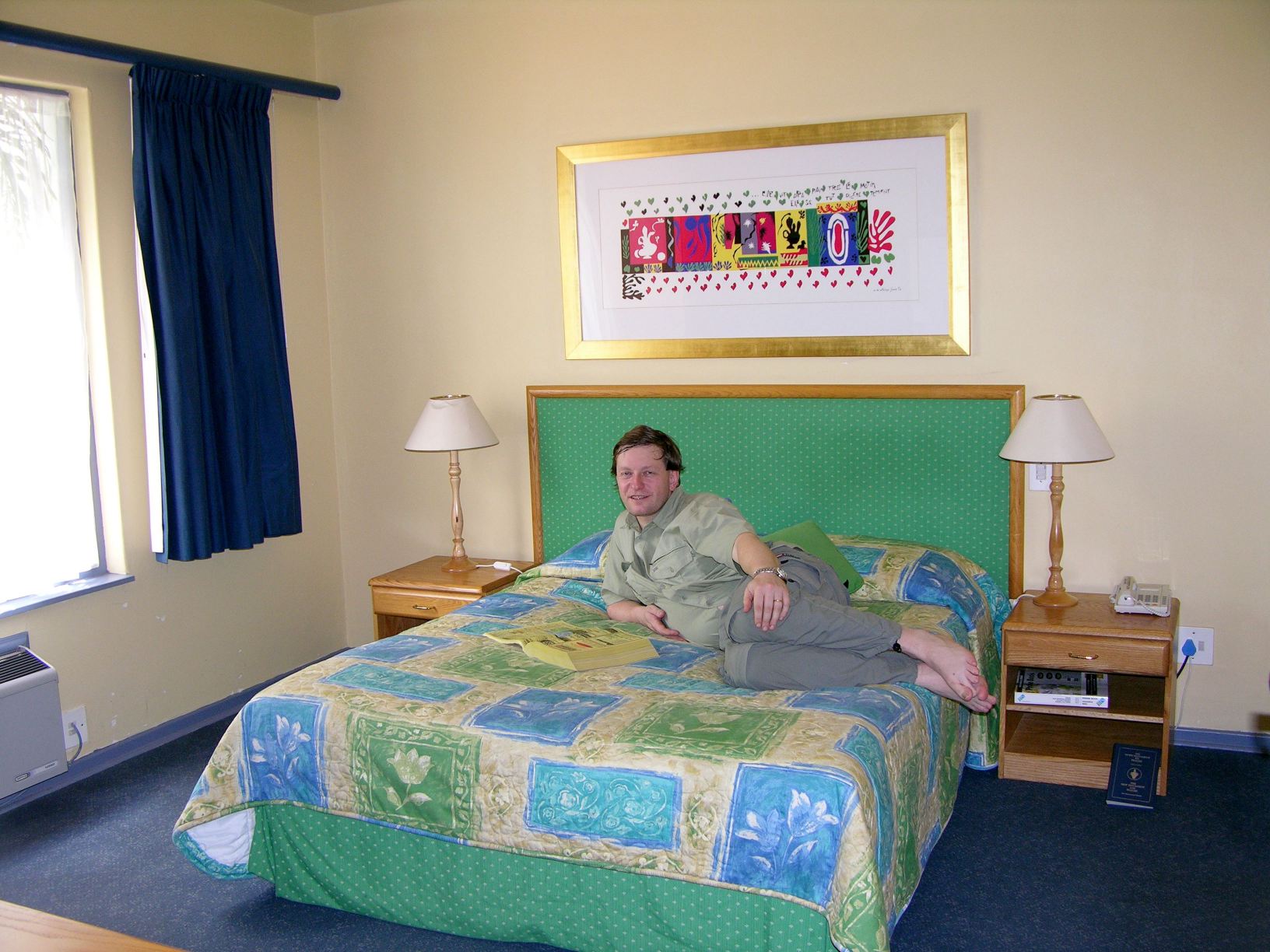
Here we are already lying on the sofa in our hotel room. Instructions everywhere: put everything in the safe, don't walk outside, lock the doors. It was unsettling. Where on earth had we come to? The one consolation was that tomorrow we'd be off to Lesotho, which was more peaceful. Even elsewhere in South Africa there were far fewer robbers.
Once we'd taken stock, we decided to walk to the shopping centre. The only people who walked here were Black, and the pavements were empty. All around us were the high fences of expensive homes, topped with electrified barbed wire. Automatic barriers, cameras and signs everywhere: ‘Armed response. We shoot without warning.’ They meant it. Guns were freely available. Any owner who shot someone climbing his fence could expect to be acquitted. There were people campaigning against the free circulation of guns, of course, but they'd made little headway. So far they'd got gun owners required by law to carry their weapons in a holster instead of in their hand, cocked. No, I don't think I'd want to live like that. It felt like Pyrrus from Deathworld.
We reached the shopping centre without incident. Sandton City is an enormous complex covering several hectares and rising as high as fifteen storeys. There were plenty of white people here, strolling about and eating in cafés. It was like the best mall in Europe. We got the maps we needed and had lunch. We put a SIM from the local network Vodacom in our phone. South Africa had no fewer than three networks. MTN had the better service, but we didn't know that yet, so we went with Vodacom. The sound when you called Russia was appalling, but text messages went through without a hitch. A text was 15 cents, or 30 cents on MTN.
It was nearly dark by the time we walked back, but it didn't seem so frightening any more. We'd already begun to find our feet in the country. Our passports were waiting at reception with their Lesotho visas. Hooray! Now we were our own bosses, with no prospect of a guide getting in the way.
After a night on the plane, I could barely keep my eyes open.
I woke in the morning to birdsong and bright summer sunshine. I'd been dreaming of something grey and horrid. I was so astonished at what I'd woken up to that I called out, ‘Tanya, where am I?’ Only then did it sink in that here I was, in the Africa of my dreams.
There was a buffet breakfast at the hotel. Perfectly decent. You could fill up.
Then it was back into a taxi and off to the airport.