Travel diary
A drive from Saint Petersburg to Turkey, Bulgaria, Romania, Hungary, Slovakia and Poland
There were three of us: Sasha and Tanya Simo, and Lena Kazachenko.
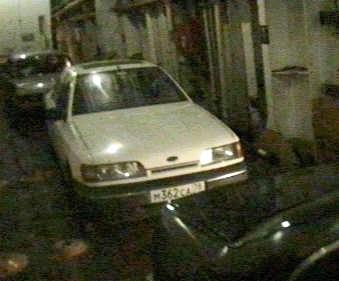
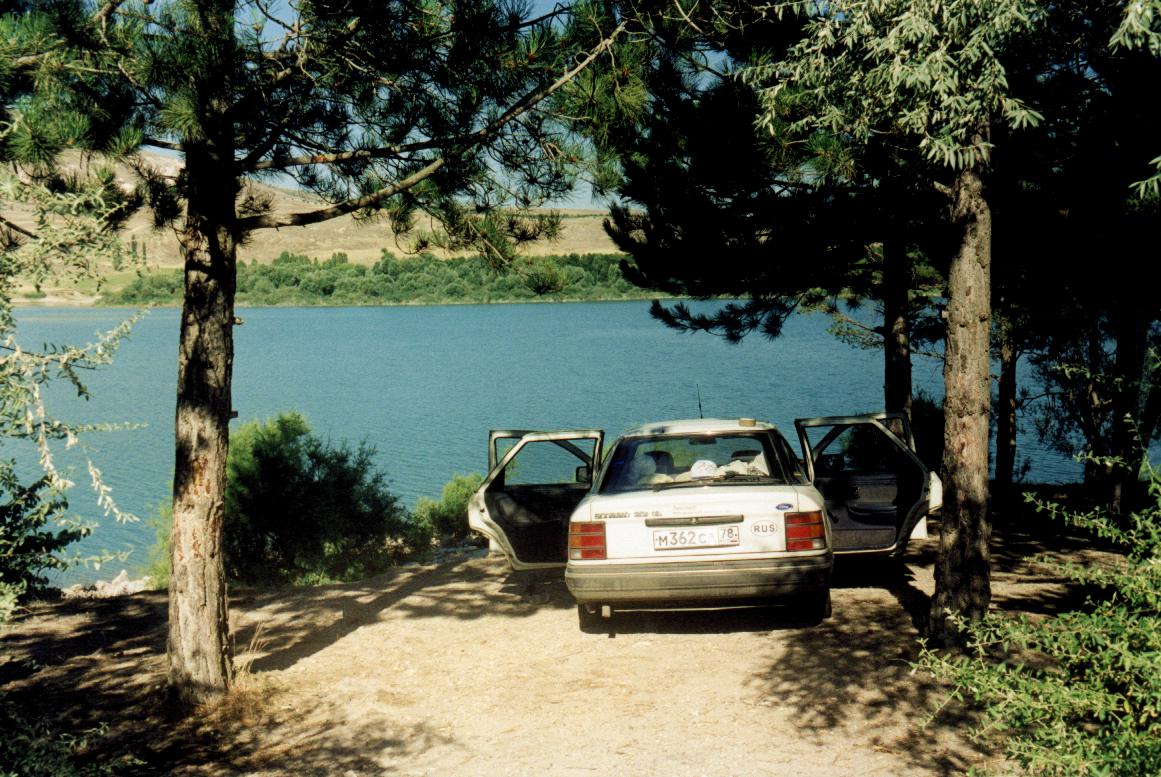
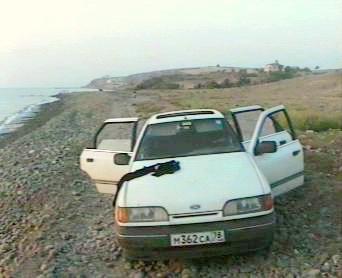
We drove a Ford Scorpio 2.0i GL, covering 14,836 kilometres between 31 July and 27 August 1999.
We used 1,250 litres of petrol and paid $860 for it. The trip cost $2,600 for the three of us.
Day 1. Saturday, 31 July 1999
We left Vyritsa, sixty kilometres south of Saint Petersburg, at eleven. Our spirits were low. We were planning to get to Iran and the Indian Ocean. There was so much ahead of us we knew nothing about, so much that might go wrong. It was hard to believe we'd get home safely. There was little money as well. First we went to pick up Lena in Pushkin and discovered we'd set out without her address. We spent a long time looking for her and found her at last. In the car we decided to take the ferry from Sochi instead of going through Europe.
We set off at half past twelve, bound for Moscow, and filled up at the Kolpino turnoff. Spirits still foul. Beyond Novgorod the traffic police caught me overtaking, which cost fifty roubles. To console ourselves we decided to eat. We pressed on to Tver without stopping and found a little café. On closer inspection it was a strip bar, but we got a perfectly decent meal there.
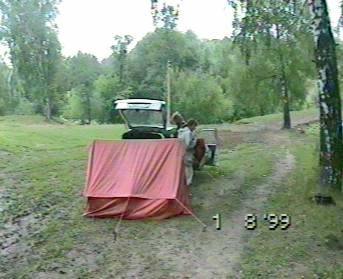
We decided against bypassing Moscow and drove through the very centre, past the Kremlin, for the joke of it. I hadn't been to Moscow for a long time and wanted to see what Luzhkov had put up there. Then we misunderstood each other and mixed up the Warsaw and Kashira highways. It got dark, and somewhere around Domodedovo we wandered for ages on some outlandish roads, in search of the Kashira highway first and then a place to camp. It was raining. We wound up in the mud beside some road (55°16.738′N, 37°52.453′E). A few surprises followed. Planes out of Domodedovo were taking off over our heads, there was a railway behind the bushes, and cars kept passing on their way to some houses. Friday, after all. People were heading out of the city. We fell asleep without even eating.
Day 2. Sunday, 1 August 1999
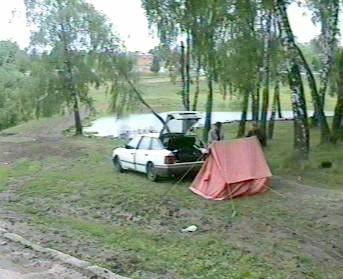
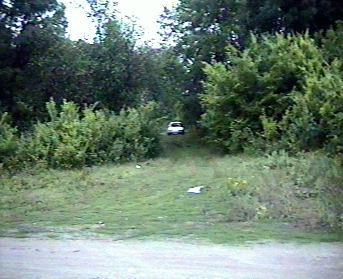
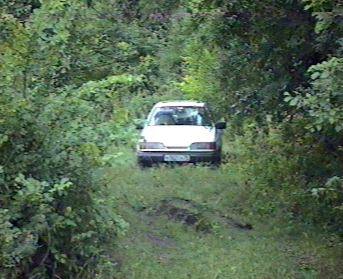
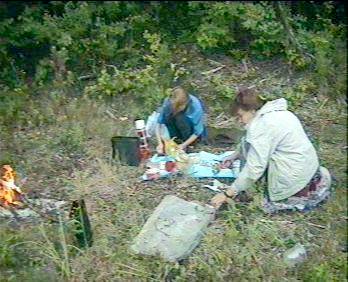
In the morning we found we'd pitched on the track used to drive the cattle down to water, right in the middle of unimaginable mud. Then a man drove up, woke us and asked how to get to Komsomolskaya Pravda. We had to pack in a hurry and get moving. A vicious rain began. We drove to Stupino, where Lena phoned home. We still hadn't found any grub and drove a long way before giving in to pelmeni at two roubles apiece in a roadside hole. The rain came down without a break until evening, when we reached Voronezh. We walked around town. You could already tell we'd come south. We found a canteen unchanged since Soviet days and finally got enough to eat. We began looking for a camp early. Alarmed by stories about bandits, we found a secluded spot on the Don, turning right before Verkhny Mamon and driving another five kilometres (50°32.208′N, 40°00.594′E). In fact you couldn't see the riverbank for the bushes, but there was a lake nearby to get water from and swim in. We had a lovely evening. Ate, drank and talked.
Day 3. Monday, 2 August 1999
We had breakfast and travelled on towards Rostov-on-Don. At the entrance to town the traffic police stopped me for speeding and tried to take three times the minimum wage, but couldn't show me the radar. Another fifty roubles settled it. We took the Rostov bypass, but they still wanted ten roubles for the use of the town's bridges and locks. It was such a small sum we paid. Just after the bridge over the Don we ate cheaply and very heartily at a tiny roadside place. Where the A149 turns off the M29, the sign says “to the sea”. Our fighting spirit returned. We crossed into Krasnodar Krai without being stopped or shaken down. That's a vicious checkpoint. Not every country in Europe has a border like it. The Krasnodar Sea is interesting to look at, with the road running along the dam.
After Goryachy Klyuch, another checkpoint. They tried to charge 120 roubles for the environment. They measured the carbon monoxide. We passed, but they wanted money just the same. We kicked up a row and wrote down the numbers of their identification and the relevant orders. After ten minutes of fighting we won. The irate policeman radioed ahead, or pretended to, to have us stopped at every post. We pressed resolutely on. A crowd of followers, encouraged by our victory, broke through behind us. We drove carefully, with no speeding or overtaking. The mountains were already around us, though the road wasn't a mountain road yet. We got to Dzhubga after sunset and went for a swim. I hadn't been to the seaside for nine years.
We had no reliable information about the ferry. We thought it went from Lazarevskoye. We wanted to get all the way there and tried, but we'd already driven nine hundred kilometres that day. It was dark and we were on a mountain road. The car was rattling like a tank. The front exhaust pipe must have come away from the manifold again. It happens a lot on my Ford and nobody has been able to cure it. They all say, “We'll have that fixed in a second. Who were the idiots who did it last time?” The result is always the same. The nuts work loose. There'd been campsites right on the shore near Dzhubga, and we'd expected more of the same, but the road went up into the mountains and there was nowhere to stop. With difficulty we found a turnoff after Shepsi and stopped on a small clearing. A nasty, dirty spot (44°01.956′N, 39°09.394′E). We went straight to sleep.
Day 4. Tuesday, 3 August 1999
We woke to find to our horror what a filthy spot we'd chosen. One vast lavatory. How on earth had we managed not to put the tent on a pile of it? I set to work bolting the exhaust pipe back to the manifold. Interestingly I've done thirty thousand kilometres since then and the nuts are still in place. We packed up quickly and drove to Lazarevskaya.
Nobody in Lazarevskoye had heard anything about a ferry. On to Sochi.
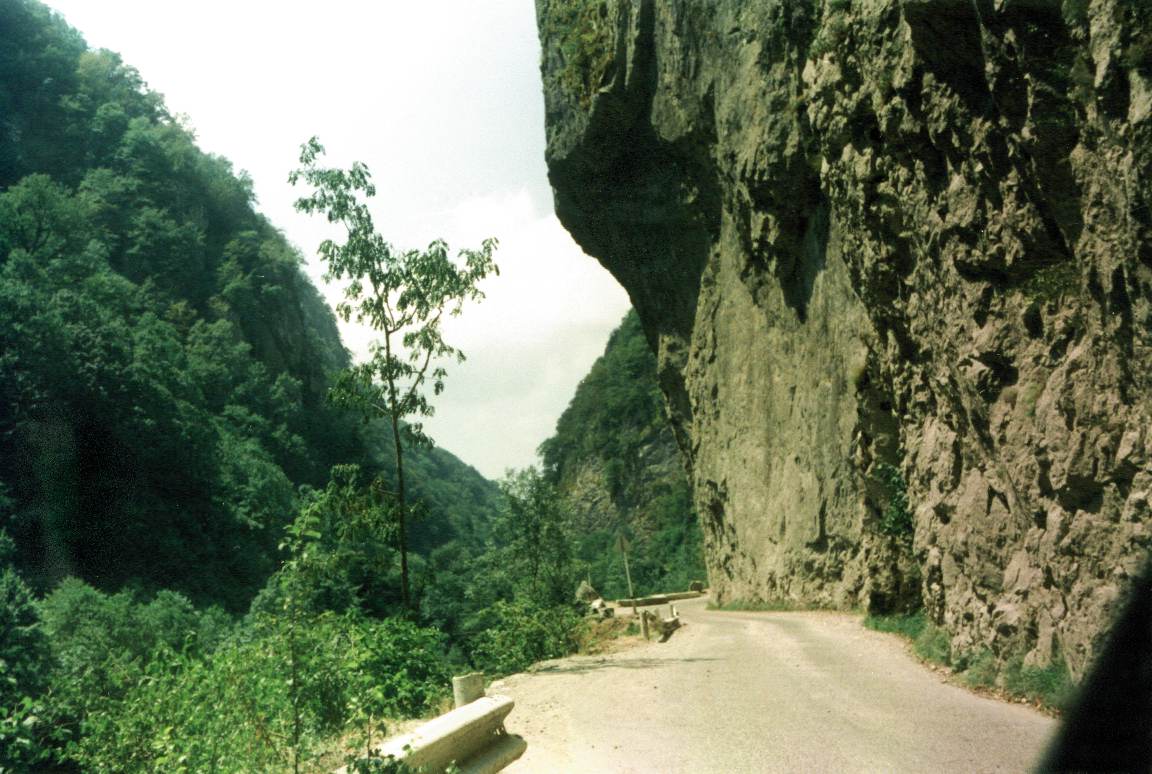
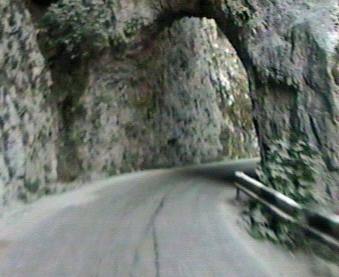
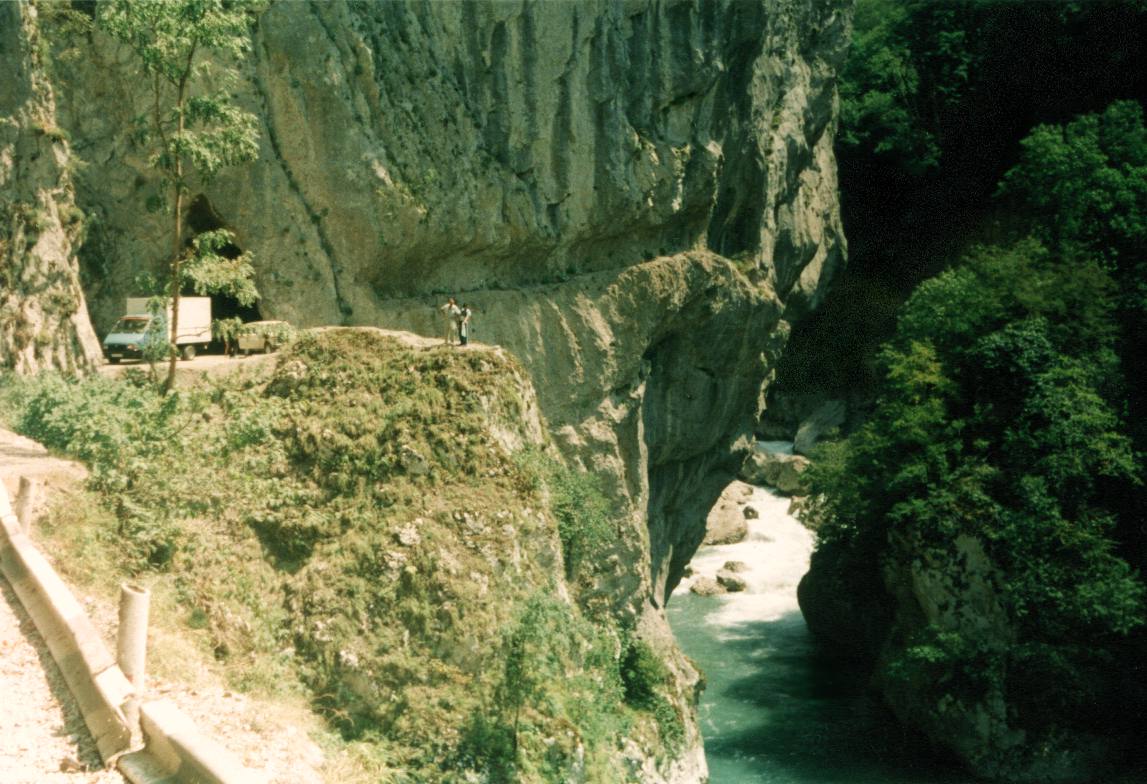
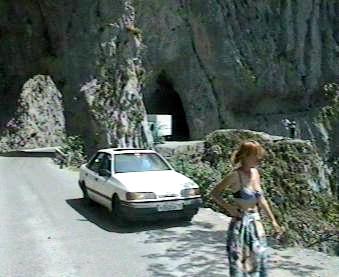
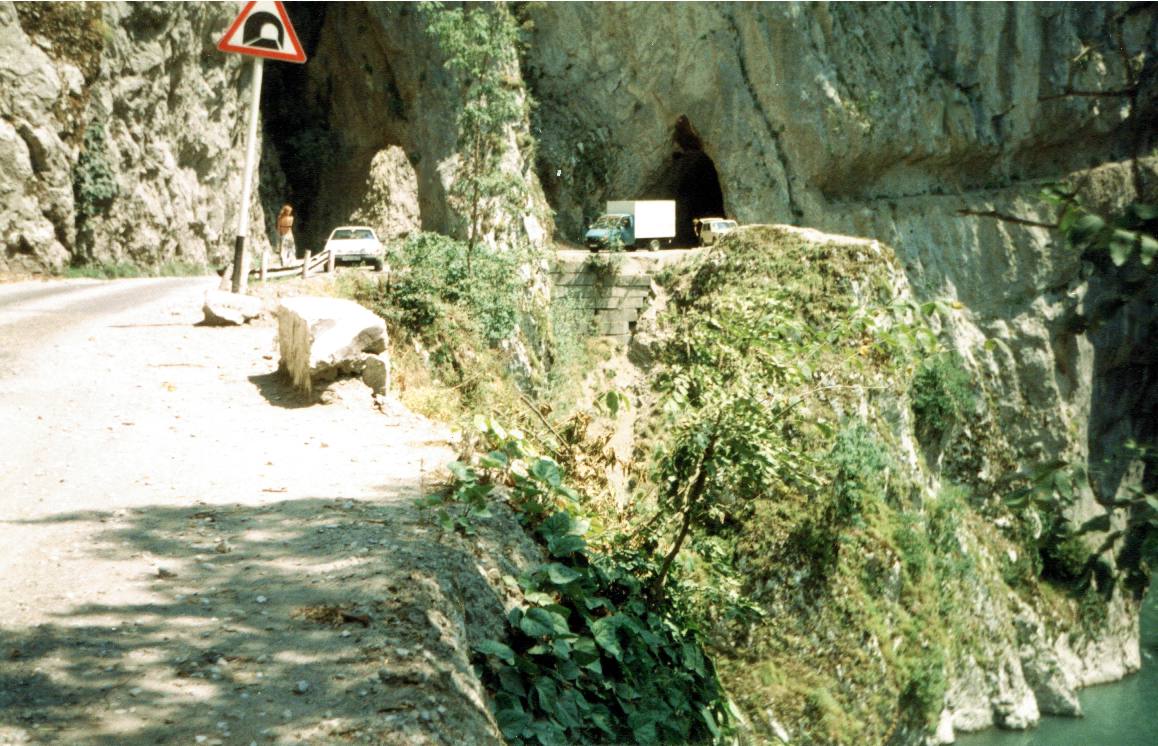
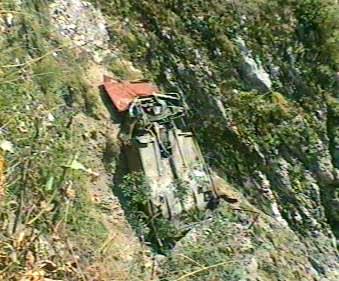
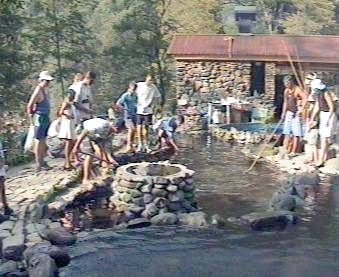
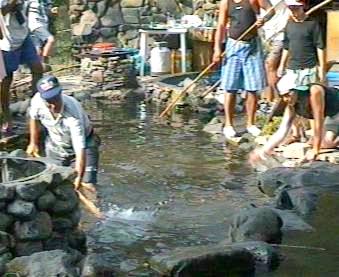
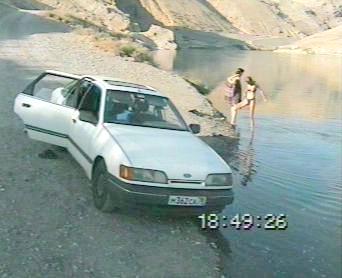
On the way in, another environmental fee, forty roubles for three days. We were in a good mood and didn't feel like an argument, so we paid. Sochi did have a ferry. It went the next day and had spaces, but it was $560. We'd have been better off going through Europe. We sighed and decided to sail, arranging to pay in the morning and going to Krasnaya Polyana for the night. First we swam in Adler and very nearly drove into Abkhazia. I liked the road to Krasnaya Polyana. A very beautiful road cut into the rock. In the gorge you can see the cars that went over the side. Everything done in our familiar Soviet style. A sign says buses are forbidden, and beside it a policeman stands collecting money. We went through without a hitch. They're straightening the road and digging immense tunnels. I suspect that once they've straightened it completely there'll be no reason to drive to Krasnaya Polyana. As it was, there was a lift that took you up two hundred metres, a little restaurant where you could scoop up your own fish with a net, and nothing more. On learning the eighty-rouble lift would take us up a little way rather than to the summits of the Caucasus, we went to the restaurant and then drove farther. The road was closed with a barrier. They said they'd let you through for fifty roubles. There was nobody at the barrier and the Ford was low enough, so I drove under it. The Ford's suspension was also rather low. We couldn't go much farther and stopped at the first convenient spot (43°40.296′N, 40°17.793′E). We washed ourselves and our clothes. There were plenty of blackberries along the stream. We kept the fire going late into the evening. The woods were full of fireflies.
Day 5. Wednesday, 4 August 1999
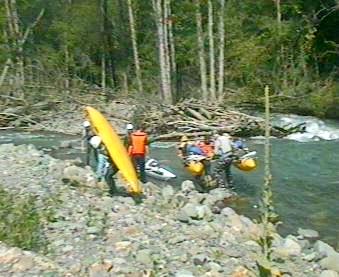
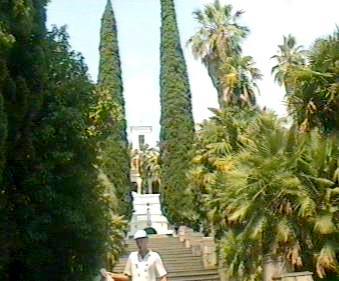
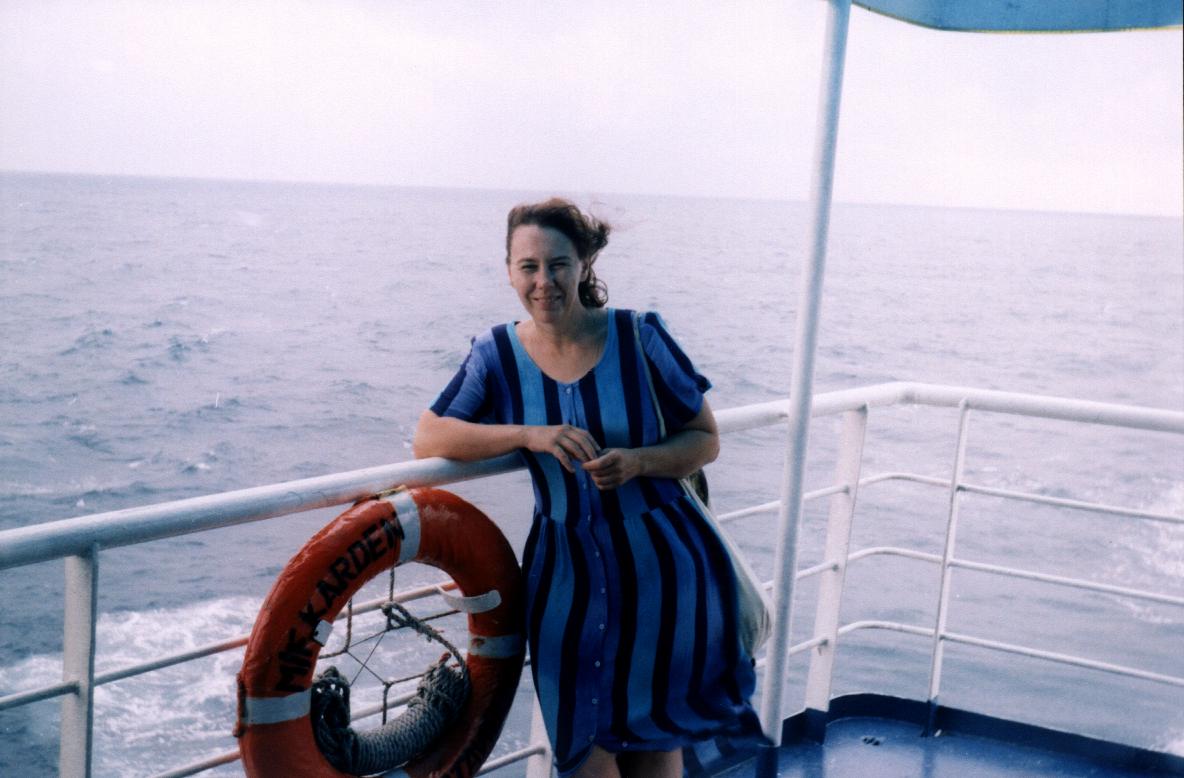
In the morning I washed the car. There was no hurry to go anywhere. We watched a group of paddlers heading down the Mzymta. They mostly walked along the bank, to tell the truth. Back in Sochi we went to the arboretum. It was hot and wet. We all had a dreadful foreboding. Fifty degrees awaited us, and we were already finding thirty-five hard. At five we drifted down to the ferry. There was a regatta that day, so it couldn't enter the harbour and was running very late. A long wait at the port began. We even had time for a swim. The beaches near the dock cost eighty and sixty roubles, so we had to walk a kilometre. Then we waited a long time again. Then Lena disappeared. Then it turned out she was already aboard. We milled about at customs for ages. The officers scolded a local man who'd brought a stolen car for having dodgy papers and told him to redo them by next week. There were three other vehicles going. An English traveller in a minibus with a group of ten was bound for Georgia and Armenia. A traffic inspector from Tomsk and his Georgian wife were going to her parents in Georgia through Turkey in a Volga. He'd actually started out in a Dodge, but the gearbox had broken, so he'd got hold of the Volga. The year before he'd wanted to go round the Black Sea but his car was stolen in Bulgaria. The poor traffic inspector was upset, bought a new Dodge and set out in that. There was a Syrian who lived in Syria and was going home to Latakia. Ten Turkish lorries were also loading onto the ferry. It was dark when we finally began to load. A customs man rummaged through our things and caught sight of the cooking pot. It had survived dozens of trips. It was black and dented and looked as if a whole herd of elephantopotamuses had walked on it. He smiled at the sight and stopped the search, hinting that our pots would make much more of an impression on the other side. The customs people were very friendly generally. You could see in their faces they'd be willing to arrange to carry anything, even a whole lorryload of heroin. I drove into the hold and went up top to the others. So there I was, no longer in Russia. The ferry was Turkish, called the Karden and registered in Istanbul.
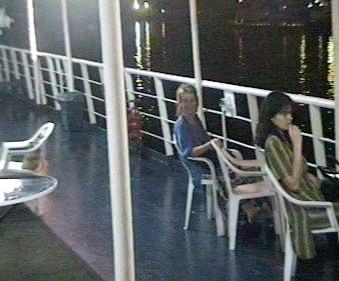
It was warm on the upper deck. Turkish music was playing. A can of beer cost $2. We had a drink in spite of the price. When buying the tickets we'd arranged to pay for places in the communal saloon but get a four-berth cabin. And so it proved. The loo and shower are off the corridor, but the loo's always shut and the shower is very awkward. We went to bed early. We'd only just fallen asleep when we heard, “Stop engines! Lower the boats!” And sure enough they lowered the boats and the crew left the ship. Well, we'd got there at last. The Titanic, basically. It turned out a young woman had got drunk and jumped overboard, and they were trying to catch her. The dip brought her to her senses fast and she began shouting at the top of her voice. They got her out despite the storm. Afterwards she sobbed out in the corridor for ages and swore at the crew for taking so long to rescue her.
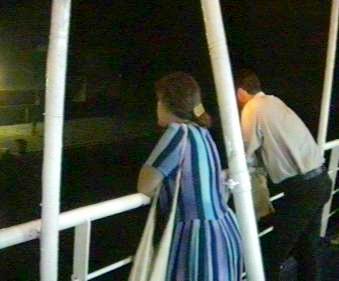
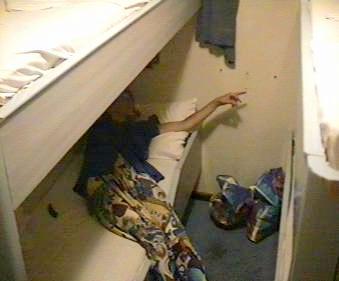
Day 6. Thursday, 5 August 1999
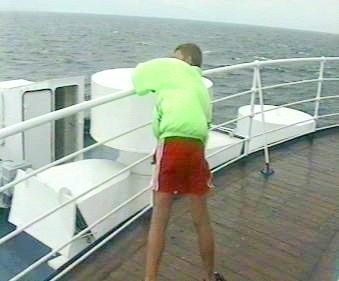
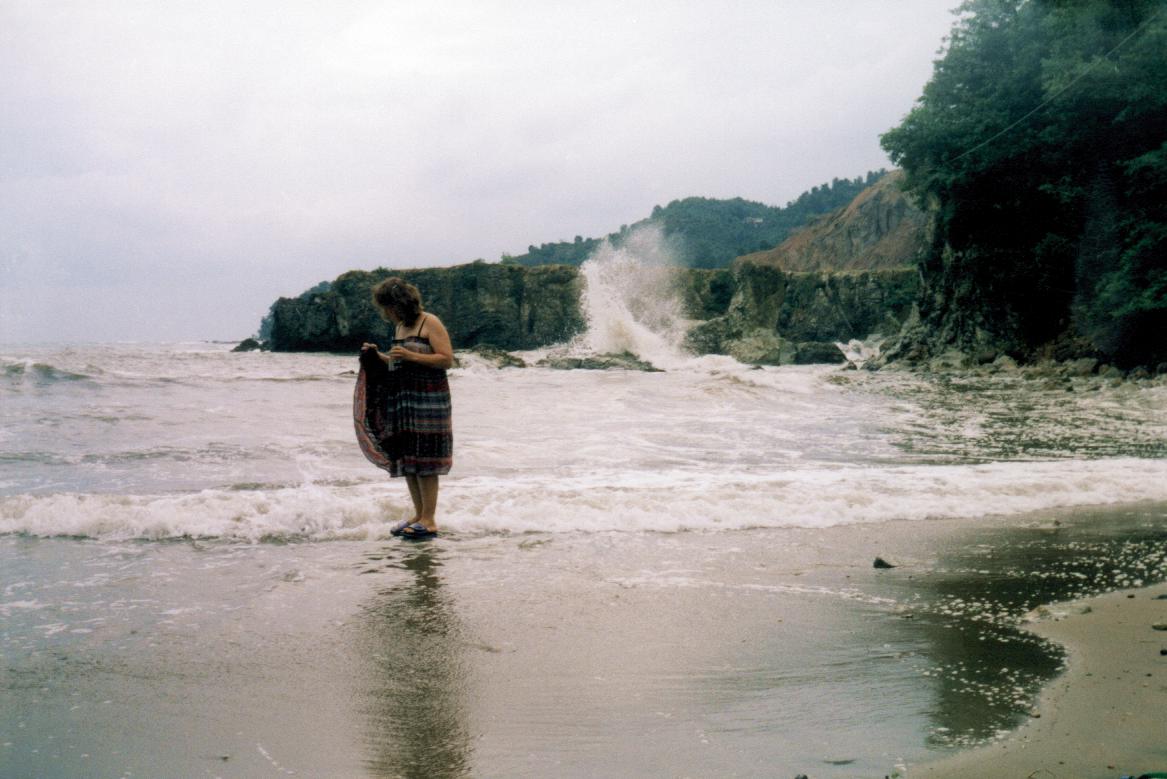
In the morning a storm was raging outside, with driving rain and a hard wind. No more sitting on deck. Everybody was discussing the fishing expedition for the young woman in the night. No shore in sight yet, but the satellite navigator said 21 km/h and forty kilometres to Trabzon, and it was right. At the appointed time the Turkish shore appeared, high mountains with houses all over them. We went into the harbour behind the big breakwater, docked quickly and drove off. So here we were abroad. First you buy a $10 stamp, stick it in your passport and go through passport control and customs. Then you go round several offices. It turned out that even here nobody knew Russian, but you could make yourself understood in English. They asked a heap of questions and filled in forms. Interestingly it was all done by hand, with no computers. In each office they welcomed you like a best friend. Every official seemed proud to be helping people. You could tell at once it wasn't Russia any more. Then came the vehicle search. They couldn't really be bothered, but the law is the law. They opened the boot and there were the same old cooking pots. It reminded me of the Russian customs man's grin and Zadornov's joke about the bushes for the bathhouse. We had a long conversation about pots, after which there were no more questions. I paid $30 for the car. Turkish lira would have been better, but you couldn't buy any there. They gave me a blue sticker for the windscreen and opened the barrier. Ahead was a narrow street jammed with parked cars and No Stopping signs from end to end. The rules don't inspire much reverence here. There was nowhere to put the car, but then we spotted an open space that didn't seem to have a sign. We got out to eat and ask about the Iranian consulate in Trabzon. We had a lead. We found a Russian woman who lived there and asked her. She said we wouldn't get a visa but rang the consulate just in case. The answer was categorical. No, at any price. A disappointment. The Iranian consul, incidentally, had been born in Soviet Azerbaijan and knew Russian. We went back out onto the street rather downcast, but there were people waiting for us. News of a car from Saint Petersburg had already spread. Local men, in the purest Russian, started offering food, petrol, a tour of the town, accommodation and a change of money, and warned us we couldn't park here and might be towed. There were Russian signs all around. We couldn't shake off our benefactors. As persistent as shell-game operators. I had a bad feeling. We changed a hundred dollars. No trick to it, but they still wouldn't leave us alone. All we could do was jump in the car and go wherever our eyes took us. We'd known Turks spoke Russian, but not to that extent. We tried to lose the prospective hoodlums. On the highway towards Samsun, the driving was no harder than in Saint Petersburg, but everyone all around was honking and flashing their lights. I tried to see what I was doing wrong, and then noticed they all honked at everyone. Grey weather and drizzle, a storm at sea. Trabzon ended and one town followed another. We stopped in one and went looking for food. We looked for ages and couldn't find anything. Cola and tea everywhere. When we finally found food and asked for it in Russian, they didn't understand a word. No English either. We weren't ready for that. Ten kilometres back everyone had spoken Russian. By means of monkey language we got ourselves understood somehow. The prices seemed high; we weren't used to them yet. We ate modestly for 1.5 million lira and attempted to bargain, successfully at that. Thank goodness numbers are written much the same way by most people. It was soon getting dark. We wanted to camp by the sea, but the shore was rocky and the road ran along the water's edge. There weren't any campgrounds in sight, at least not to our eyes. There were splendid cottages, but we didn't even dare ask what they cost. It was quite dark by then, and tempers were fraying, when our luck turned. We saw a turnoff to the sea. It was raining and muddy everywhere. I was afraid to drive down in case we couldn't get back out. I ended up parked right on the beach, two metres from the sea. Nobody about and the car out of sight. All well (40°57.461′N, 38°36.322′E). The spot for the tent was poor, among blackberry brambles, with rubbish all around. There is more dirt and roadside rubbish in Turkey than at home. Scratched and full of blackberry thorns, we put up the tent. We didn't bother with a fire, but went to have a swim. The sea was in a storm. In the end I was the only one to go in. We fell asleep at once.
Day 7. Friday, 6 August 1999
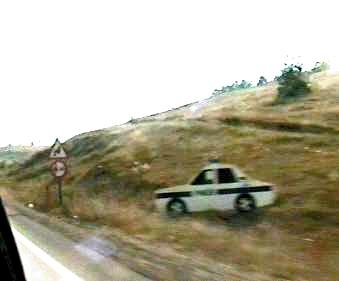
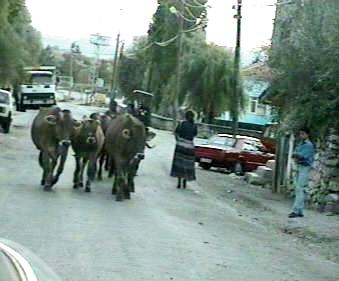
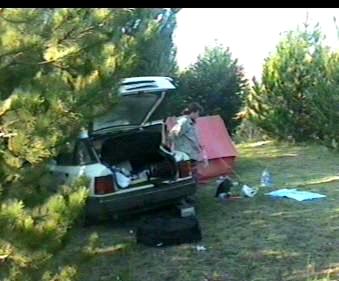
I woke in the morning. Outside it was cold and raining. So much for Turkey. Weather straight out of Saint Petersburg. Stomach aching, and I could feel a fever. I ran for the bushes. They were prickly and wet. It felt like a bad intestinal infection. That was that, we were done for. No health insurance, but plenty of pills. We'd prepared for the worst. I couldn't drive in that state, so Lena took over and I lay on the back seat. Outside were high mountains tumbling down into the sea, though they didn't look like Crimea. There weren't many outcrops, and when we saw one it was a great spongy lump of solidified lava. We tried to find an immersion heater we could run in the car. Nobody had heard of such a thing. They all sent us to the Ford station, where nobody had heard of it either. In the course of the conversation it turned out they'd never seen a Ford Scorpio before. A new one is terribly expensive in Turkey and it isn't usual to import old cars. All of this in Turkish. Nobody knew Russian, and at best they knew a few words of English. The weather improved. The sun came out and it got hot. Near the Yeşilırmak delta the mountains drew away and we were on a perfectly flat, ploughed plain. A railway came alongside. We arrived in Samsun. I had to take the wheel back. Lena was nervous about pulling away on the steep slopes; her Volvo has an automatic. Driving through town was a fierce business. Narrow roads and horses everywhere. With difficulty we squeezed into a space and went looking for a guidebook and phrasebook. Time to learn Turkish in a hurry. It was hot and I felt terrible. I could hardly walk and didn't dare eat. We found a phrasebook, but no guidebooks. They said we wouldn't find any before Ankara. The ancient capital of the Hittites lay ahead, but we didn't know where. There was nothing to see in Samsun, a new, modern city. I'd expected a fine climb through the mountains, but there was nothing interesting. The plain with its little hills sloped up, and we went on across the same sort of plain, only at nearly a thousand metres. All around us it was ploughed. The traffic was lively, people doing about 100 or 110. A few dummy police cars stood about to keep people in line, and occasionally there was a real one. Oncoming traffic flashed its lights, but they loved flashing and honking, so it was hard to know when it meant there were cops ahead, or rather the Traffic Police. The road was quite astonishingly monotonous. We tried to find the Hittite capital and found nothing of the sort. We ended up by some little village near Alaca, with a museum for 1.5 million lira. Cows wandered in the road. We bought a watermelon. Things went better with the phrasebook, especially for Lena. We found a camp on the shore of a reservoir in a planted pine forest (40°13.845′N, 34°47.467′E). Very few trees and terribly dry, but you could pitch by your car and light a fire. So we did. Towards evening I came round. My stomach was still a mess, but my head cleared. We lit the fire, shared a bottle and cooked soup. Life was good, all in all. The southern sky was already above us: Corona Australis, Telescopium, Ara. A car drove nearby and stopped beside us. Out got a man in camouflage with an automatic rifle, who worked the bolt and began speaking a lot of Turkish very fast. His uniform said Jandarma. We tried English. To our surprise he spoke it quite well. This wasn't Russia, where the army is the least educated layer of society. When he at last understood we weren't having him on and really came from Russia, and saw the passport, his eyes broke into a smile. He shook our hands and apologised, calling us arkadaş, which means friend. Then he quietly took off. It did leave everybody rather on edge.
Day 8. Saturday, 7 August 1999
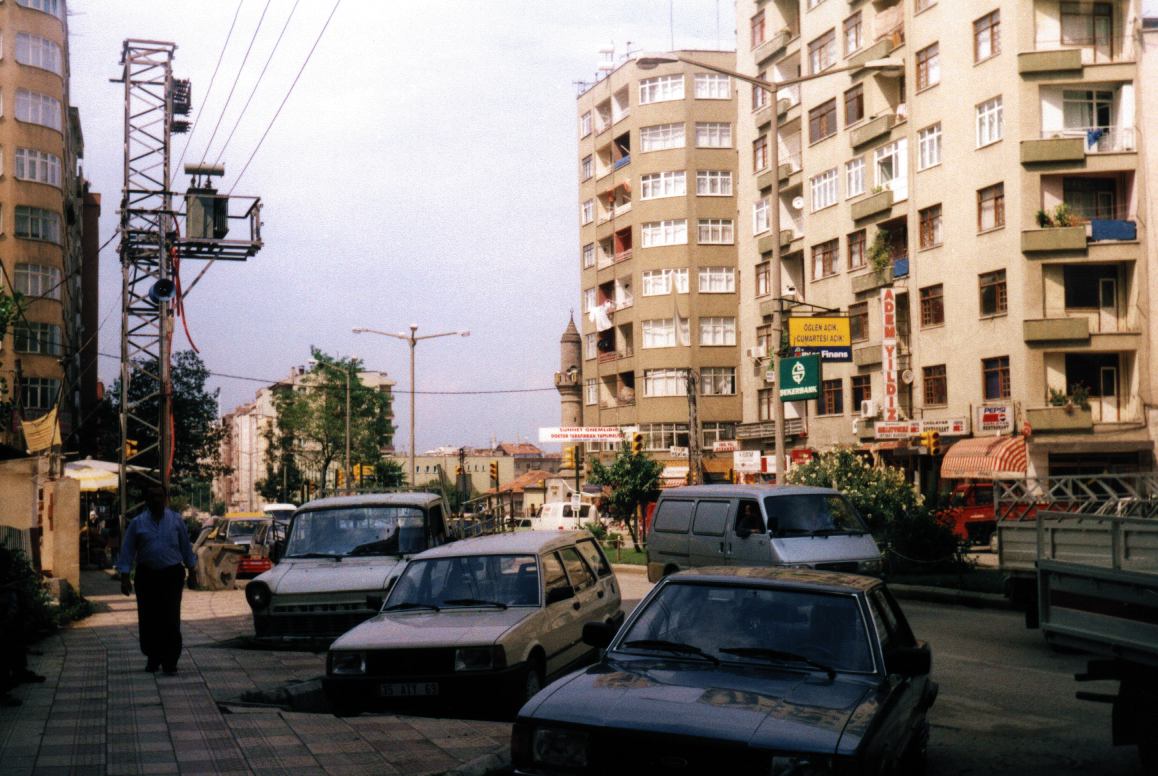
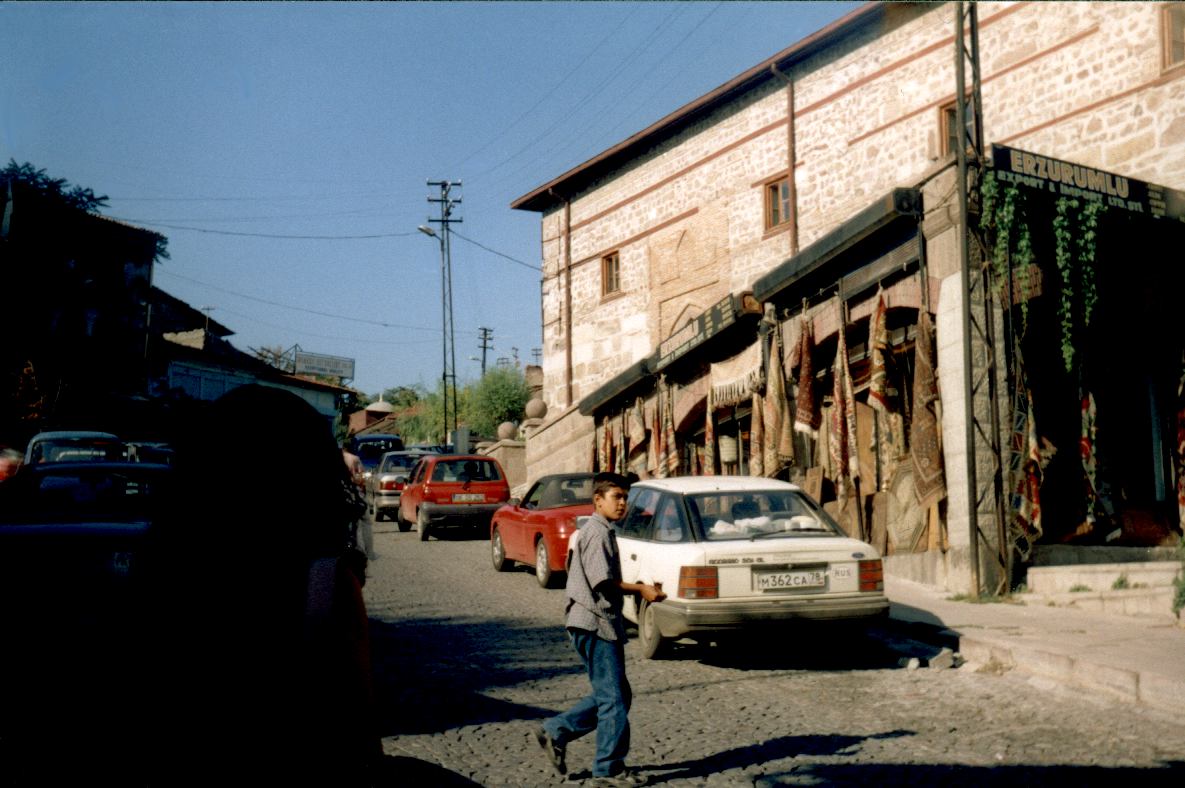
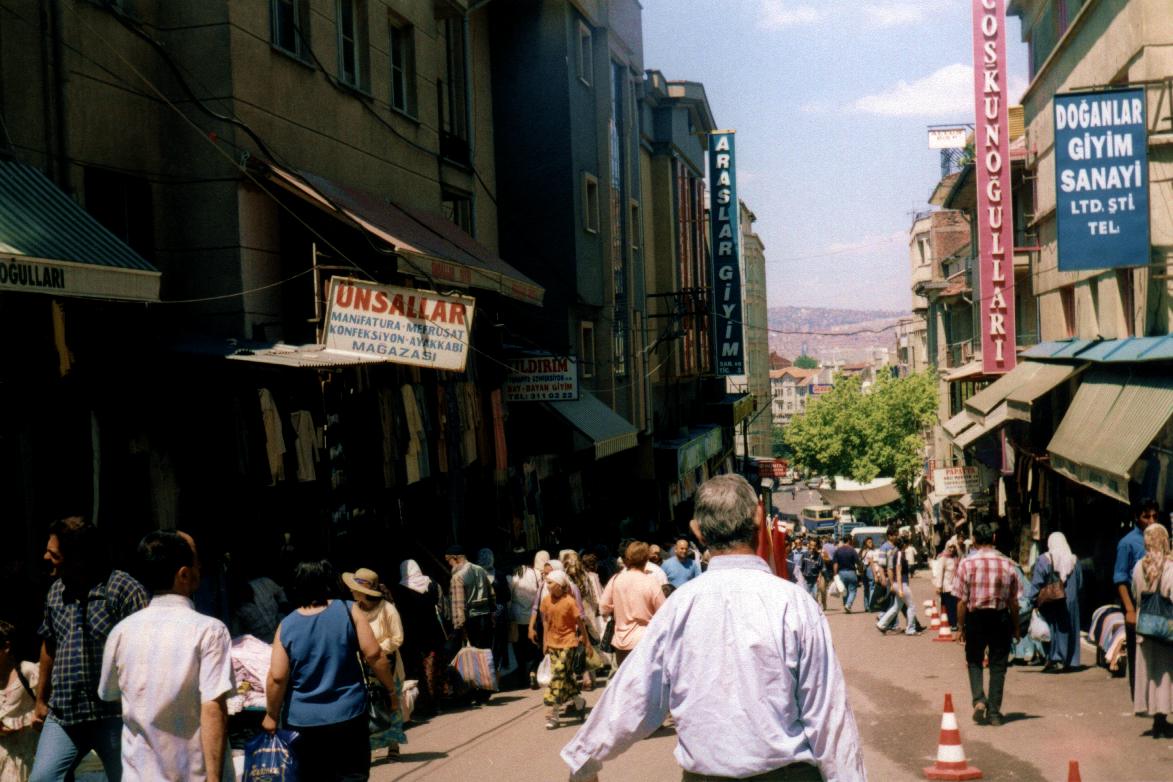
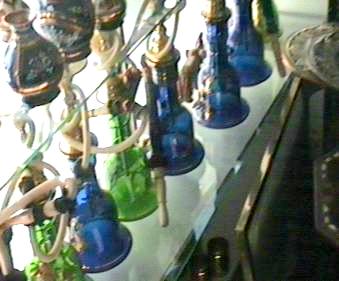
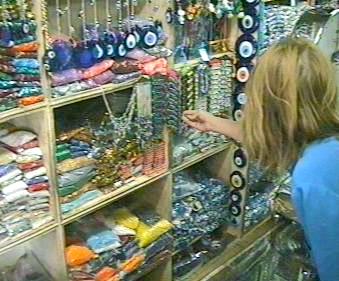
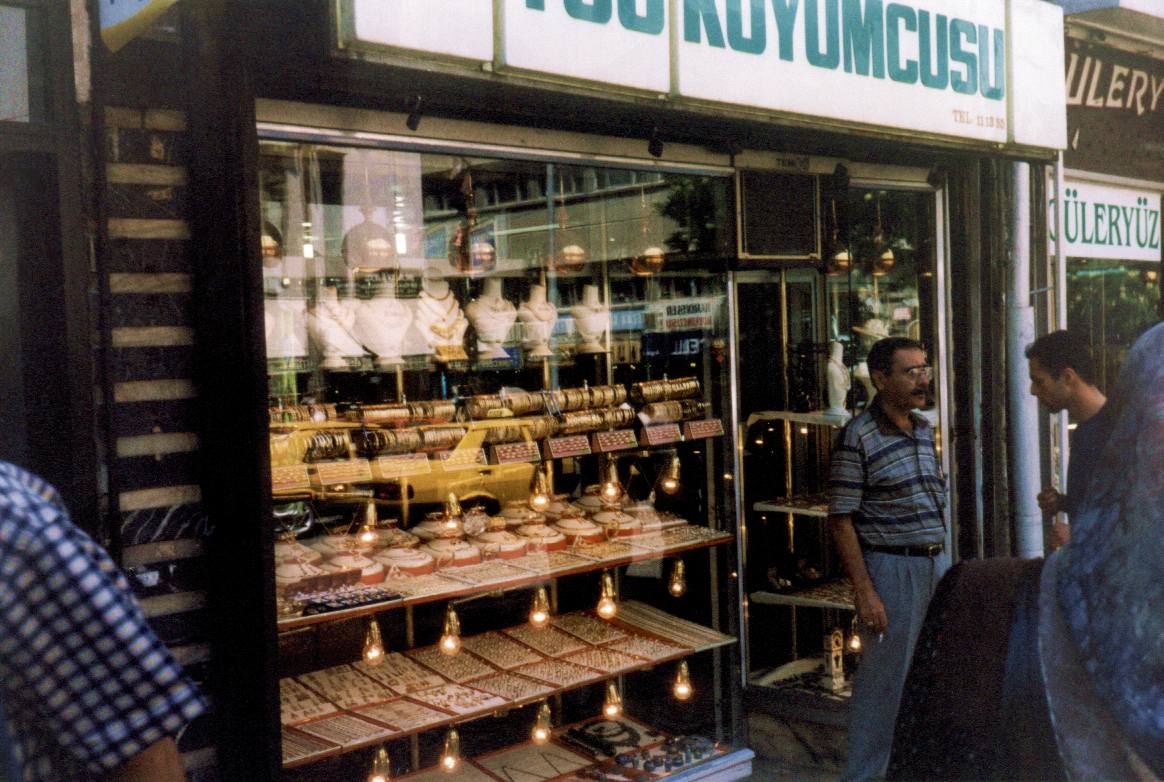
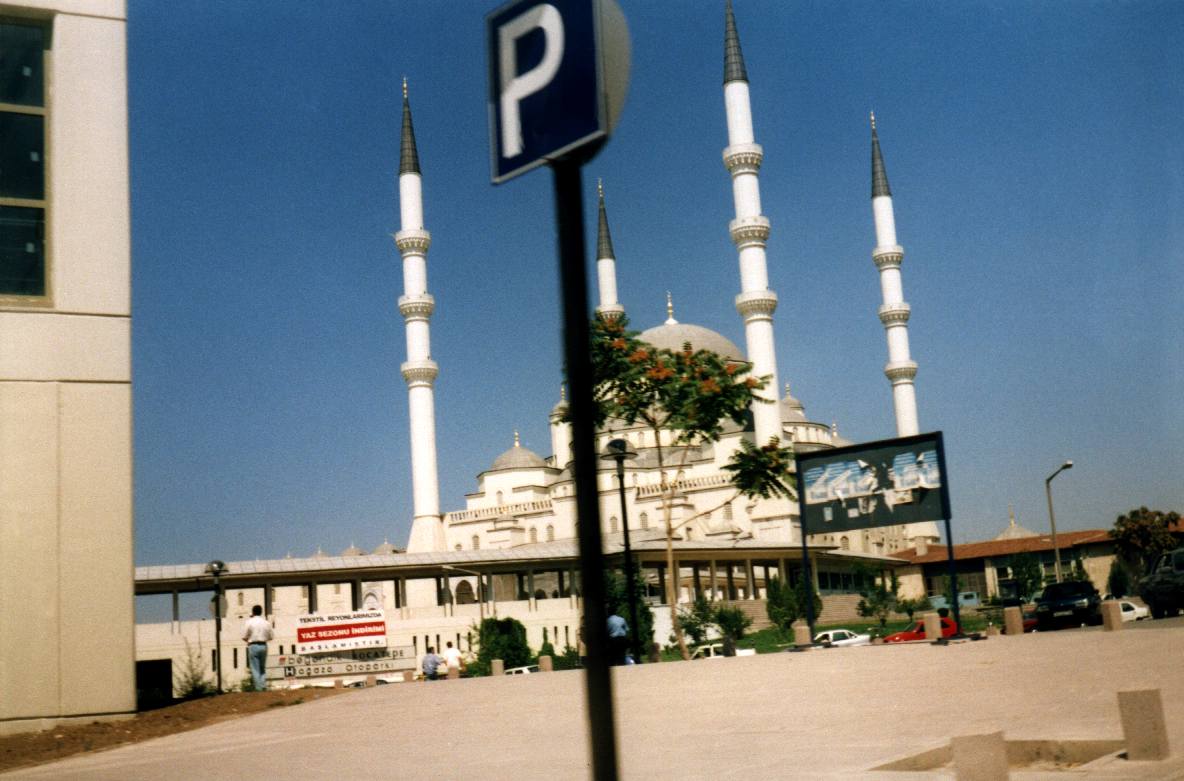
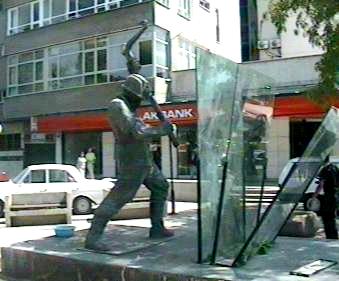
At last we slept our fill. My stomach hadn't put itself right yet, but it was much better. Off to Ankara. More and more cars, then interchanges on several levels. I looked for the centre by instinct and found it as best I could. Parking trouble again. I got the car into a narrow, steep little street near Ankara Castle. A shopkeeper immediately came out to protest and try to sell us at least something. I said I wouldn't be long, and he left us alone. We walked round the nearest shops. Small places with partly handmade wares, quite colourful with their hookahs, ceramics and beadwork. The jewellery shops all looked the same, slick and boring. Tanya made straight for the sweets. We tried to find the Iranian embassy and shops selling maps and guidebooks. Everyone said the main shopping district was Kızılay, a long drive. We tried to set off, but the entire street was blocked. A traffic jam in front, a horse behind, and a thirty-percent slope downhill. Good-natured locals shouted and waved their arms, trying to clear the jam. Even a man who could speak Russian turned up, the first and last one we met in Ankara. Good Lord, it was hard. The horse behind couldn't back uphill. In the end I squeezed between a Merc and the horse and gave the horse a slight nudge. No harm done. In about ten minutes we broke free. At every junction we asked the drivers beside us for Kızılay, and got there quickly and without trouble. I parked on the pavement under a No Stopping sign. Other people seemed to have done the same. With luck I'd get away with it. There was a bookstall nearby and lots of cafés, even an internet café right in front of us, and a statue of a man breaking a pane of glass. Lena went to make a call while we wrote a postcard. Making a call in Turkey is simple. Almost every shop has a telephone with a digital meter. When the call ends it shows how much you've spent. It's noticeably cheaper than an international call office. They have a telegraph but nobody uses it. The post is worse still. Even in large cities you have to explain what a postcard is, and they offer you all sorts of phone cards. In the end the card from Ankara took three weeks. We did get one fairly quickly in Ankara itself. We bought a guidebook, though it was in Dutch. No luck with a map of Ankara. Now for the Iranian embassy. Our landmark was the Karum, a large round building and shopping centre, near the Hilton. We found it quickly but searched for the embassy for ages. There are a lot of short crooked streets with no names. You don't need an address in a place like that: Karum, Iranian embassy, that's it. The embassy was fairly large and there was an open window you could speak through. The man there spoke English and was polite, without being unfriendly. We told him our rehearsed story: “We need a transit visa for Turkmenistan.” He wanted to see a Turkmen visa. We insisted we didn't need one as CIS citizens. We later found the Turkmen authorities had introduced visas after all, the swine. The man promised to speak to his supervisors and gave us forms to bring back tomorrow with photographs. They took five days to consider them. The embassy is open daily, I should add. We happily went to get photographs and photocopies of our passports. No trouble there. The early southern evening was approaching. At seven-thirty it was pitch dark. The cheapest hotel we'd seen was $50 for the three of us. We could look out on the edges of town, but decided to get farther away and camp in the national park north of Ankara. The road was excellent and I drove fast, nearly 200. It parallels the motorway to Istanbul. We drove to Kızılcahamam, turned left and pitched beside the little Koca stream (40°23.961′N, 32°37.625′E). Planes were taking off above us again, this time from Ankara airport. We lit a big fire. The night was surprisingly cold, around fifteen degrees. We warmed ourselves by the fire discussing the prospects of Iran. It looked as though we wouldn't fit it in.
Day 9. Sunday, 8 August 1999
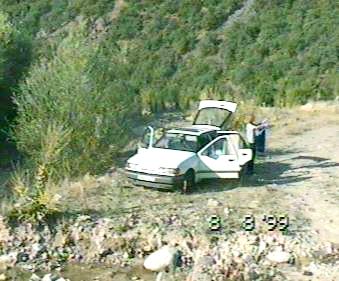
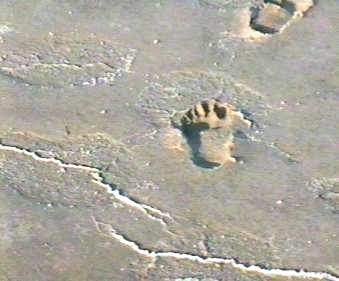
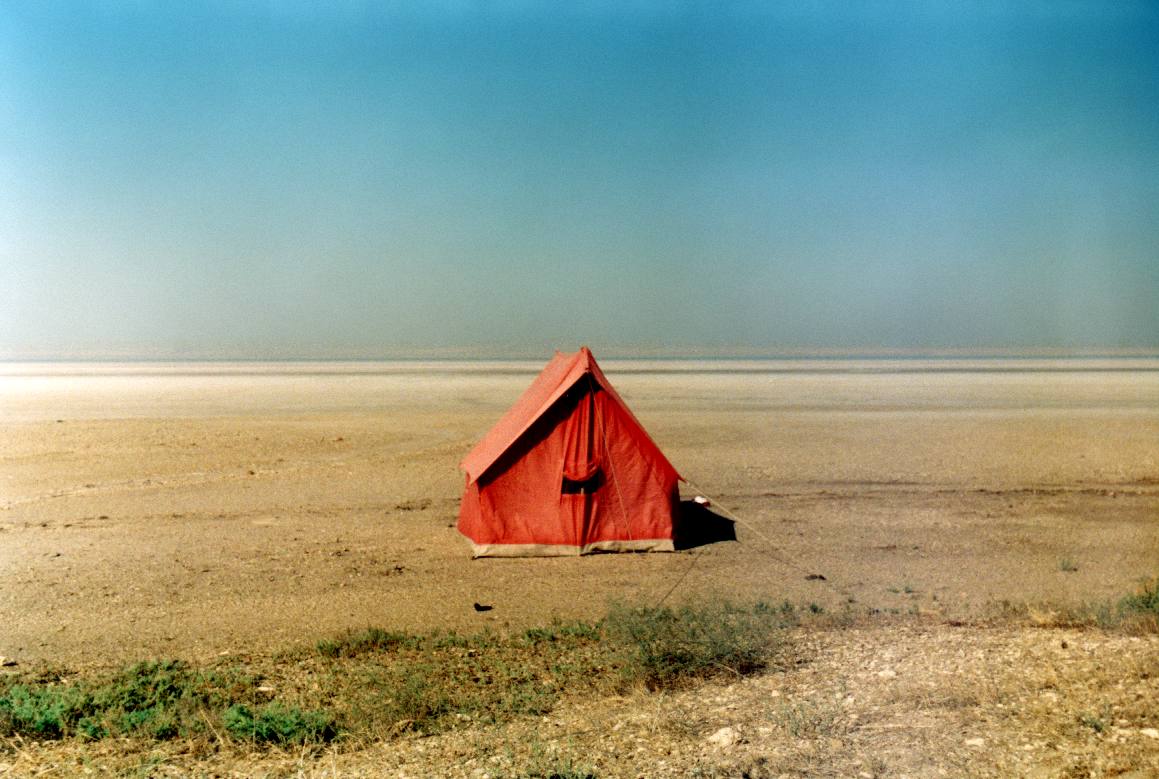
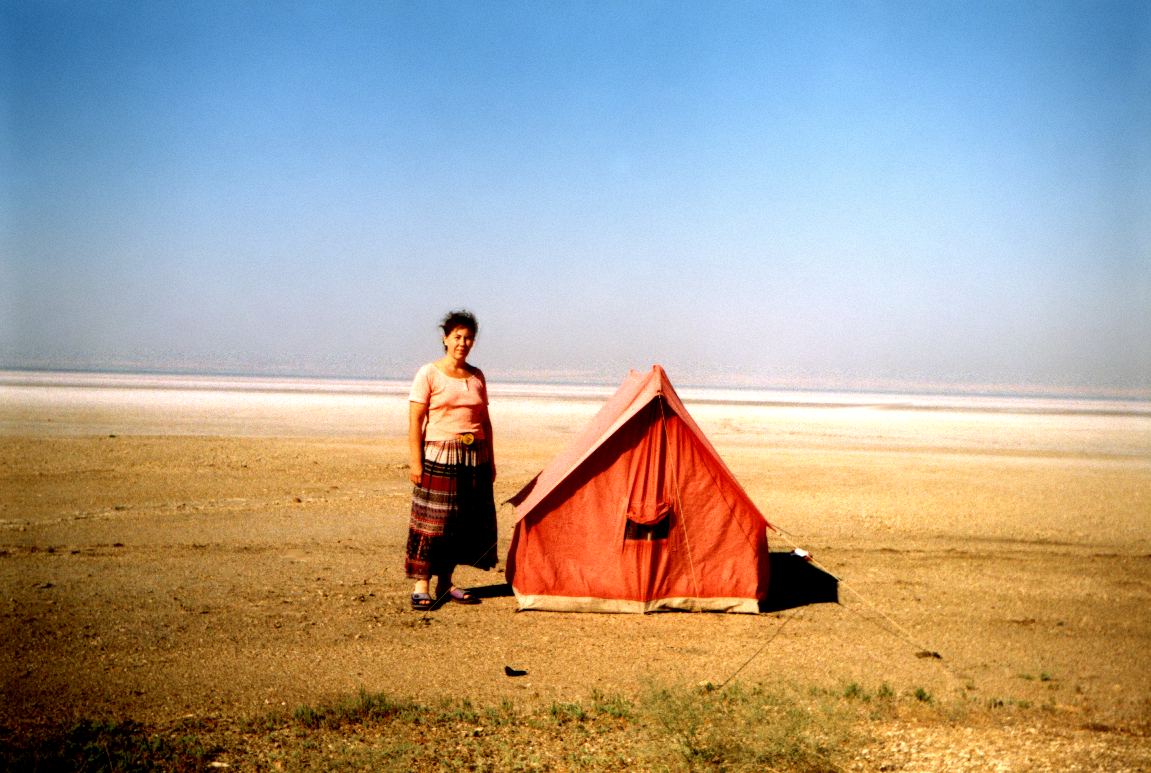
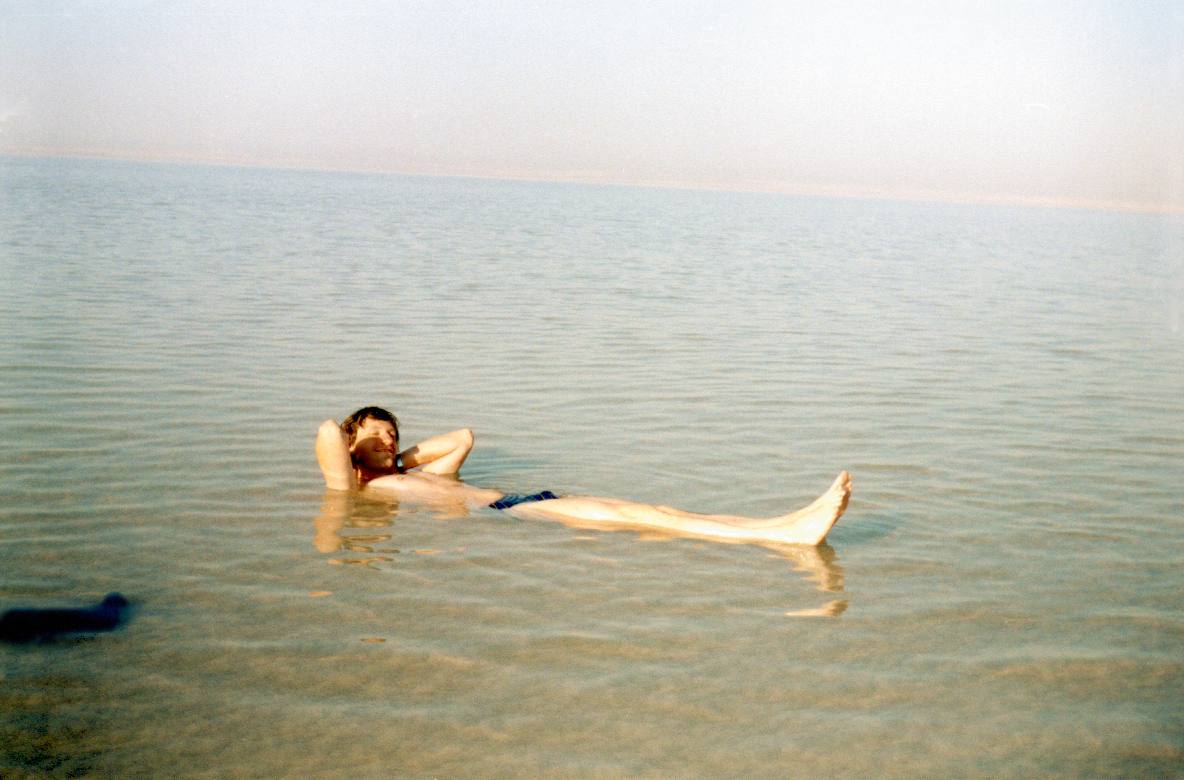
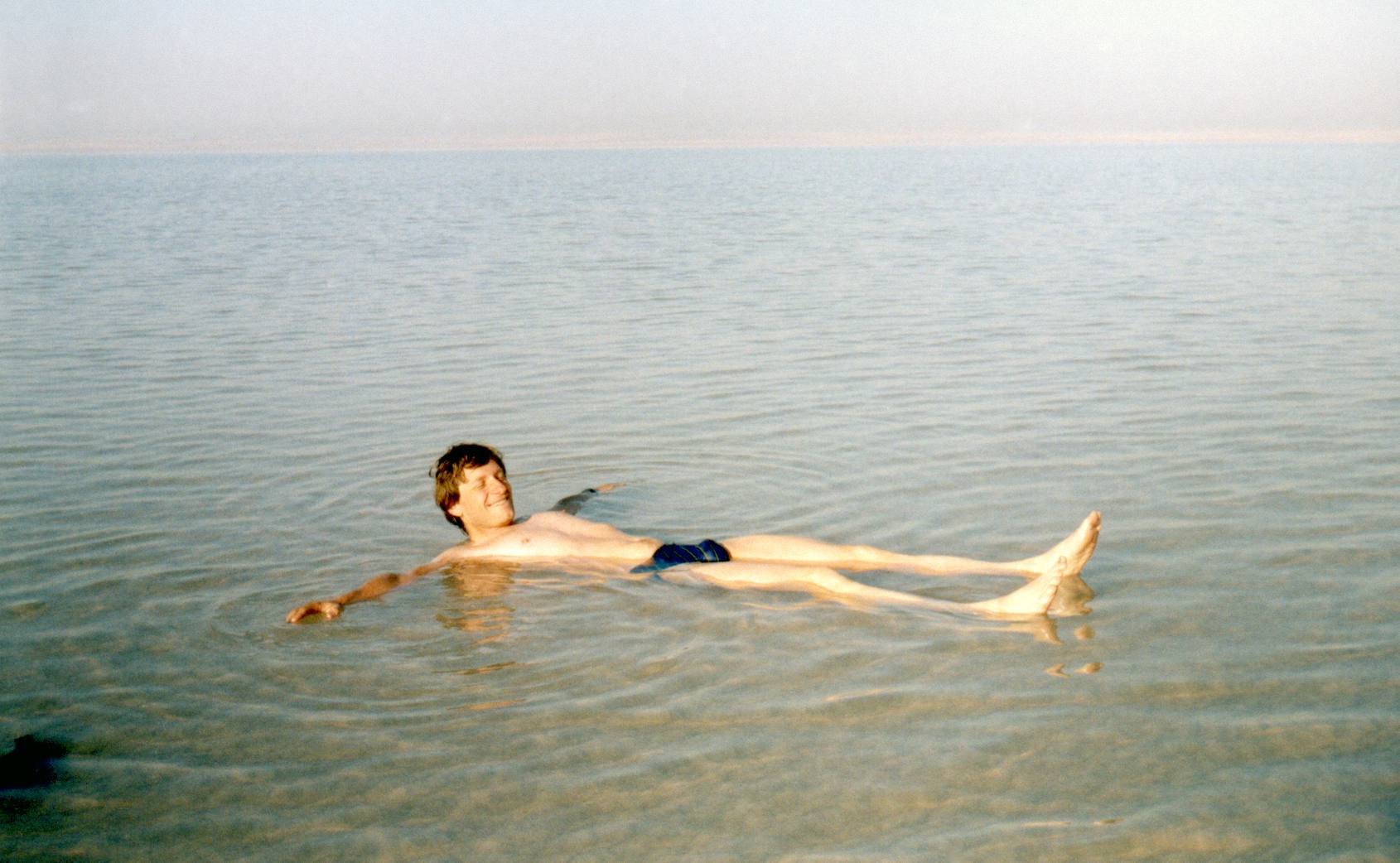
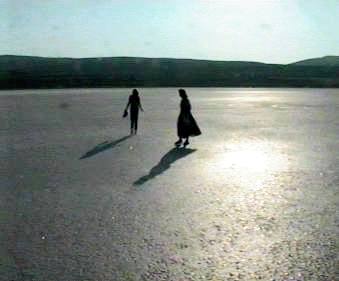
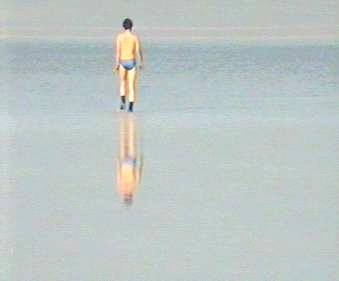
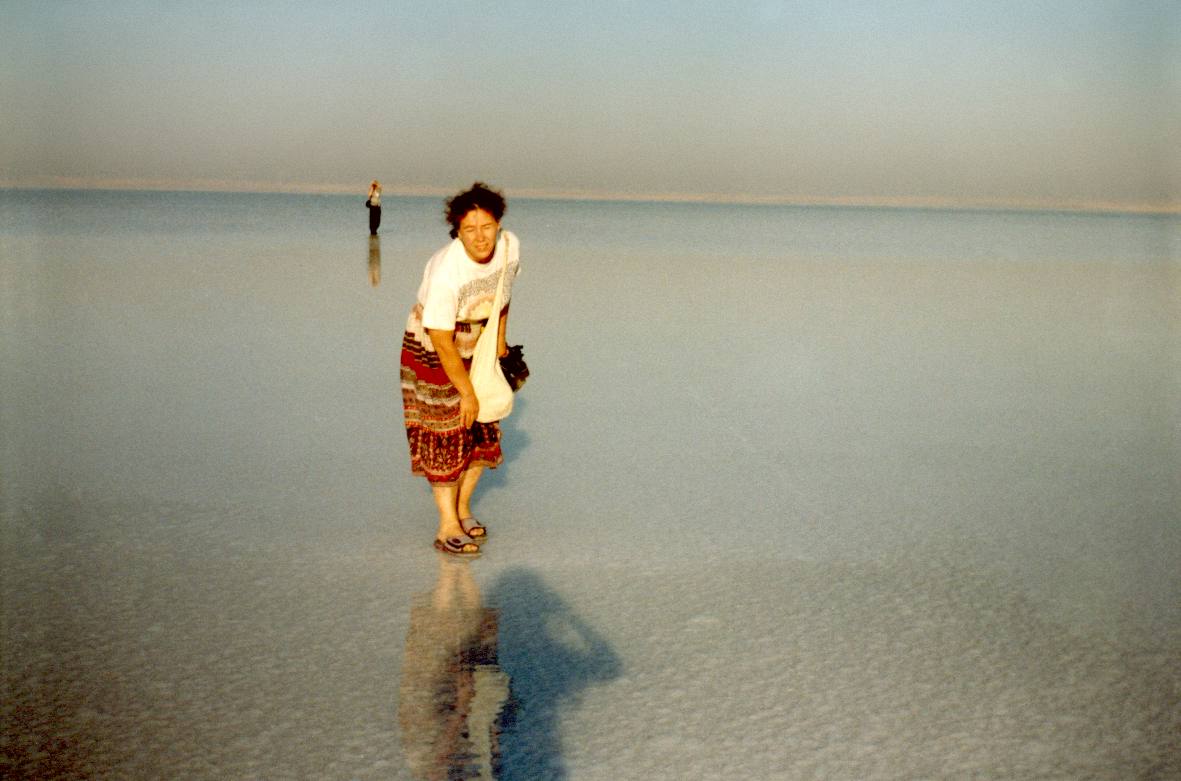
In the morning we washed our hair and the car and went straight to the Iranian embassy. The guard looked at our papers, phoned the consul and let me speak to him. Again the consul wanted a Turkmen visa, or, without one, a recommendation from the Russian embassy. If we could get that, he'd authorise the visas. My spirits sank at once. I didn't expect anything good from the Russian embassy. We went all the same. It occupies a whole block and looks like a besieged fortress. The fence isn't especially high, but there's a lot of barbed wire. Unlike at the Iranian embassy, there's nobody to talk to. Just an intercom button. I pressed it and got the immediate reply, “Whaddaya want?” The tone took me straight back to the Big House, the security headquarters in Saint Petersburg, before perestroika. The same insolent secret police voice. I explained the problem. The consular section sees people on Mondays, Wednesdays and Fridays, he said. He knew nothing about anything now, and hung up. The prospect of waiting in dull Ankara till Monday, then spending several days dealing with Russian officials, didn't appeal. We were already short of time. We hung about by the embassy hoping to find someone for an informal chat, but nobody came or went. We hadn't gone on holiday for this. Iran had been the most ambitious possibility from the start and we weren't really ready for it. We decided against Iran. There was one other idea: Syria. The man on the ferry had said we could get into Syria without visas. We ought to check, but none of us had it in us to look for another embassy. We'd chance it at the border. We went to see Ankara Castle. I already had a fair sense of the layout, two days and I knew the main roads. Lena was speaking long Turkish sentences by then. We tried climbing the hill. Very hot. Noon. We were still heavily dressed for Muslim standards. I had trousers and a long-sleeved shirt on, having prepared for the Iranian embassy. Inside the walls, when we finally got there, we found a residential quarter. Little prehistoric houses and loads of children flying kites in the streets. We saw a skinny cat and realised it was our first cat in Turkey. People here aren't fond of pets. Cats are few, all skinny and uncuddled. Dogs move like shadows and don't dare raise their voices. If a Turk is walking a dog he might just as well take out a gun and shoot it. They are generally easy about firearms here. Perhaps that's why there's no crime. We saw a small museum. A ticket was two million lira. A shame, as it was such a small museum. We went down and drove to Kızılay, where we went round the shops with determination. Ankara has an underground, it turns out. I looked in and found lots of stairs with no escalators, and passageways. It's a five-minute walk to the train. We had tea in some fancy establishment. It was so strong and overboiled that I could hardly make myself drink it and felt terribly sick afterwards. We had no more business in Ankara and drove south towards Lake Tuz. I breathed a sigh of relief once we'd left the city. Driving there is hard: fast, heavy traffic on steep roads and no regard for the rules. One thing astonishes me: you don't see wrecked cars. Just outside Ankara is a lake with two big fountains in the style of the one in Geneva. The road goes south. People use it to go to the sea on holiday, and traffic is very heavy. All of a sudden a car came right at us head-on. It was trying to overtake somebody. Lena was driving and braked hard. The Merc behind us pulled into the oncoming lane and we went onto the shoulder. The Merc and the overtaking car passed each other in the wrong lanes while the car being overtaken drove onto its own shoulder. Everybody got through. The Merc driver swore at Lena for a long time, though. Lena felt ill afterwards and let me drive. We needed to fortify ourselves and stopped at a sumptuous filling station. It had everything: a pond with goldfish, an infrared automatic flush in the loo, a restaurant, a canteen, a supermarket, a hotel, a GSM relay and so on. An oasis in the desert. We ate our fill and went off to look for a camp. A salt desert appeared in front of us, merging into Lake Tuz. “Tuz” is Turkish for salt. The lake is salty and in summer it virtually dries out. Its bed is made of snow-white salt crystals several metres thick. The water is concentrated brine, ten times saltier than the oceans and thirty times saltier than the Black Sea. Like the Dead Sea. While looking for a place for the night we decided to pitch right on the salt bed (39°03.818′N, 33°25.341′E). A rather unusual camp. It soon got dark. It was a warm night and we'd just eaten, so we didn't light a fire. When the camp was ready I went for a swim, barefoot. It was a little frightening to walk out there. They say you can break through the bed of a dried salt lake, sink into the mud and drown. At first the bed was firm. I even regretted not driving out onto it. A drive on the floor of the salt desert would have been interesting. In places the crust of dried salt gave way, but not far, a centimetre at most. A black southern night. You could see the Milky Way perfectly, including its brightest part in Sagittarius. On the horizon the lights of little settlements and passing cars flickered. I felt perfectly happy and thought how beautiful this world is. At the water the salt crystals turned very sharp, sharper the farther I went. I imagined I was a yogi. I really wanted that swim. I undressed by the water and walked out using the stars to keep my bearing. Every step took a heroic effort, but I badly wanted to go on. I got to where the water was ten centimetres deep and swam. You can't sink in water that salty. At least a third of your body is above the surface. Your centre of gravity is almost at water level, so it's very easy to roll over from your back onto your front. After half an hour of floating I started back. My enthusiasm had gone, and I found it almost impossibly painful to walk. I tried all fours, but my feet still hurt and now my hands did too. It was dreadful, but metre by metre I got out. My feet hurt so much that even ordinary ground was painful. I found my clothes surprisingly quickly. I'd walked five hundred metres from them and then swum, and it was pitch dark. You couldn't see twenty metres.
Day 10. Monday, 9 August 1999
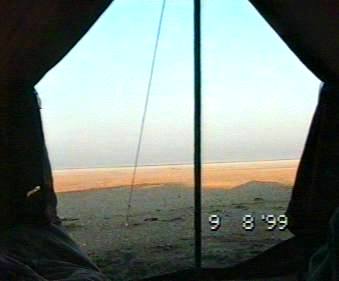
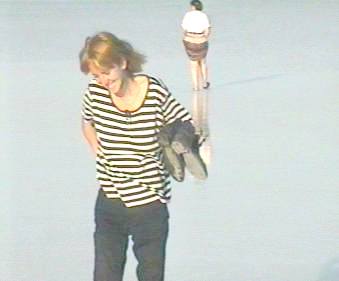
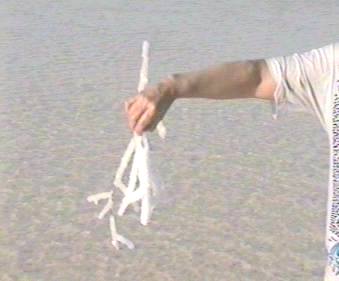
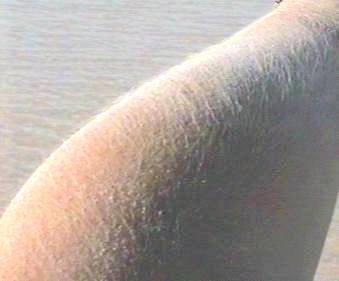
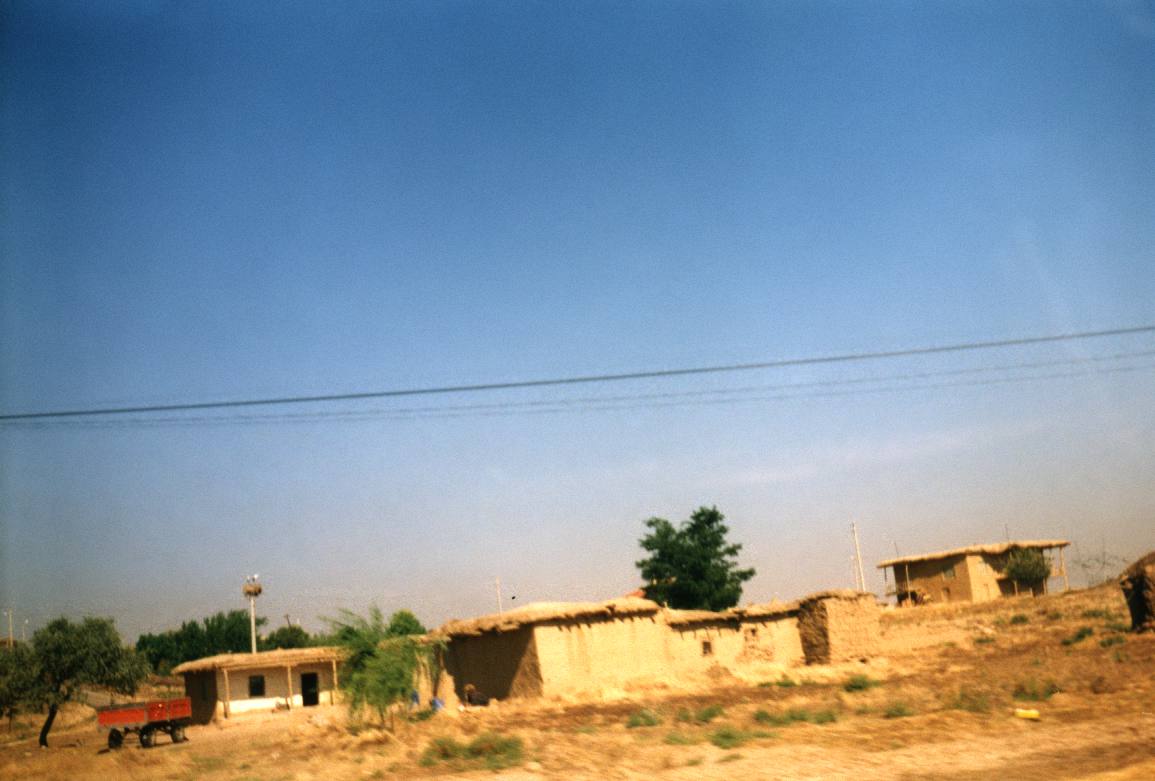
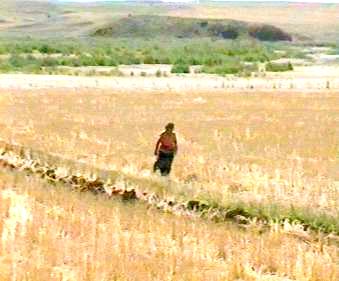
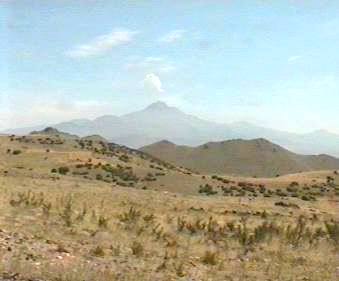
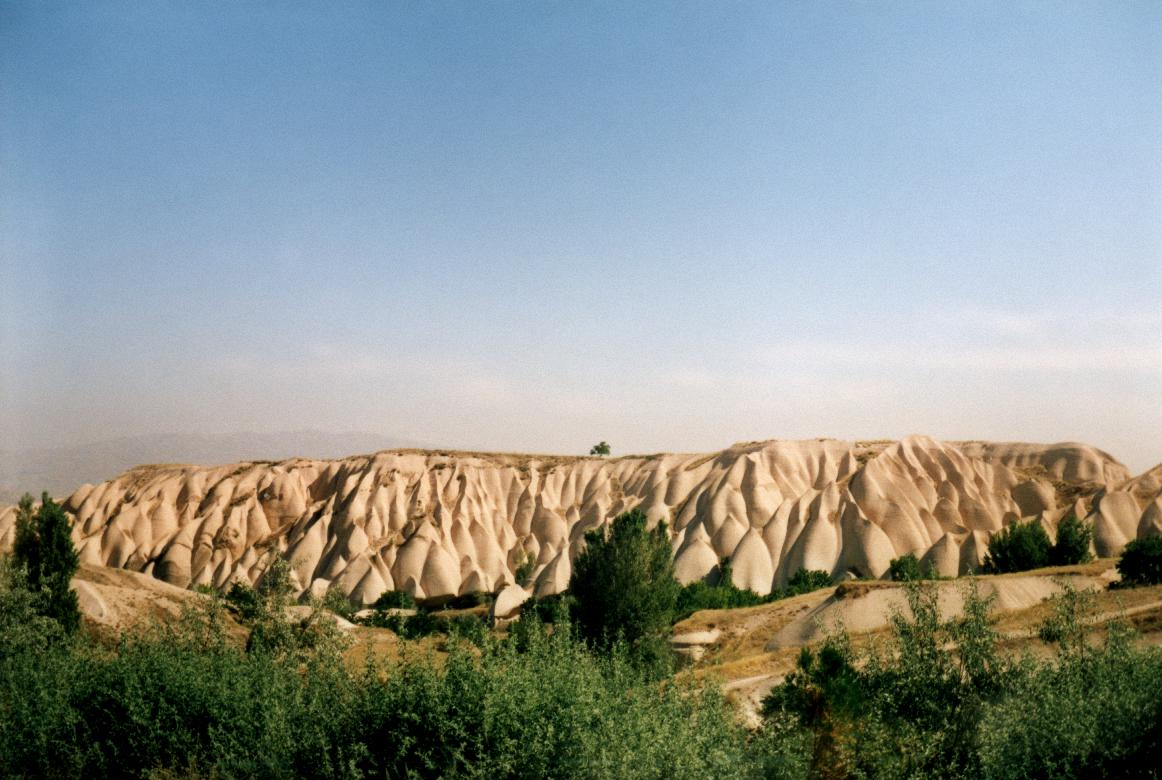
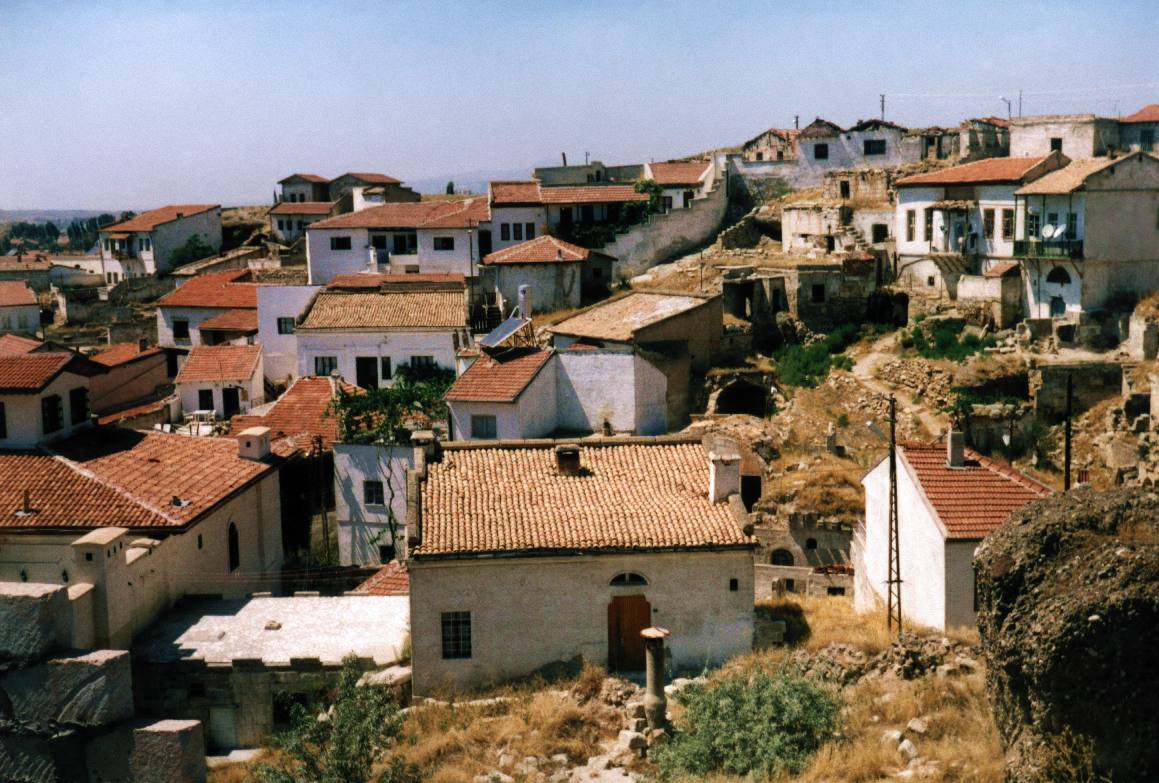
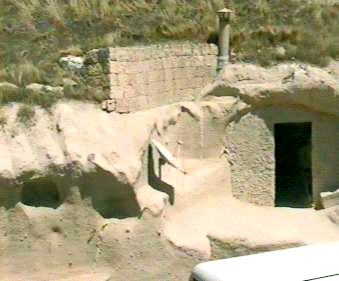
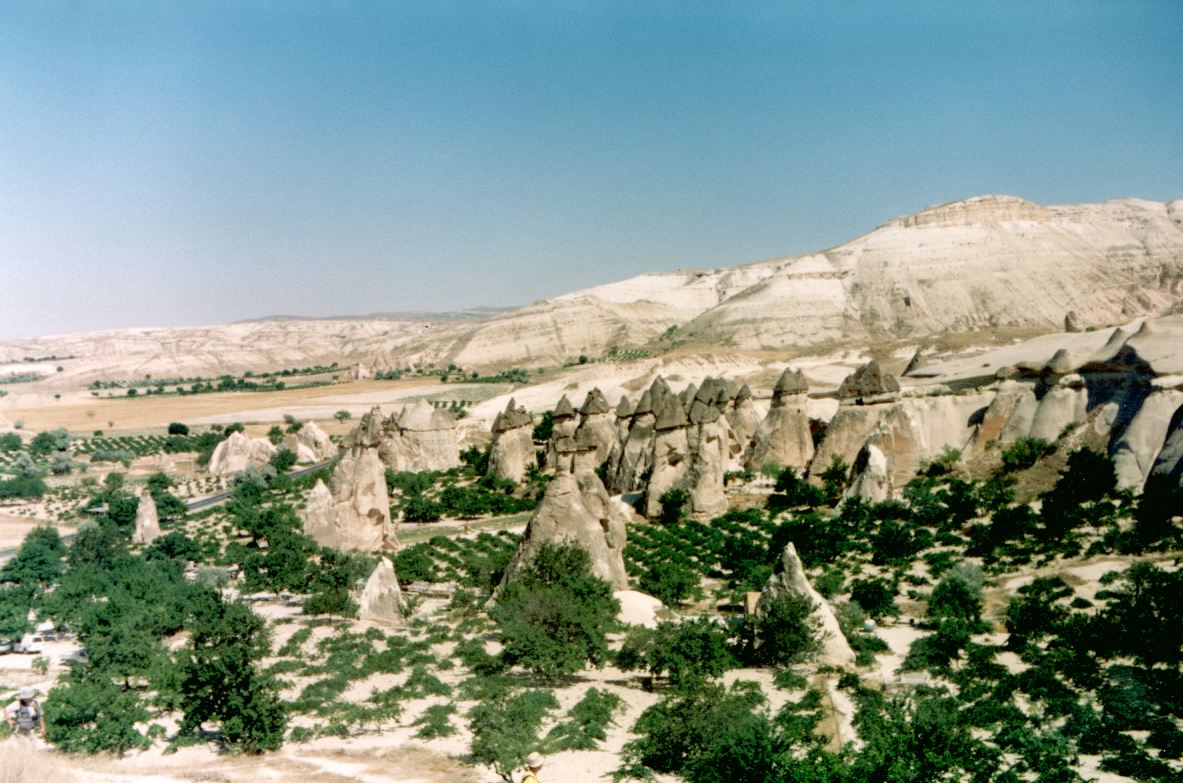
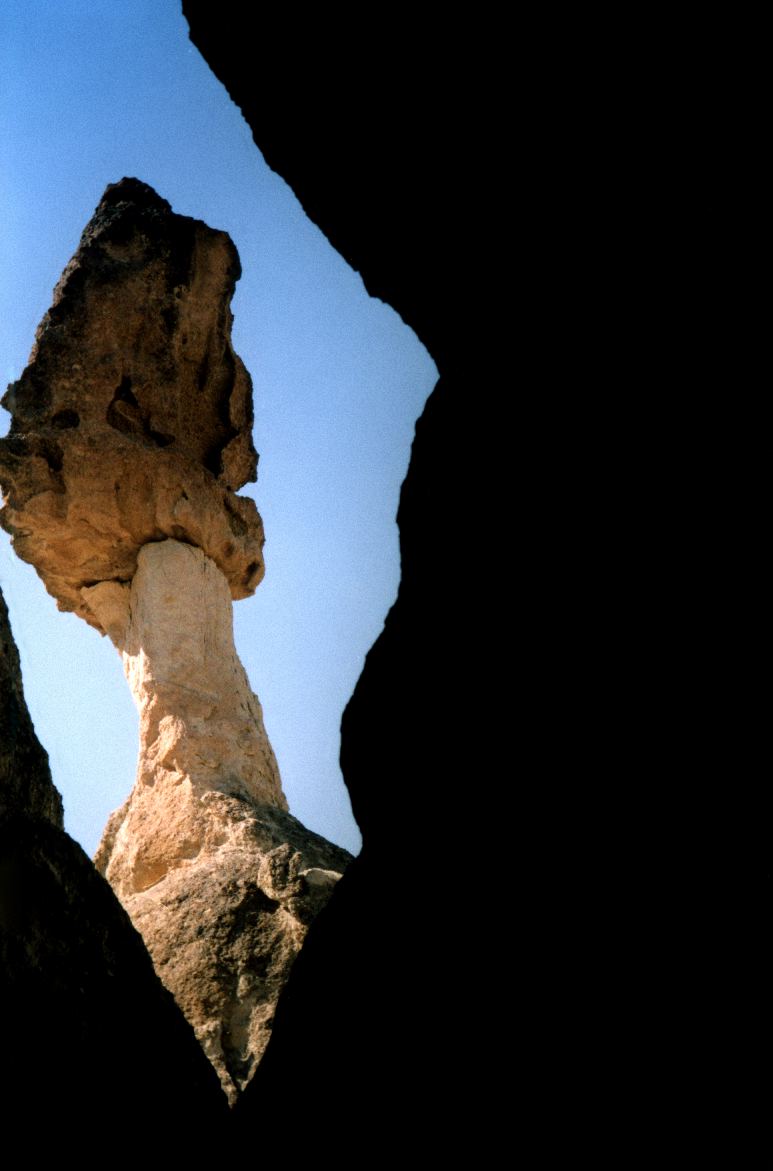
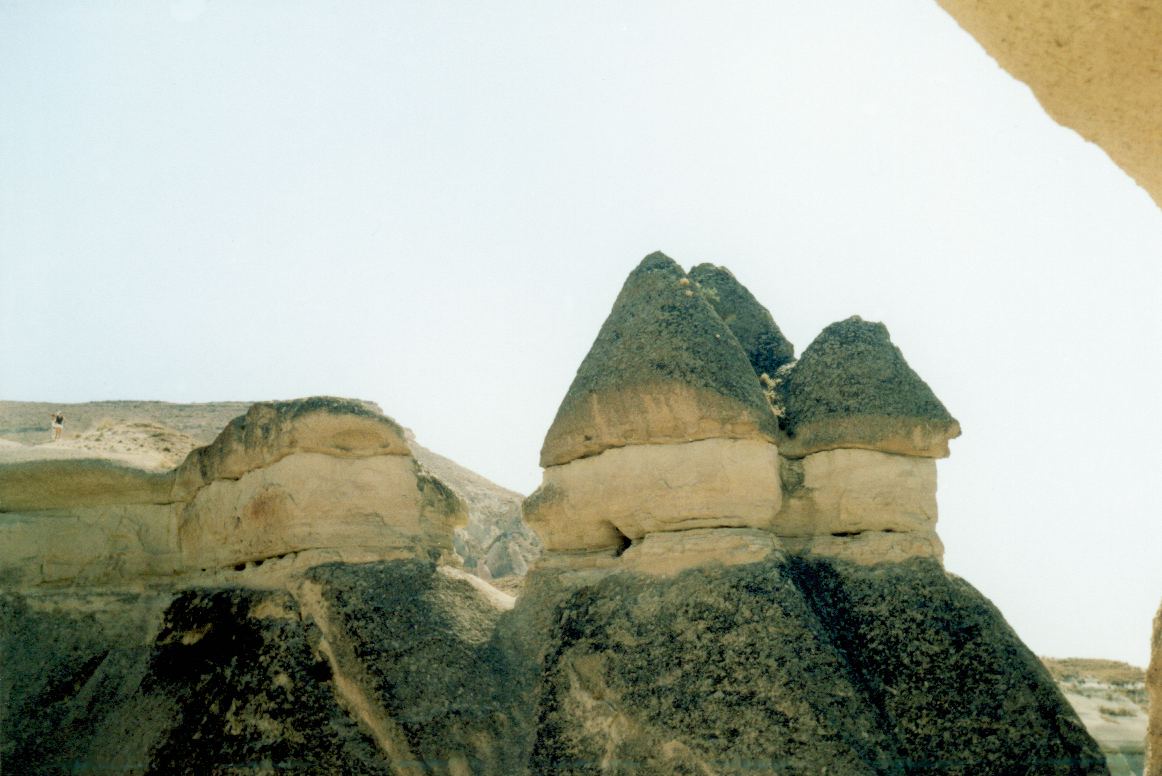
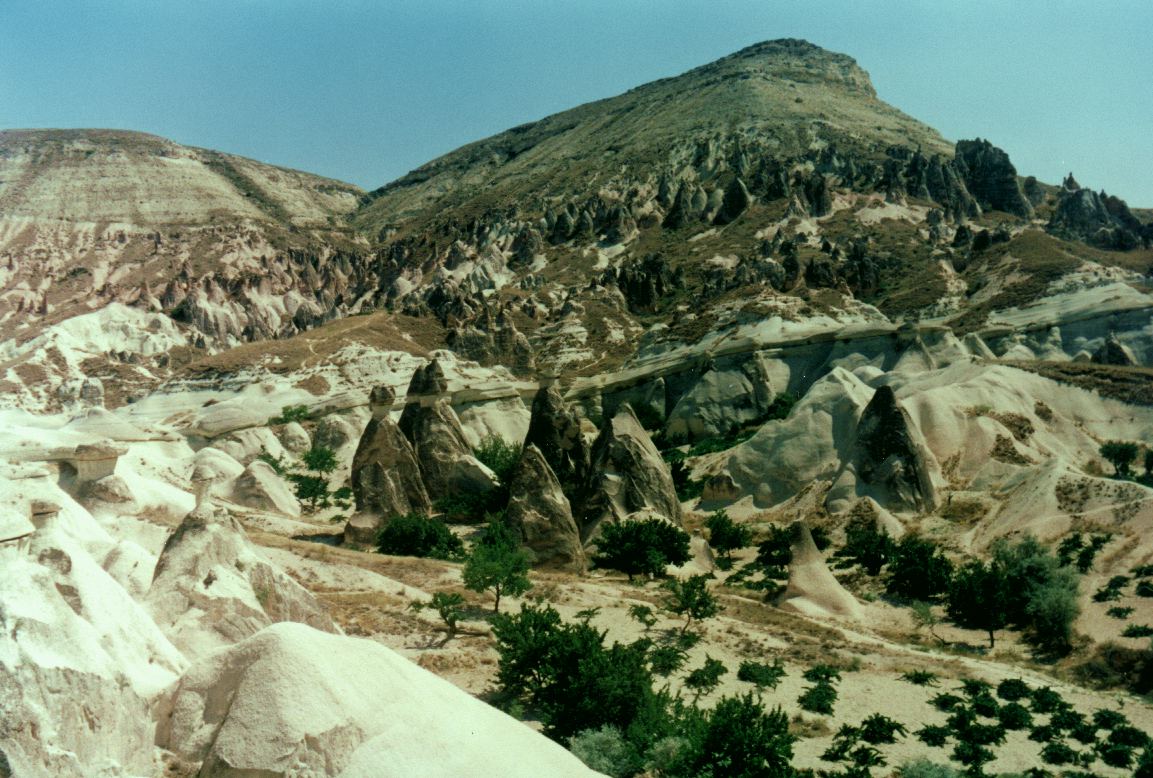
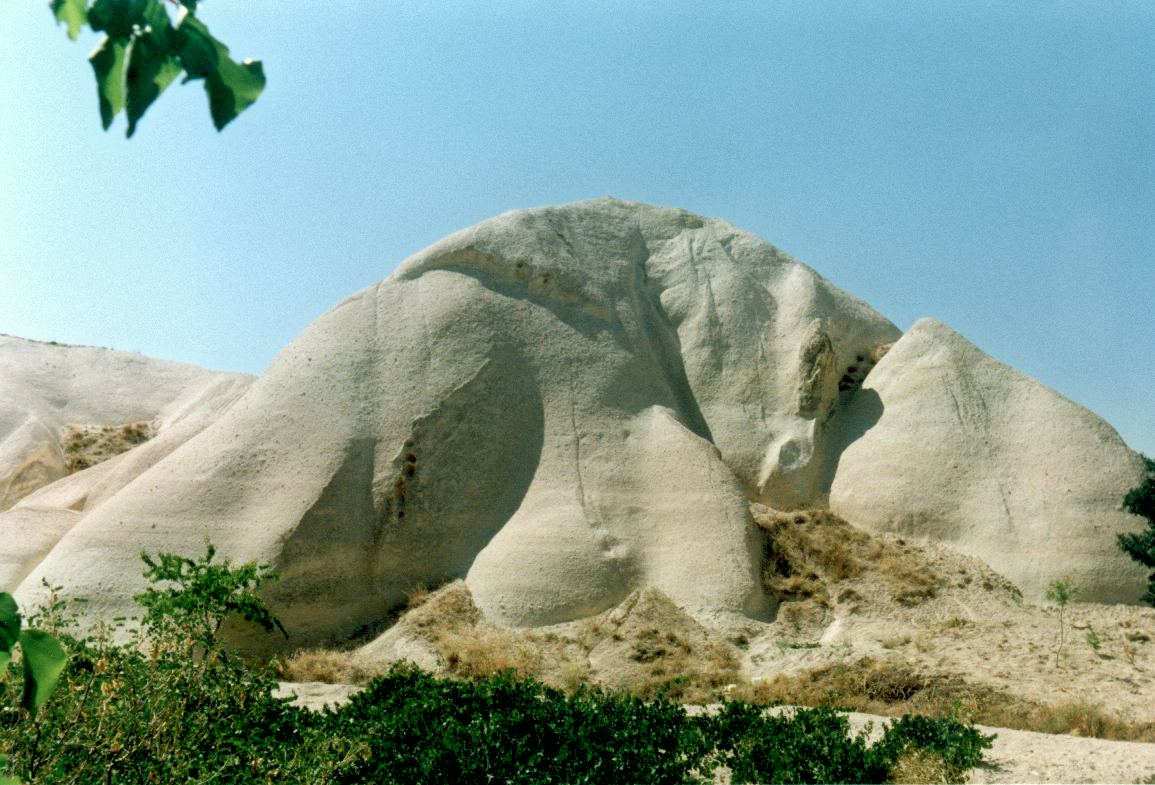
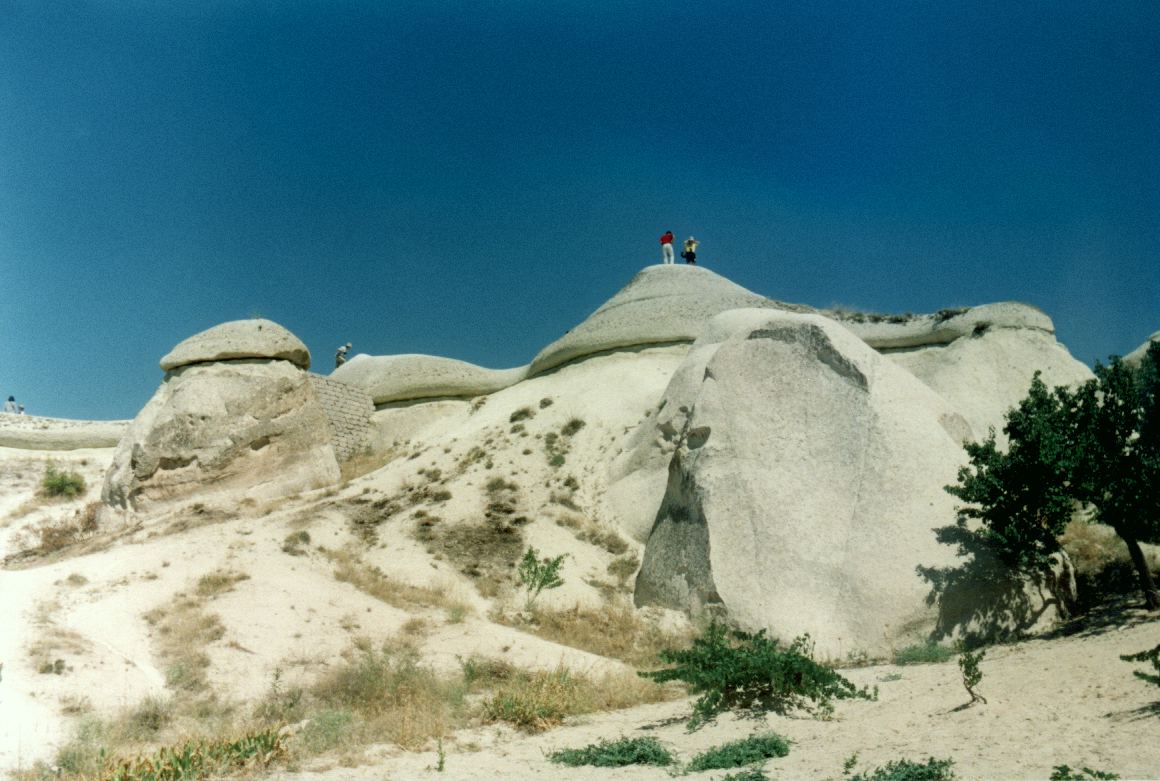
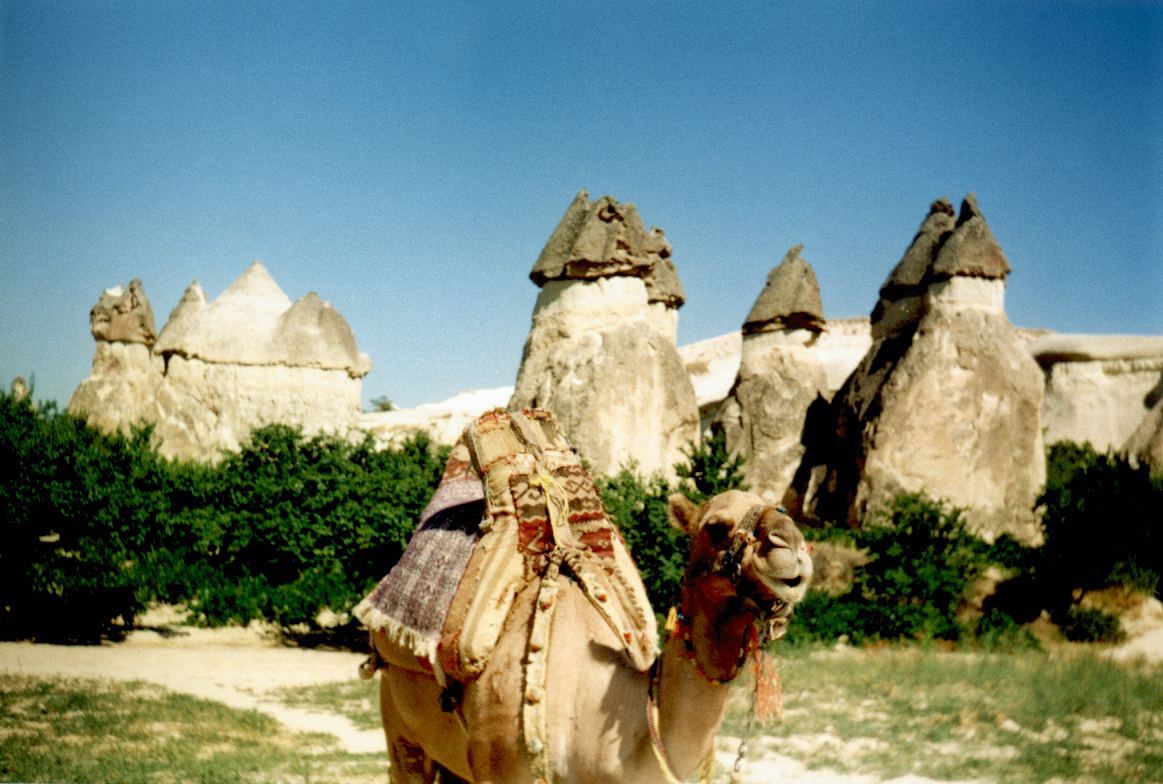
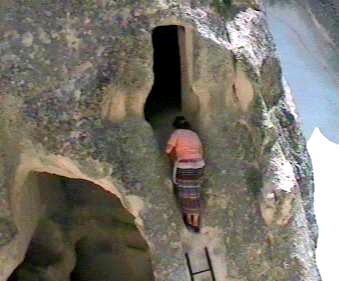
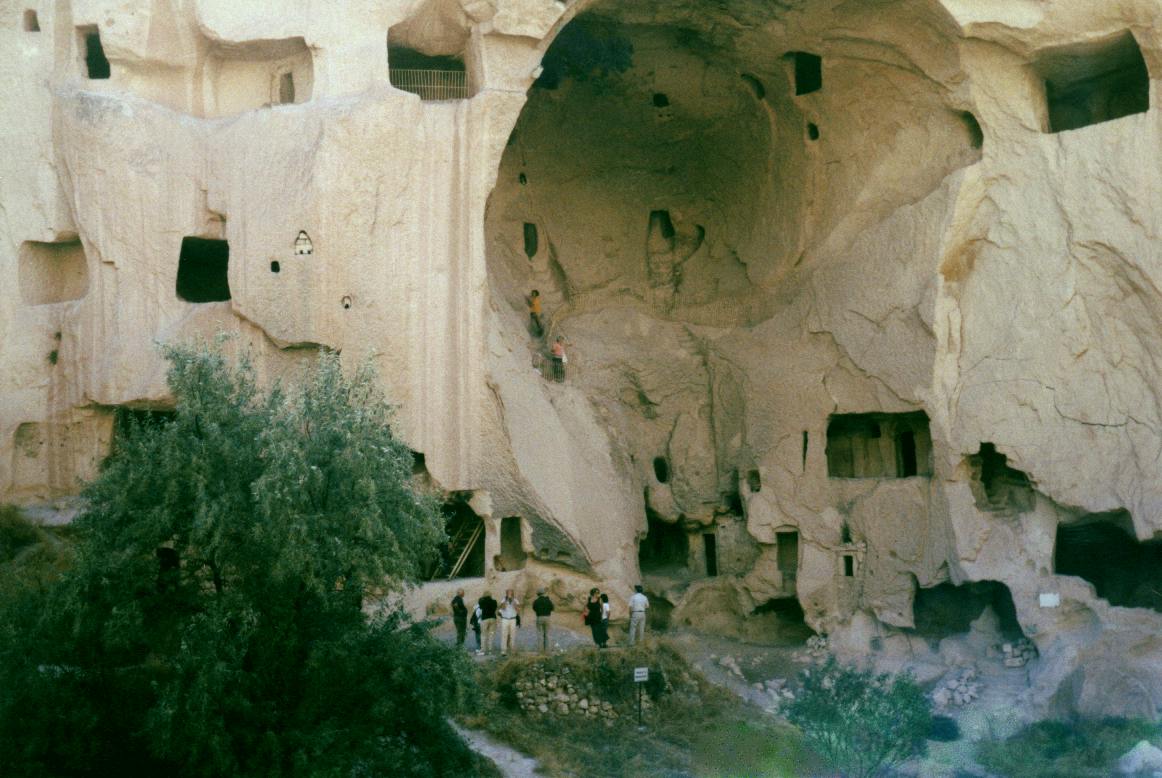
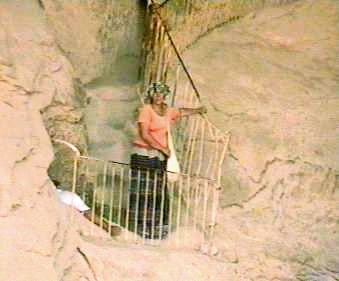
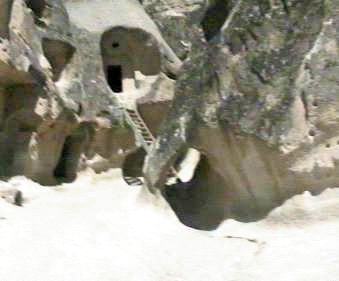
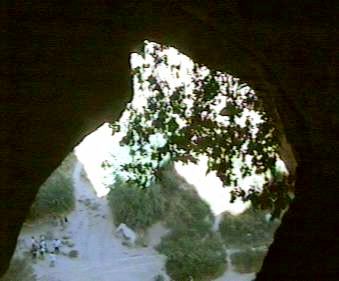
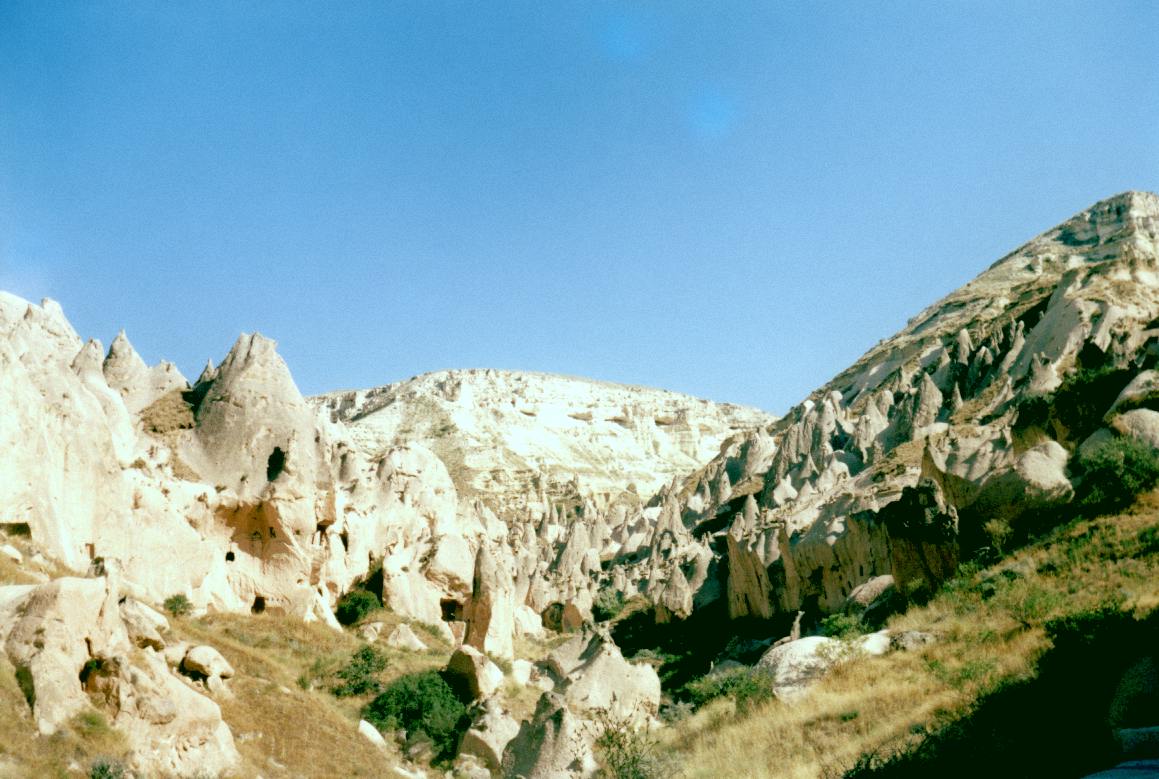
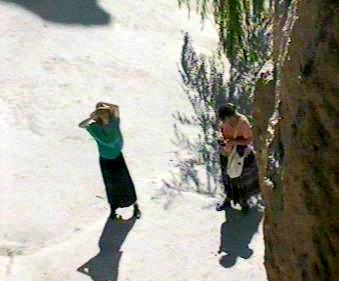
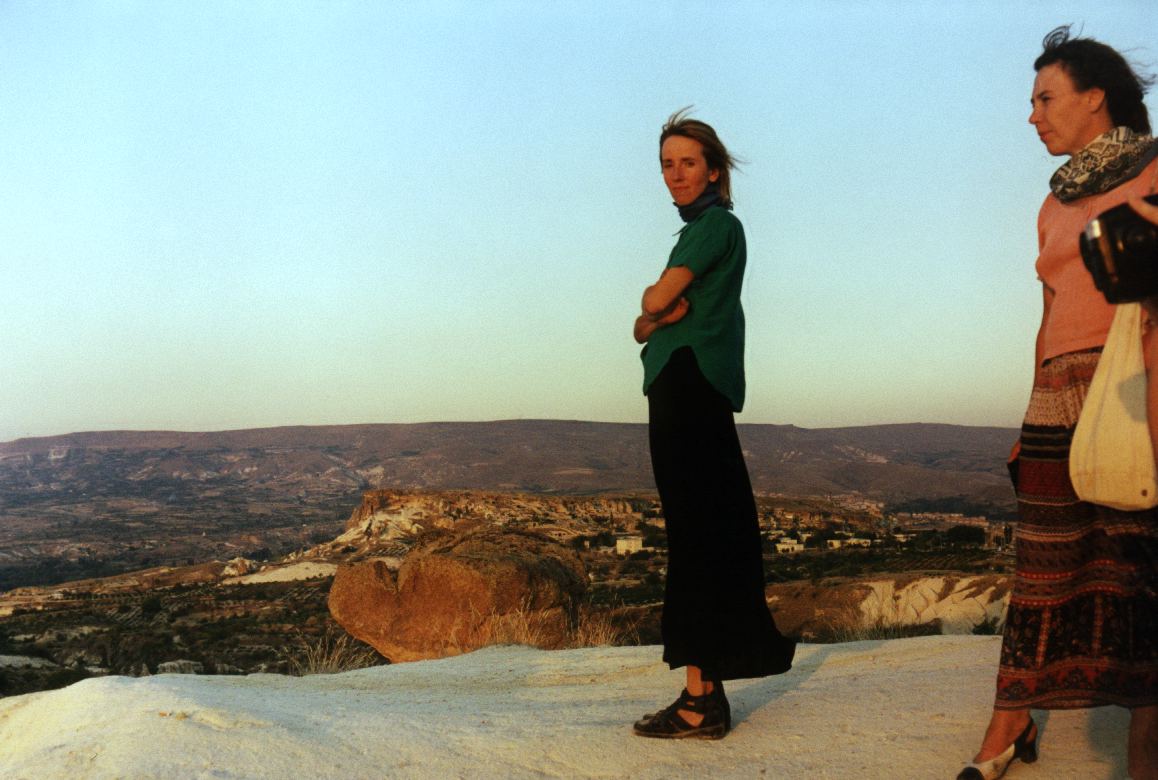
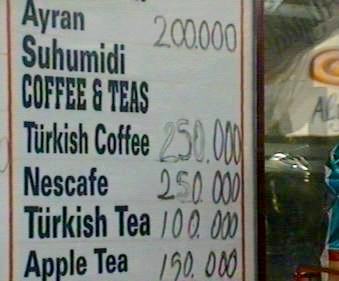
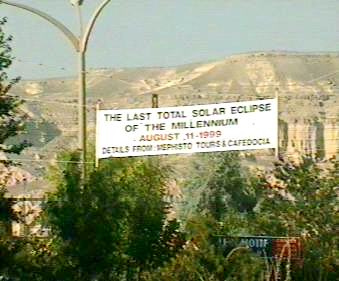
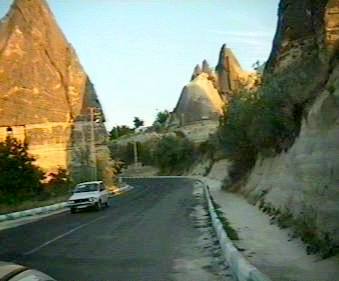
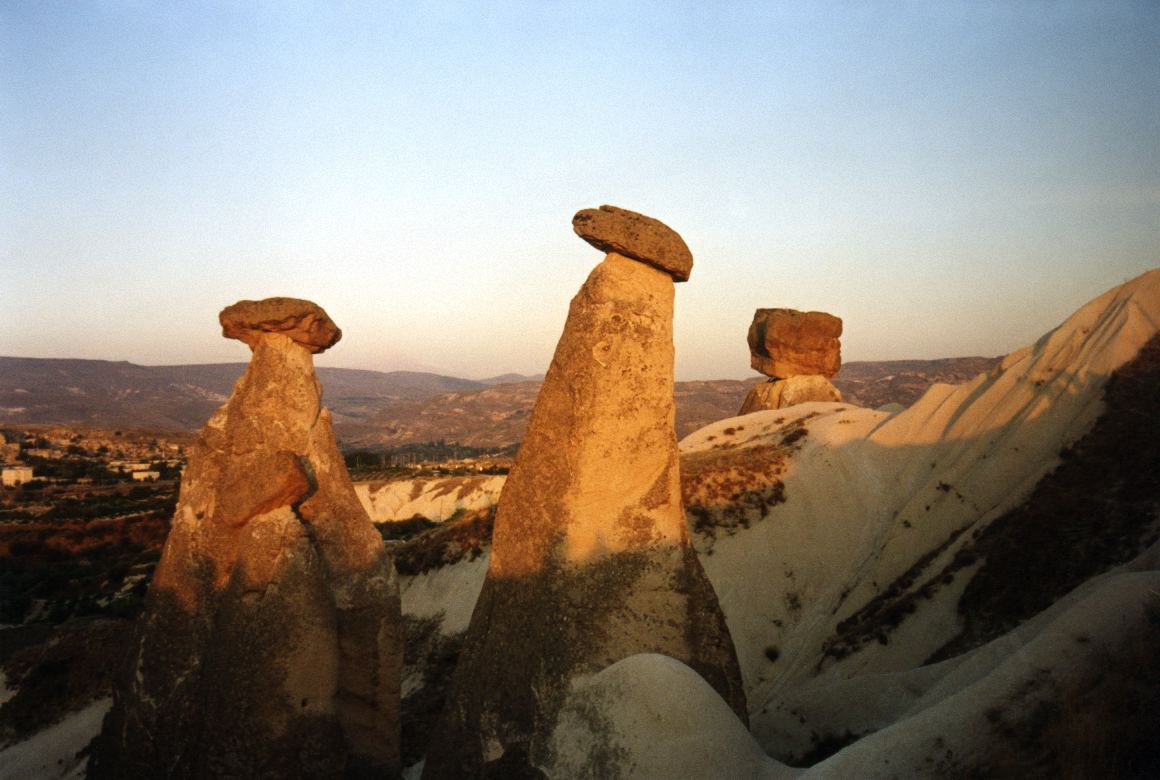
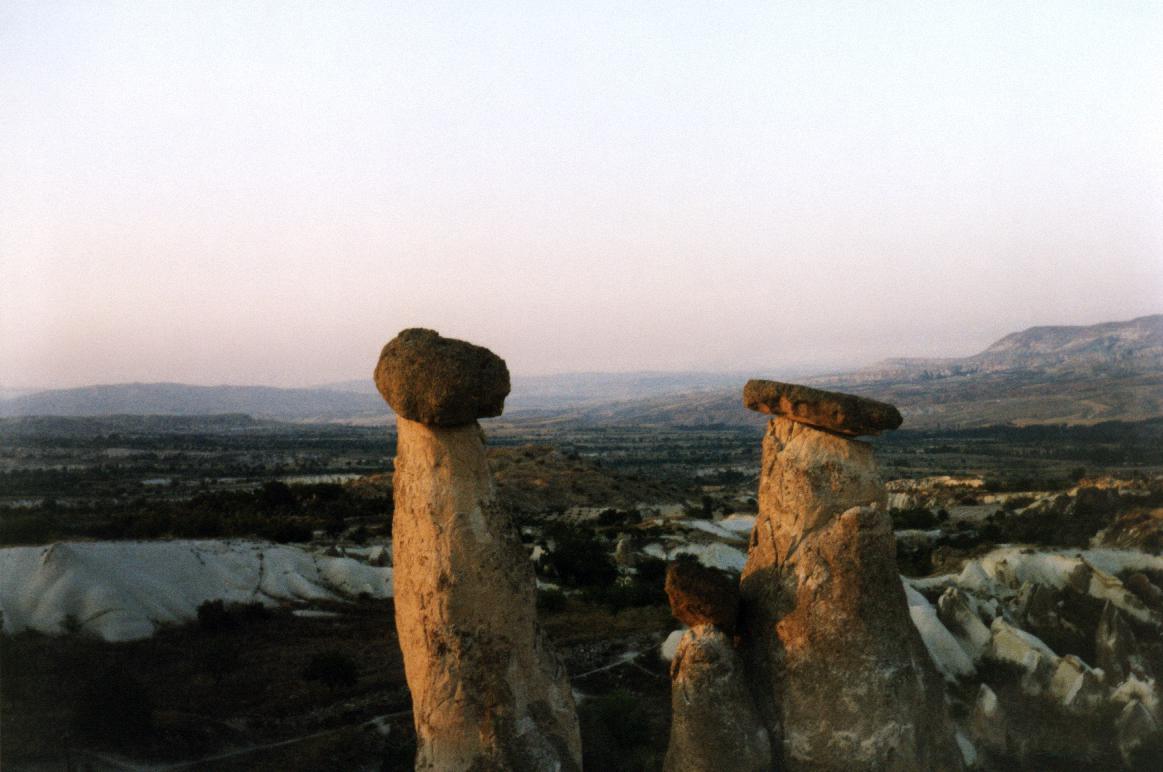
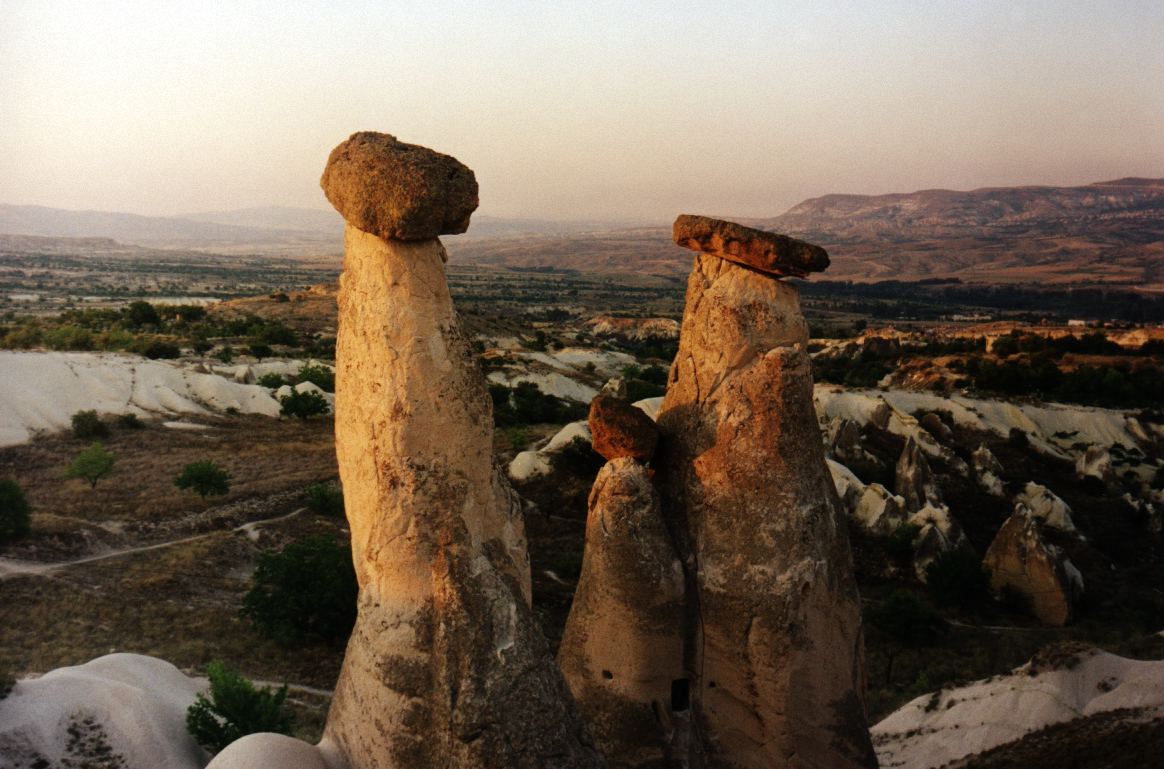
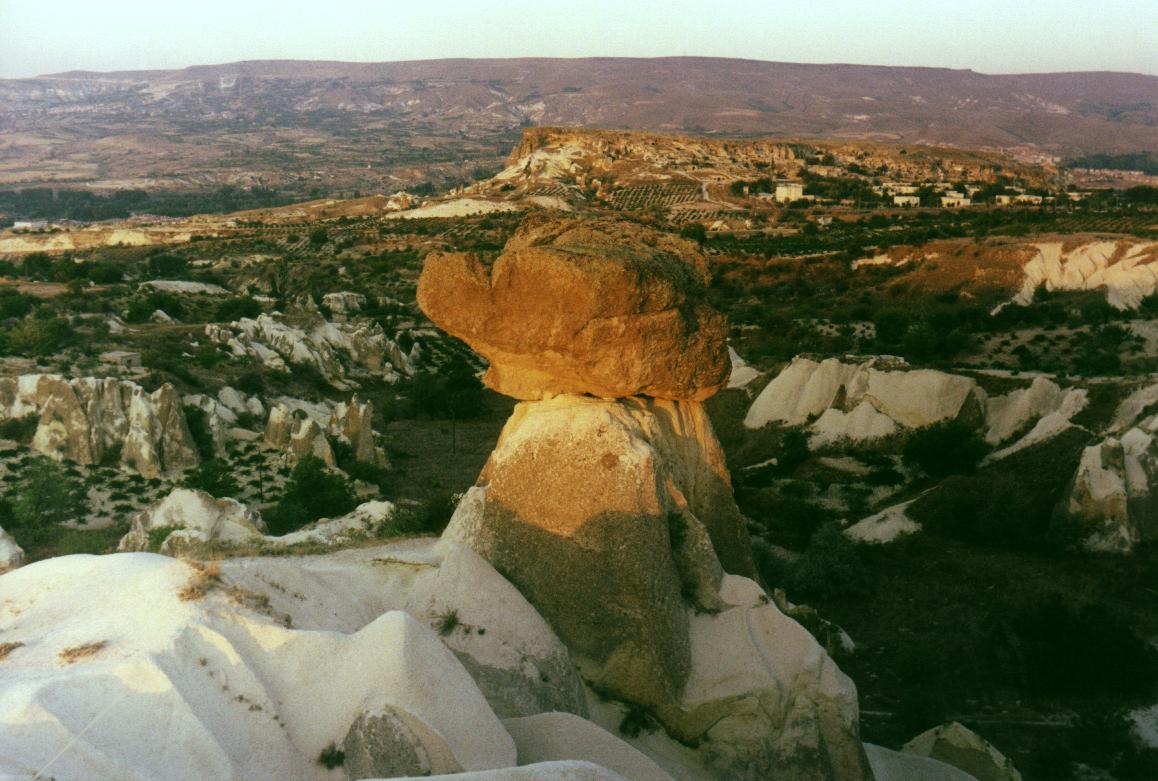
We woke quite early in the morning. Big lorries were driving around nearby and making a great din. The sun was just coming up behind the mountains. Lake and salt were lit red by the morning sun. My heart trembled with happiness. Here at last was something interesting I'd never seen before. We went for another swim, all together this time. I went in gumboots, Lena in flip-flops. Tanya tried to make it barefoot and couldn't. We swam and took pictures. On the way back we found several large salt crystals. If a blade of grass, a twig or anything else gets into the water, salt crystallises on it as the water evaporates. The crystal is usually stuck fast to the bottom, but we broke off a few and took them home despite the puzzled looks from customs. After the swim, a thick white layer of salt covered our skin and it couldn't breathe. Every hair stuck to the next and felt as though it was being pulled all the time. Nothing to do about it, though. No fresh water anywhere round here. We turned back and then east. The houses outside the window took on a typically Middle Eastern look: little mud houses with windows facing the courtyard. We passed Hirfanlı Reservoir. We badly wanted a swim, but the road ran in the hills far above the water. It crossed the river on the dam, which was under heavy guard, so we couldn't get to the water there either. It was getting hot. We stopped for lunch. Lena tried a women's bathhouse and discovered you had to wash with your clothes on in Turkey. At last the Turkish heat was living up to our fears. We drove another hundred kilometres before the road came close to the Kızılırmak River. Noon, with the sun almost overhead. We crossed a mown field to the river. Its dry white straw was dazzling. The current was fast and cloudy, with signs of a cattle watering place. In spite of the dirt we went in and washed off the rest of the Lake Tuz salt. That felt better. Our next objective was Cappadocia, around Mount Erciyes, a volcano that last erupted in the first century. A broad area around it is buried in layers of ash of different densities and colours, compacted into tuff. In the river valleys erosion by wind and water has made a fantastic landscape, columns very like morel mushrooms in shape and colour. Tuff is easy to work and the local people cut dwellings into it. Early Christians had lived here and built an enormous city for tens of thousands, with monasteries and churches. In the account we were given, the Turks slaughtered them and damaged the paintings, mostly the faces, as depicting them was contrary to Islam. The first town we came to was Avanos. One of the caves there has been turned into a restaurant. It was funny to see a satellite dish and air conditioners by the mouth of a cave. We bought and ate a melon. Then on to Göreme. The road climbed and we suddenly entered a fairy-tale landscape. The mushrooms stood a few tens of metres apart. Grapevines grew below them. We got out to find lots of tourists around. The tuff was so white it looked like snow. The heat was starting to make Tanya ill. We didn't even have hats. Nearby there was a visitor centre with shops, where we bought a hat and a cap. There were masses of souvenirs: model mountains, spheres and animals of every kind in onyx, and a local wine called Cappadocia. Tasty, incidentally. They even had bottles shaped like a typical local mountain. We bought several bottles and a guidebook to Turkey in Russian. Then we went clambering in the caves. Unlike our museums, where the slightest hint of danger is reason to keep you out, here you can climb in wherever you like. There are rickety ladders set up everywhere. People scramble high above the ground with no railings. I liked it and climbed into everything I could. A local man started pestering Lena and offering money. Frightened, she bought a scarf and turned into a Turkish woman. A woman travelling without a man makes no sense to the Turks, so every so often I had to announce I had two wives. That ended the questions, despite polygamy being forbidden in Turkey. For some reason people took Tanya and me for Americans. We still looked all right, then. (In seven days they'd take us for Arabs, and eight days after that for earthquake victims.) There were tourists of every kind: French, Japanese and American. Many had come for the eclipse, judging by their badges. The city is enormous. They charge for entry to much of it. It's quite impossible to climb into it all. I tried my hardest and wore myself out all the same. Tanya sat at the bottom looking flattened. Despite the heat she'd caught a cold and went about with her throat wrapped up. In the evening we got to Göreme proper. A town for tourists. Even an internet café. Best of all, for the first time we saw real Turkish coffee. Delighted, we ordered it and waited. After half an hour we started swearing. How could it possibly take that long to make three tiny cups? At last they brought us a big tray. On it was something large with salad. It was köfte: a patty in a bun, slathered and sprinkled with everything they had. Our faces fell. I pointed in the menu to the line I meant. The man was surprised at our exotic choice but finally produced the three long-awaited cups. Straight across the street hung a banner: “Last solar eclipse in millenium.” The sun was going down and we drove out looking for a camp. The road slalomed past stone mushrooms sticking out of the ground, lit red by the setting sun. An unearthly sight. We came down a very steep mountain track and pitched by a reservoir (38°32.958′N, 34°55.636′E). I had grave doubts we'd manage to get back out under our own steam the next day. We'd driven through a break in the barbed wire, so we were also afraid of being arrested for going into a restricted area, but nothing happened. Peace and quiet. Fish splashing in the reservoir. We found plenty of wood and built a big fire. After the heat the air cooled and it became very pleasant. We swam to our hearts' content and washed ourselves, getting the last of the salt off. In the evening we listened to the radio. Fragments of a broadcast in Russian drifted in: “Stepashin has been dismissed,” “The dollar is rising,” “The dollar should stabilise at thirty.” Then silence. So that was it. And yet a curious feeling inside: it was all over there. Here it had nothing to do with us. The dollars in our pockets were still green. We spent the rest of the evening wondering how we'd managed to be born in such a country and grown so attached to it we didn't want to leave.
Day 11. Tuesday, 10 August 1999
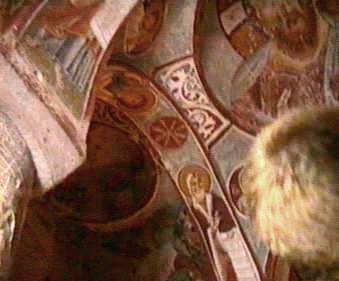
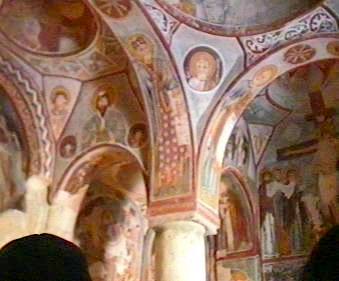
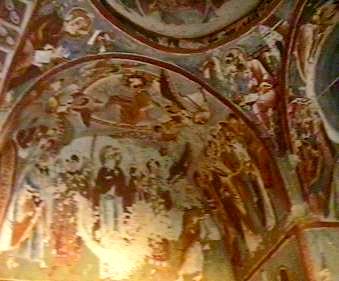
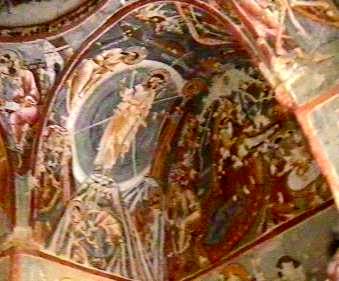
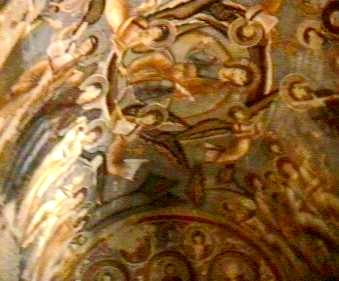
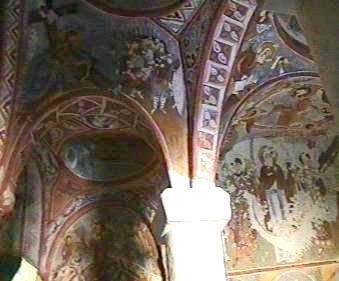
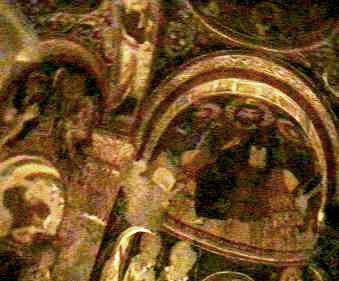
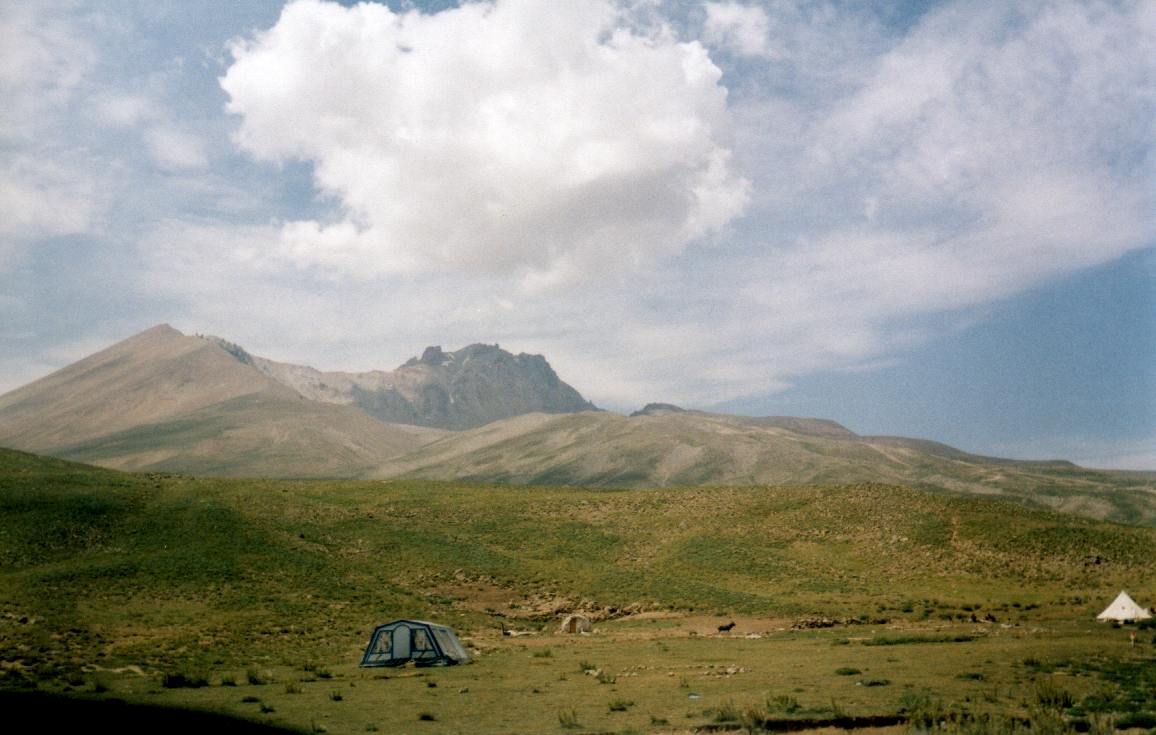
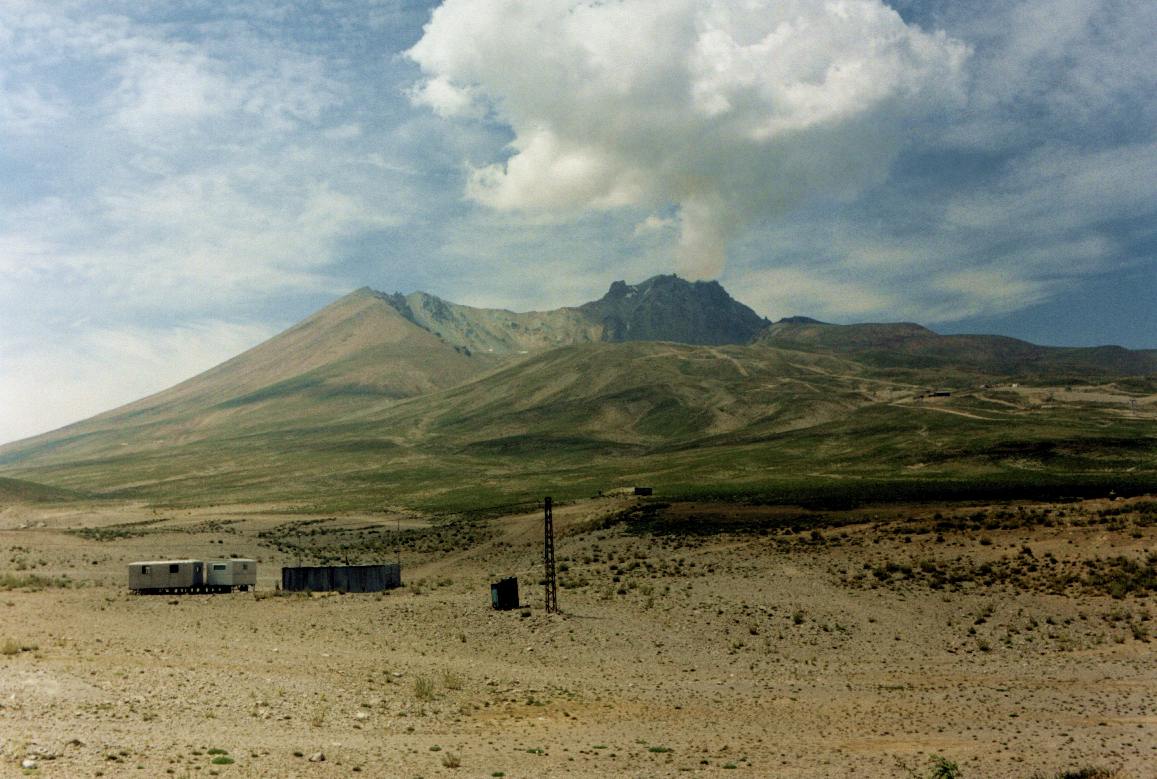
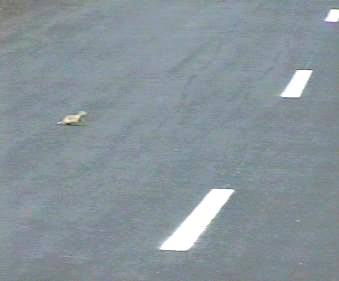
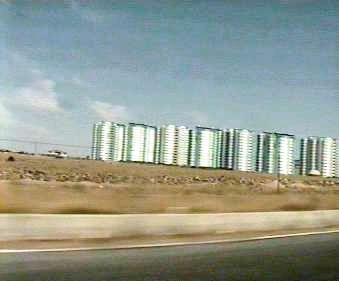
In the morning we made breakfast and, surprisingly, drove out of the camp without trouble. The slope was at least twenty degrees. We filled up with water and went back to see the Armenian cave monastery. Entry was one and a half million lira and they charged another three million inside. A rip-off, in short. The churches, it should be said, are better preserved. The frescoes were being restored. There was even a notice in Russian promising that all damage would be repaired. It was forbidden to take still photographs inside, but they tried to stop my video as well. I filmed anyway. The Dark Church is the best preserved; that was the one that cost three million. I made it through without a ticket and filmed the lot. The Turkish explanation for the killing of Christians, Armenians for example, went something like this: “Armenia never existed as an independent state, so they had no culture. The paintings were made by various tribes some people call Armenians, but they aren't quite Armenians. For a while a few of them happened to be Christians, but when they saw the light of Islam they all became Muslims and began destroying their churches. They'd have destroyed them completely if the Turks hadn't stopped them. Then they went somewhere.” After clambering through holes in rock in the heat, we couldn't face another hole, so we went to look at Mount Erciyes. The road goes through Dörtyol, Develi and Kayseri. Between Develi and Kayseri it climbs to almost three thousand metres, where there's a ski resort. No snow in summer, of course, but campgrounds and tourists in tents. At the pass it was cold, eighteen degrees, and ground squirrels, or something of the sort (we're poor zoologists), ran around. They dashed across the road in front of the car, then sat up on their hind legs to look. We came down from the mountains into Kayseri. It got very hot. No time to see the town. They say there's plenty worth seeing, but we were tired after the caves. The city's enormous, in any case, with over a million people. The eclipse was tomorrow and we still had nearly a thousand kilometres to go. We lost our way and went in the wrong direction, ending up at the local university. We consoled ourselves with a watermelon and ate it with our packed food. The smooth, ploughed hills were all around us again. Here and there, set in the middle of the steppe, was a whole block of sixteen-storey buildings. It was a mystery who lived there and what they did. After Pınarbaşı the road goes into the mountains and starts to zigzag. Passes at two thousand metres and valleys a thousand metres below. We were running out of petrol, but had gone a hundred kilometres surrounded by rock with no sign of a filling station. In Gürün we finally filled up and ate, sent a postcard to Saint Petersburg and Lena made a call. The postcard arrived in early October. Then the road went into the mountains again and a thunderstorm was gathering there. Lightning struck the peaks and curtains of rain hung from the dark clouds. I was worried about the weather deteriorating. Would it be like this at the same time tomorrow? We'd be considerably farther east, though, where rain was less likely. In the end we never got into the heavy downpour. It seemed to evaporate before reaching the ground. When we came over the pass and down into the great Euphrates valley by Malatya, we were hit by heat and humidity unlike anything we'd known. It was evening but thirty-eight degrees and almost foggy. Tanya groaned that she was about to die. I noticed I was getting careless at the wheel. This was no small town and there were plenty of cars, so a moment's inattention could end badly. We meant to camp on the Euphrates. I saw the great river almost in darkness, the river that had stood in my memory since childhood as something as unreachable as Mars. The banks were settled end to end and there was nowhere to camp. Tanya groaned she was at death's door. We ended up right in a parking area by the road (38°25.596′N, 38°48.126′E). A hundred metres above us was a peasant's or a farmer's house. What do you call him in Turkey? A pack of dogs was running about, and Kurdistan was nearby. There were thistle-like plants so tough you could tie the tent to them. Tanya was nearly unconscious. I was having trouble with my heart too. A bleak mood. The entire trip was on the verge of coming apart.
Day 12. Wednesday, 11 August 1999
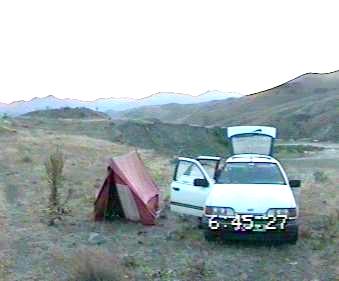
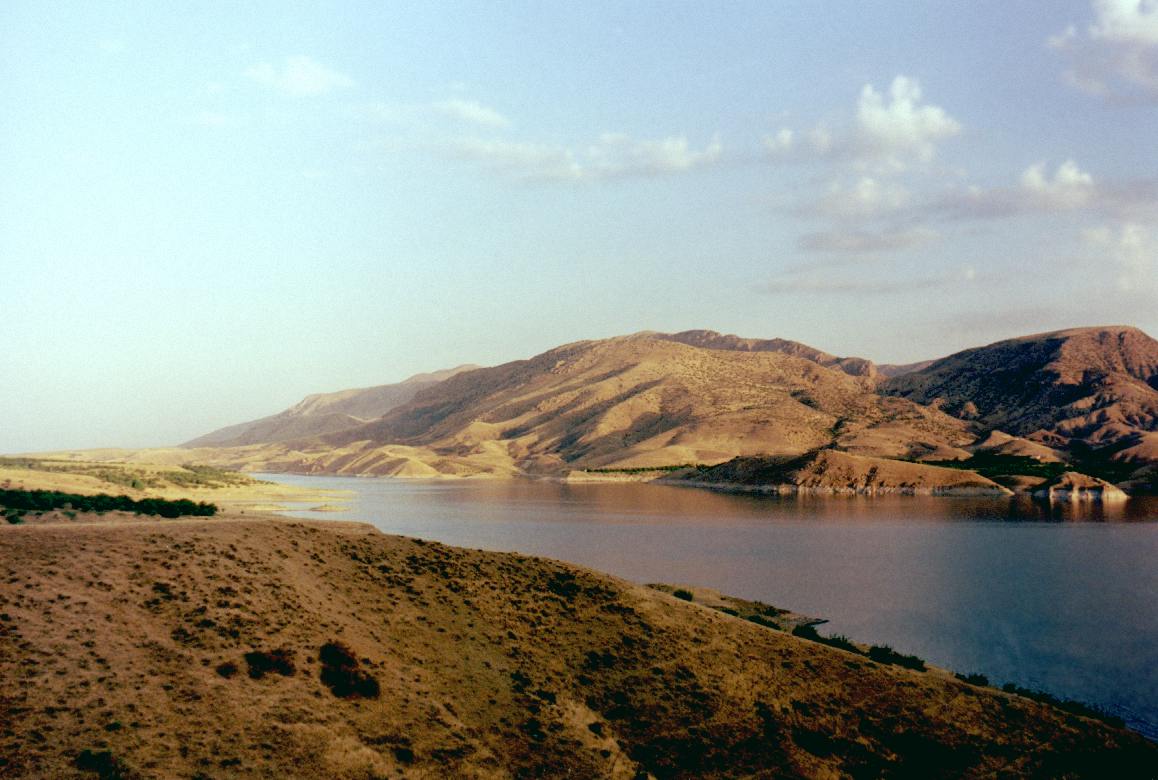
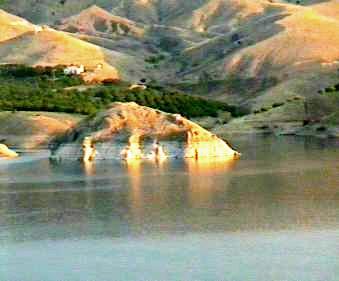
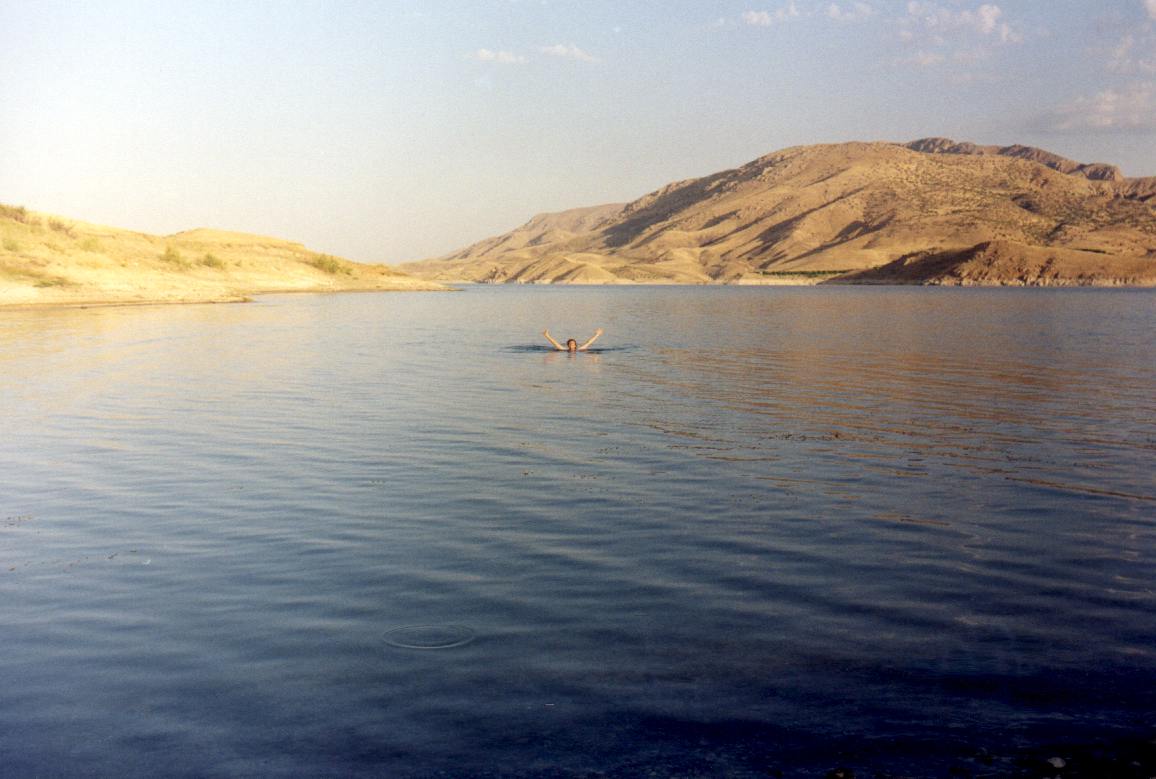
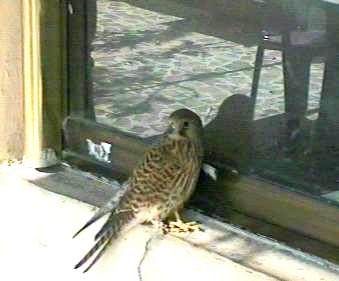
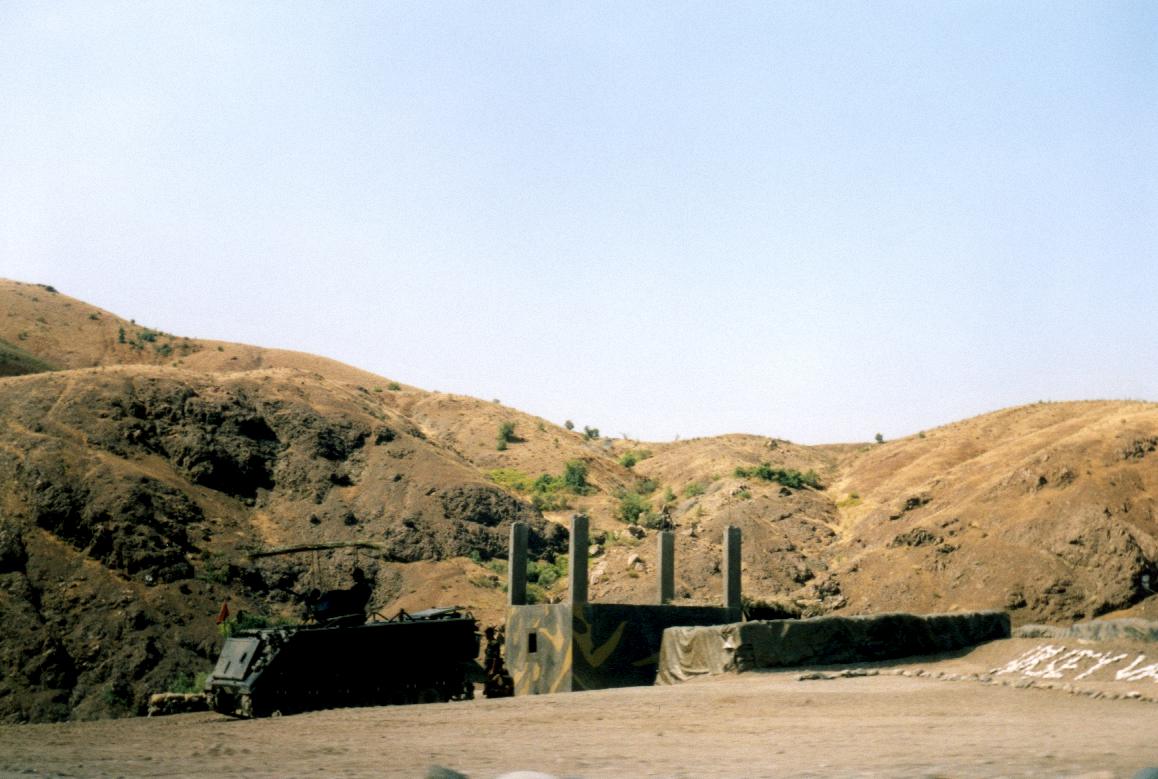
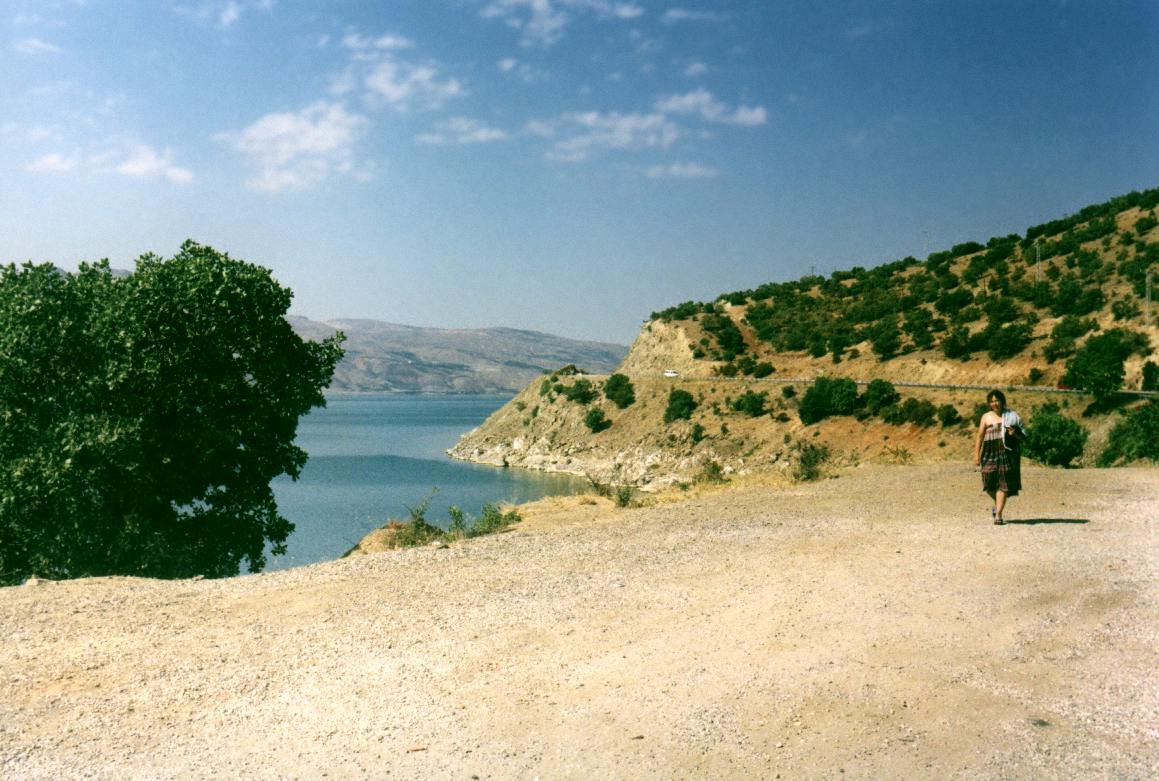
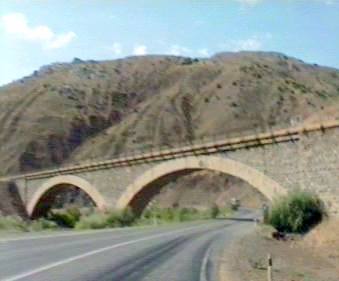
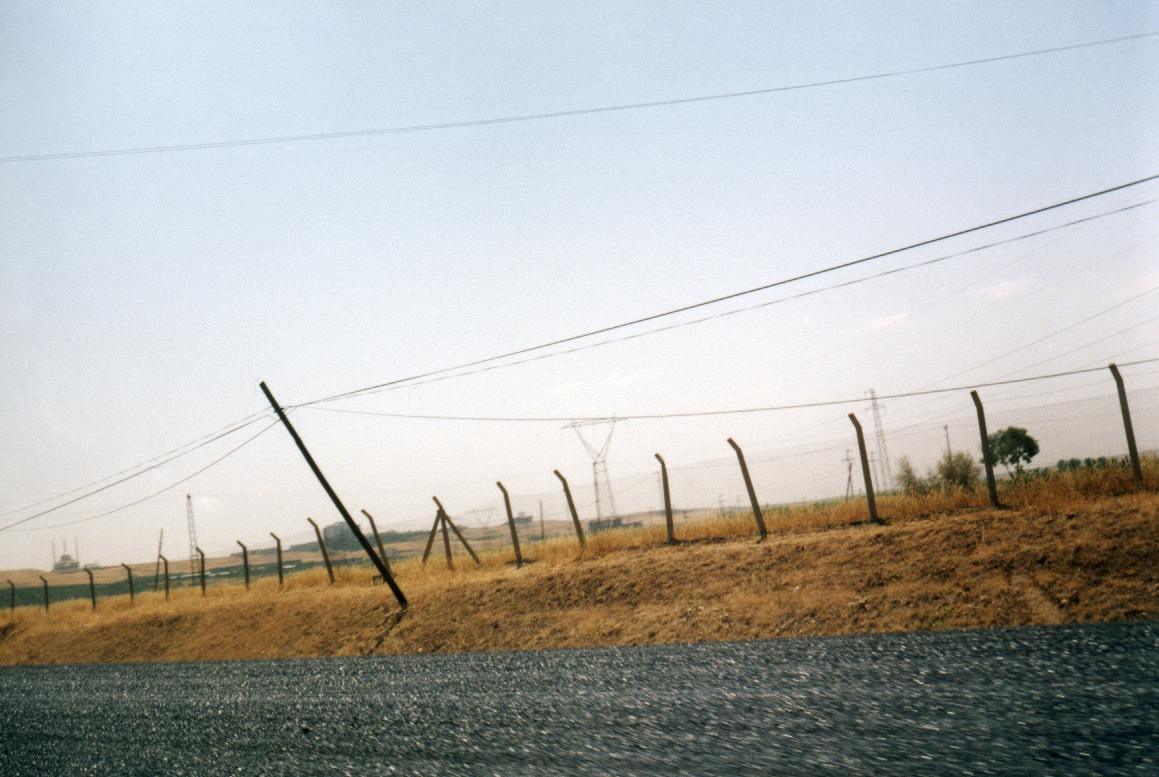
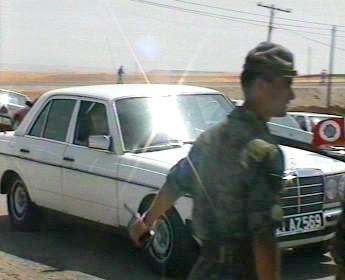
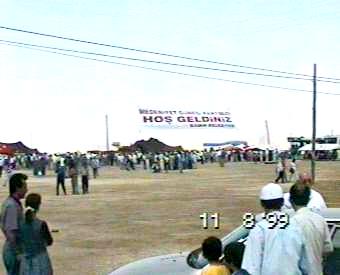
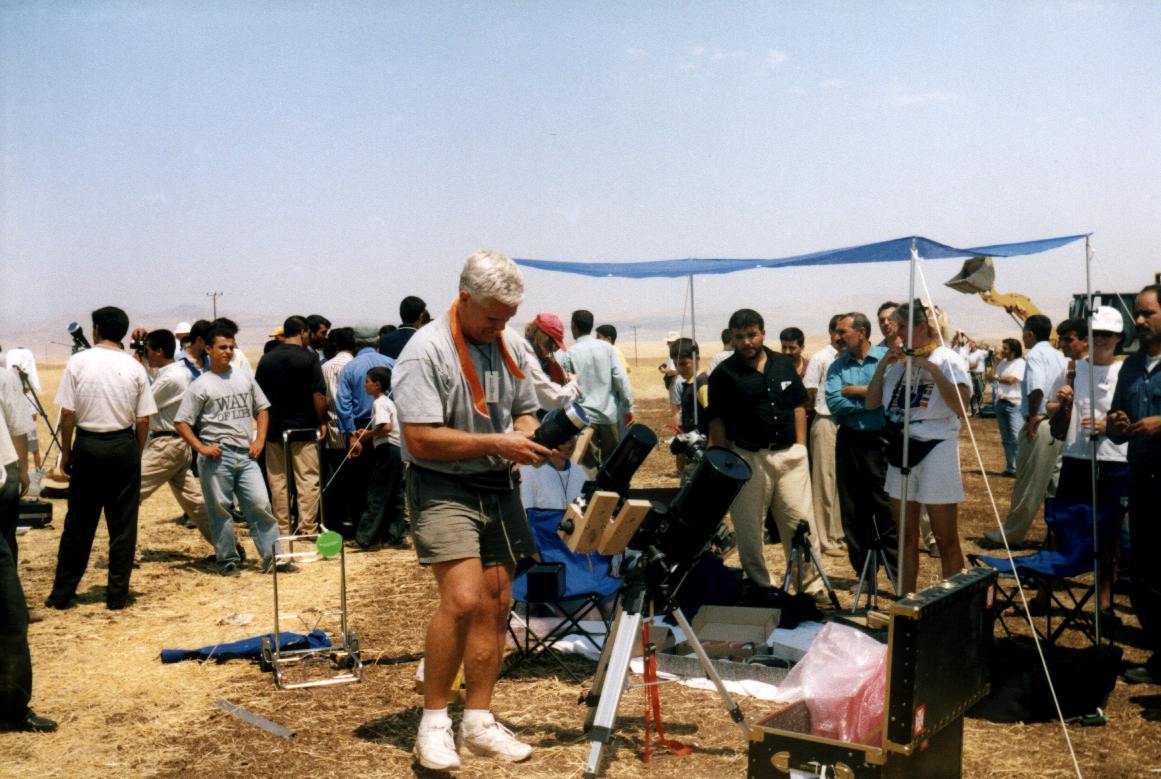
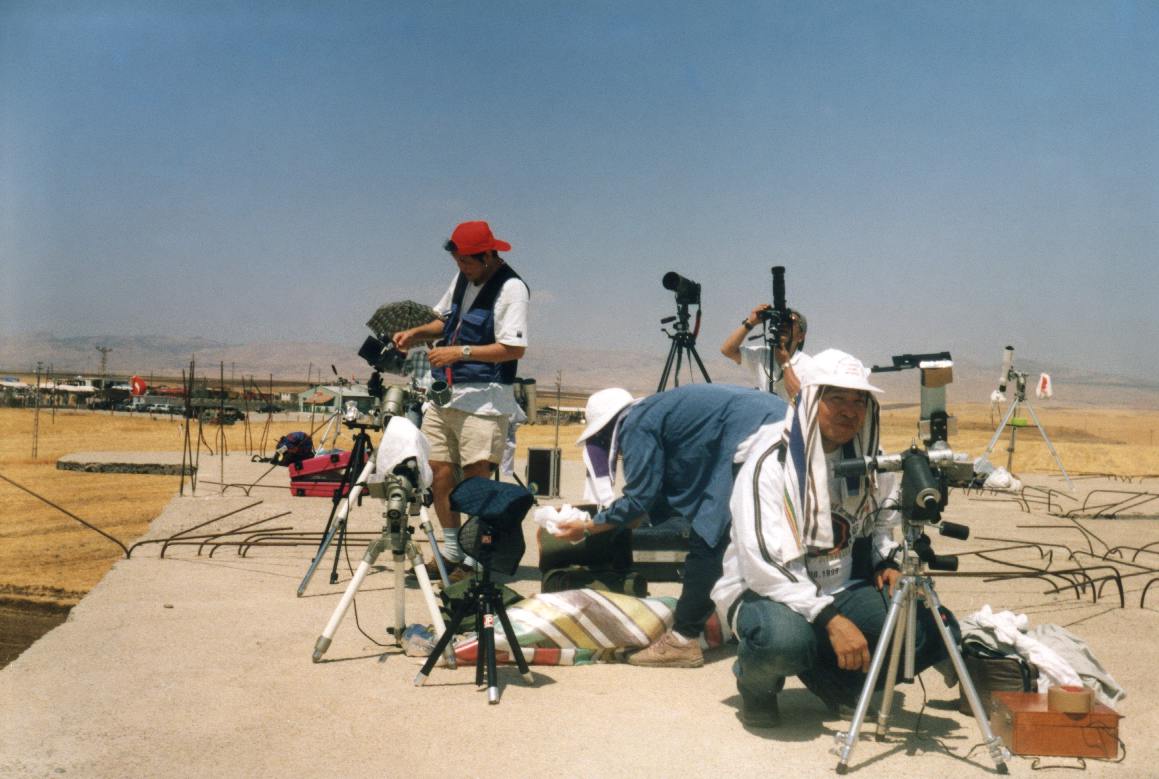
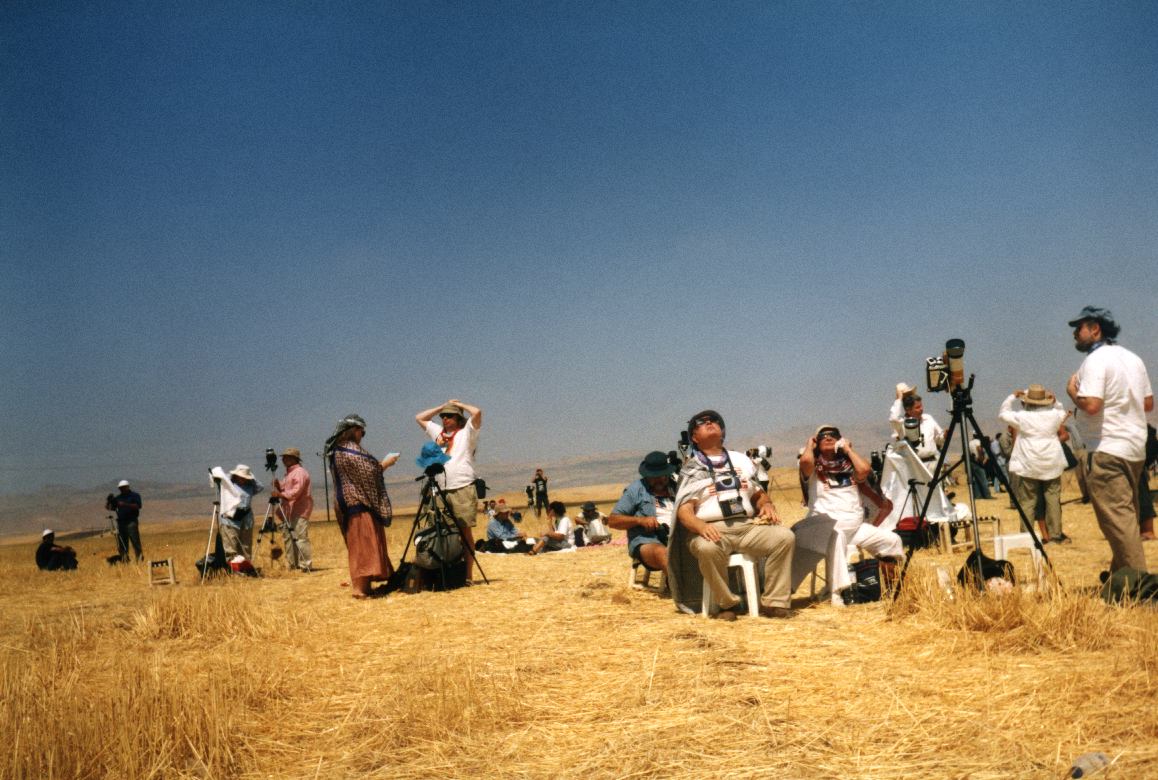
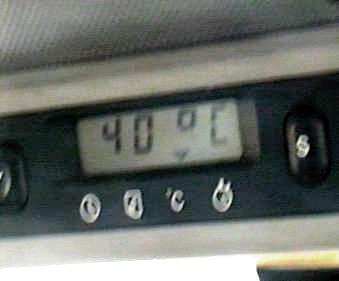
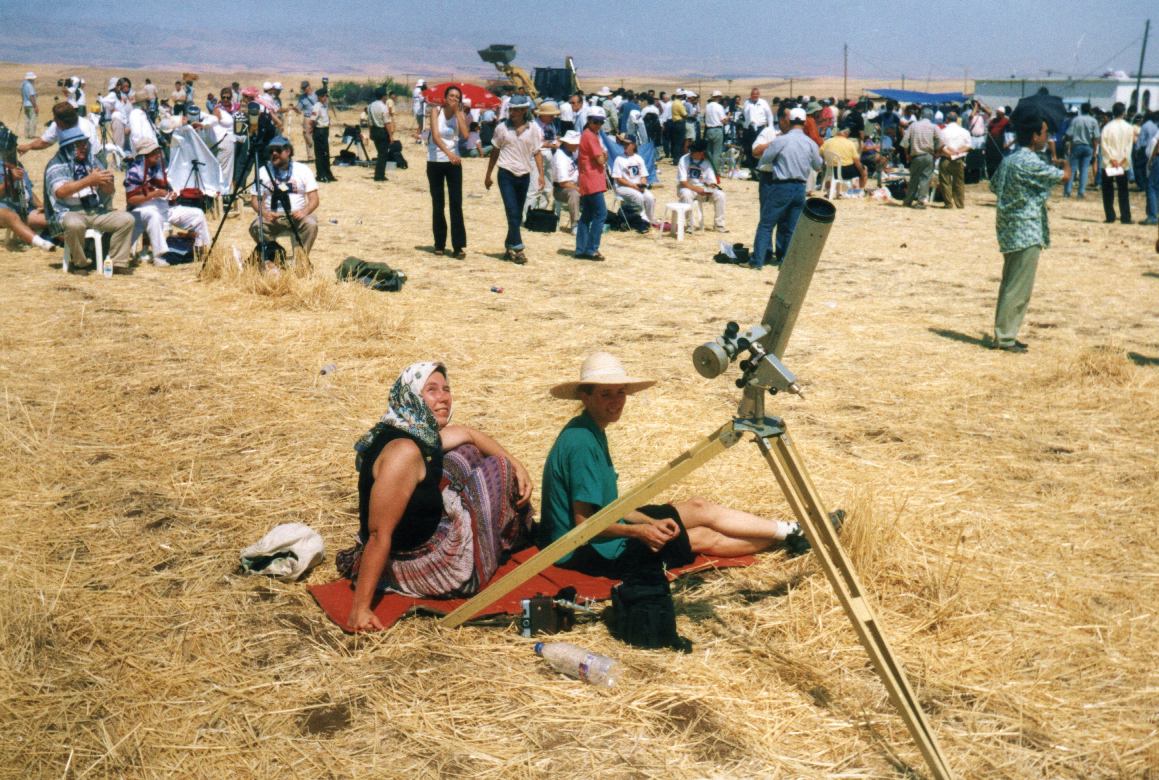
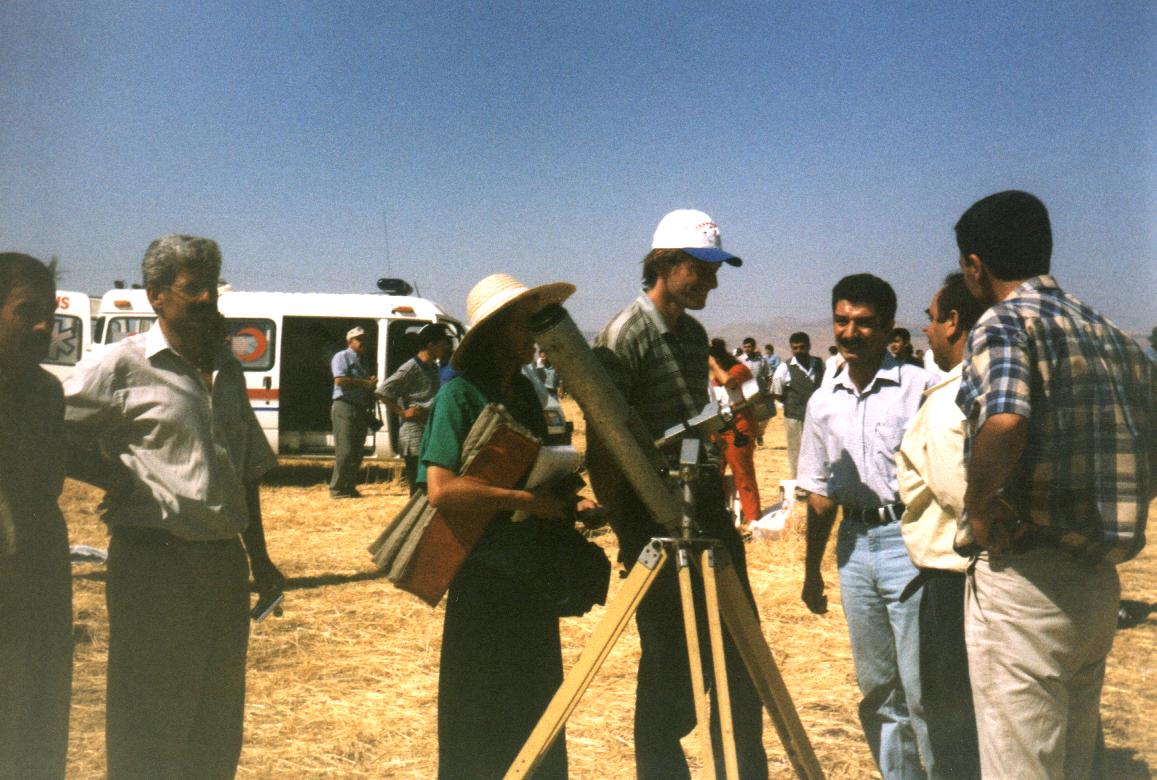
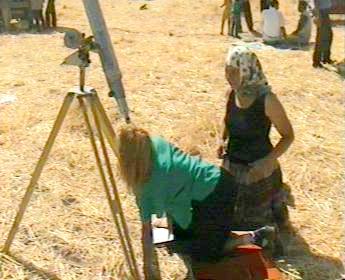
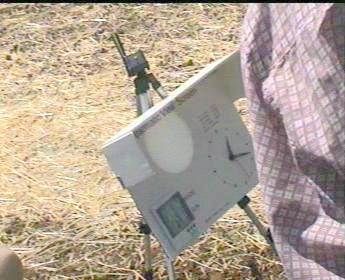
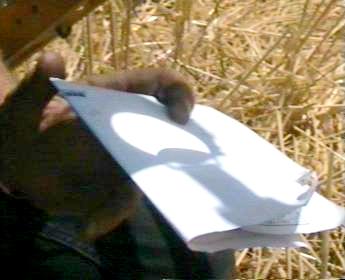
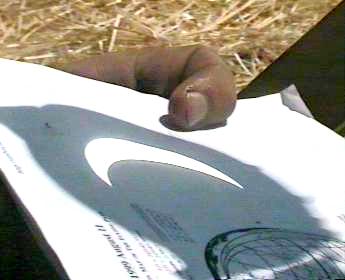
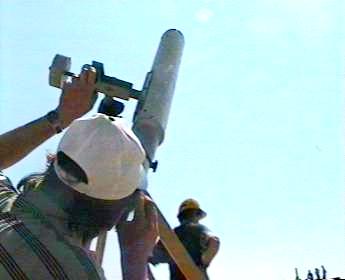
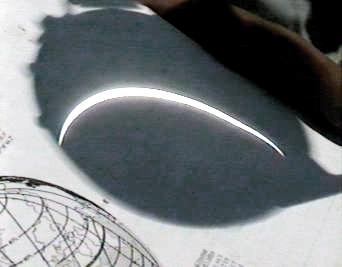
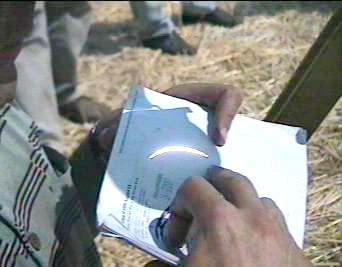
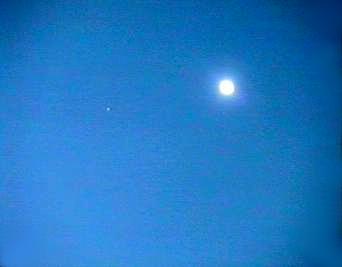
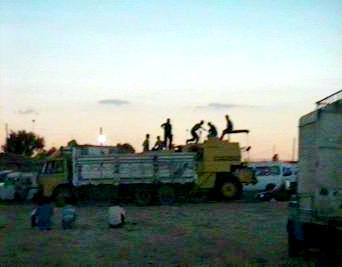
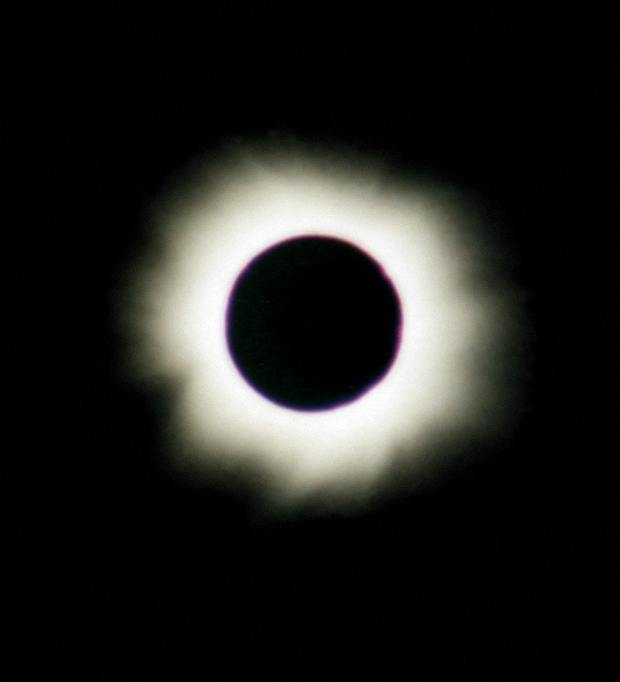
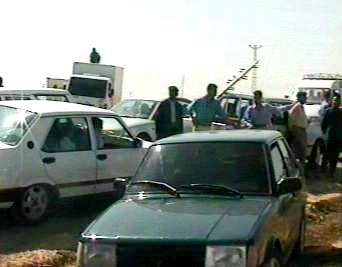
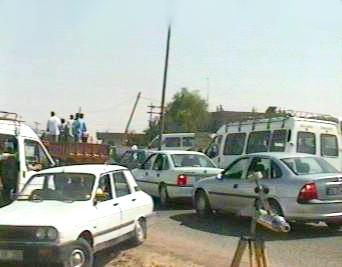
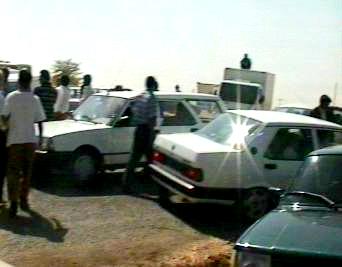
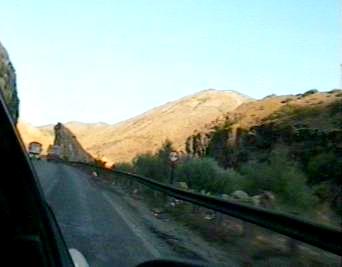
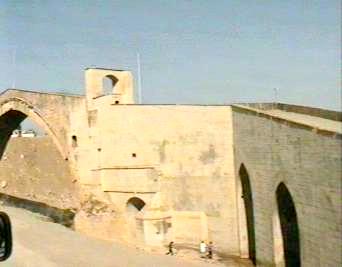
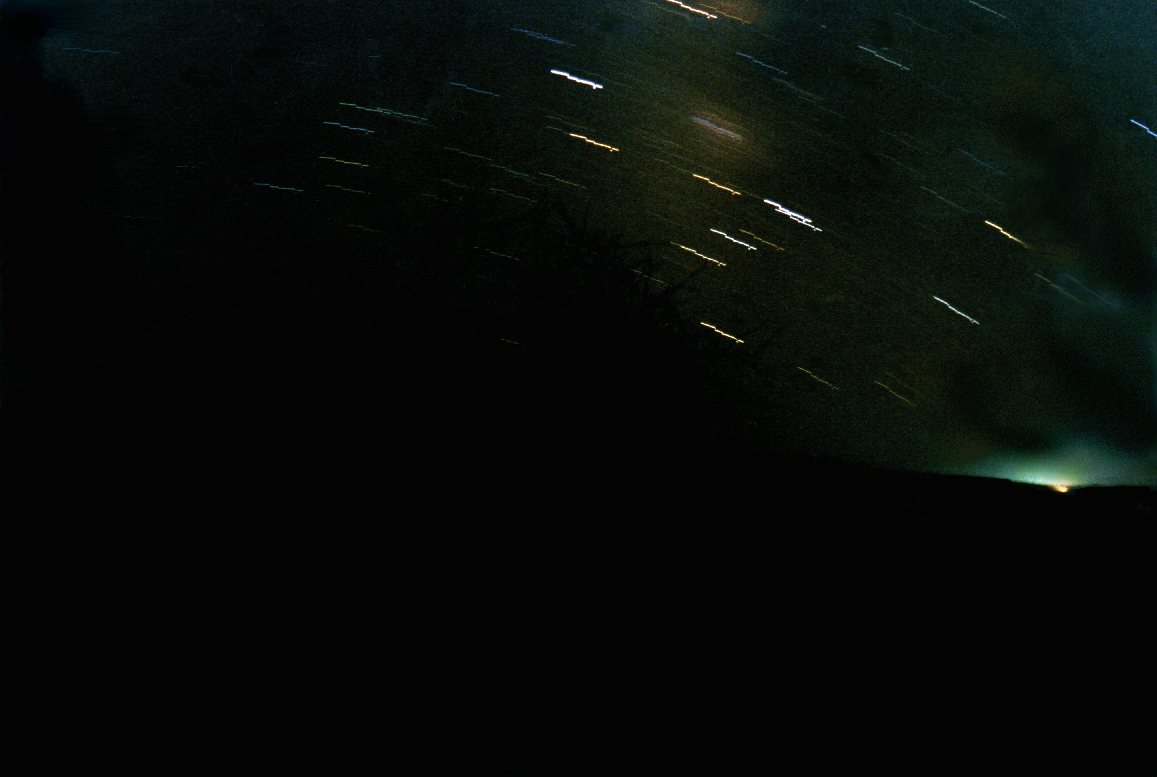
We woke in the morning. It wasn't so hot now. The first rays of the sun had just touched the mountains. We still had a long way to drive. Today was the solar eclipse. We were already within the band of totality, but I wanted to get farther east, where it was less likely to rain. We swam first thing in the morning, Tanya with Lena first, then Tanya with me. The water was warm and clear. The Euphrates spreads out here into a reservoir. It's not just the plants on the banks that have thorns, it turns out. The weeds in the water scratch your belly as you swim. We packed quickly afterwards and drove to the nearest village to find something to eat. We managed a meal, if not a very filling one. In the café where we had ayran and tea, a falcon was tethered by one leg. After Elazığ we turned towards Diyarbakır, the capital of Kurdistan. Posts appeared on the road, manned by soldiers and gendarmes, with concrete defences and tanks. Every ten kilometres they stopped the car and checked our papers, sometimes rummaging through the boot. We had the cooking pots on top. They usually made an unforgettable impression, and the search went no farther. We went past Lake Hazar, fresh and warm, with no prickly weeds. Easy approaches to the water and nobody about. A perfect place for a camp. We swam. The only unsettling thing was that the entire beach was strewn with cartridges of different calibres. The road was in the mountains again, with a railway along it. The stream and the two routes constantly crossed one another on bridges. For half its length the railway was in tunnels. Here and there in the narrows the two roads ran one above the other, and both over the stream. At Diyarbakır the mountains disappeared and we went out into scorched desert. We took the bypass and turned towards Silvan. A four-wheel drive went in front of us and a security car behind. We were driving to the point where the E99 crossed the centre line of the eclipse. An odd sound to that. We were so far from home, scorched steppe all around, and the road's name was so much like the familiar E95. We used the satellite navigator to find our bearings and look for the line. We could place it to within thirty metres. The map put it near the village of Başnik. We drove into the village and saw we weren't alone. “Not alone” hardly covered it. There were thousands of people, television crews, local dignitaries. One of them had been driving in front of us. Posters about the eclipse hung on the poles. Americans, Japanese and people from God knows where else. People had come with enormous telescopes. The officials had seen to security and put in a pay car park. The village hardly knew what to do with all this good fortune. A glass of water cost $2, and people paid it. What else were they to do? White people aren't well adapted to 45-degree heat (the thermometer reads five degrees high) and the sun overhead. We had twenty-five litres in plastic bottles in the car and were always topping them up. At first we drank only boiled water, then began drinking out of the taps. In Muslim countries there are taps beside the roads so travellers can wash their feet and pray. That's where we took our water. In the car it quickly heated up to forty or seventy degrees, but we'd swap it for fresh. Children offered smoked pieces of glass. The local canteen probably made more than in the preceding hundred years. We set up our telescope. They counted us straight away as the Russian delegation among “scientists from *** countries here to observe the eclipse”. Everyone with a telescope was assigned a policeman to protect the valuable instrument from the attentions of the locals. Meanwhile the eclipse began. The shadow started creeping across. I projected the Sun onto a piece of paper, and the locals watched from the permitted distance. At first you could see it only through the telescope, but then there was a strange feeling that darkness was seeping into the whole world and absorbing it. The Sun was overhead and the sky cloudless, but something was wrong. Shadows sharpened. Soon you could see even with the naked eye that the Sun was down to a little crescent. Through the telescope you could see the enormous mountains of the Moon on the edge of it. The crescent gradually turned into a dotted line. They stopped the music and put on slow beats of a drum. The whole crowd gasped as one, and the shadow raced across the ground at tremendous speed. Because it was desert all around and you could see for kilometres, you actually saw it move. The sky darkened in an instant and Venus appeared. In the last seconds the corona began to show and then, suddenly, the Sun was completely covered. It was a staggering sight. A black hole and a golden corona around it, perhaps ten solar diameters across. Everybody was quiet, as in a theatre when the curtain goes up. A ring of dawn was visible in every direction. The telescope showed enormous red prominences. I don't know whether it was real or my imagination, but they seemed to rise and fall before my eyes. You felt you were looking at some vast infernal machine. Unbreakable energy beating against the force of gravity that held it in. It's almost unpleasant to think that our warm, kindly little Sun is really like that. The eclipse lasted only two minutes. I tried to film it, but my silly Sony went mad at the sight and flatly refused to focus on it. The still camera with my Granit 200 mm lens at 1/60 of a second got it beautifully, though I didn't get the prominences. I'd relied on the video camera and hadn't attached the still camera to the telescope. The eclipse ended just as suddenly. The first little ray of sunlight and the sky brightened rapidly, swallowing the corona and the stars in a few seconds. There was a disappointed sigh, then a rustling as people packed up to leave. They couldn't get away quickly. There was such a jam on the road that people couldn't pass one another for another half-hour. We had it easier, as we were going the other way, towards Lake Van. After Silvan the road went up into the mountains along a little river. Beside the new sealed road ran the old one, which dated back to Roman times, with most of its bridges in ruins. We got ready for a swim but curious Turks materialised at once. We found another spot and managed to get into the water. It was beautifully cool. The current was so strong that you couldn't swim, though. At best you could hang onto the rocks. By the time we finished, the village had come running to the bank again, wanting to talk and sit in the car. It was frightening for a moment, up in the mountains in Kurdish country. It turned out fine. It was just the usual Turkish unselfconsciousness and the social awkwardness that comes, we thought, of seeing women only clothed and once a week on Friday. It also turned out we'd put the car below a cliff with sheep grazing above, and stones dislodged by their feet could have fallen onto the roof. We broke away and carried on. The road was heavily guarded. A soldier with a machine gun on every height, and tanks along the road. They kept checking us. When they found out we were from Russia they shook hands and smiled. At one post I asked how things were with the Kurdish terrorists and whether it was safe to go on. “We are the Kurdish terrorists,” came the answer. “It's safe to go.” We gradually climbed to two thousand metres and it turned cool. We drove into Bitlis and I liked it at once. An old Armenian town in a narrow gorge. So narrow that they build houses over the river. Many Armenian churches have been made into mosques. The conversion consists of adding two minarets and removing the paintings. The minarets are often merely symbolic. Nobody climbs them any more. These days the muezzin broadcasts through a loudspeaker and tape player. Miming to a backing track, the lazy thing. The locals noticed us straight away. They'd not seen a car with Russian plates there. They took us to a canteen on the roof of a three-storey house and fed us very well and for a long time. Then we walked about town and round the shops, changed some money and bought honey. Honey, bal, is sold along the roads as well. Buy it anywhere, they'll let you taste it. It was growing dark and we needed to find a camp quickly. We wanted to get to Lake Van, which was still a long way off. To our surprise we made good time. The road suddenly became flat and straight. We bypassed Tatvan and drove clockwise round the lake. It was quite dark by the time we began the long search for a place to stop. We drove round a big headland, but locals came out of every hole and wanted to talk and hang about us. Our arrival was like a flying saucer landing to them. In complete darkness we had a surprising piece of luck. We drove right out onto a beach with a grassy clearing (38°38.492′N, 42°27.008′E). There was a dead old apple tree beside it. It was warm and pleasant, with plenty of wood, so we made a fire. The radio picked up Armenia and we put on some music we liked. We were thoroughly tired of the Turkish tunes. Up here at nearly two thousand metres the sky was perfectly black. Stars and the Milky Way. The lakeshore shelved gently and had a beach. There was pumice on the shore, which tickled your heels nicely. Toss a piece into the water and it floats. It's marvellous, a lake with stones floating about. The water is moderately salty, eighteen grams per litre, and about thirty degrees. We splashed around for about an hour and sat talking around the fire late into the evening. An astonishing day.
Day 13. Thursday, 12 August 1999
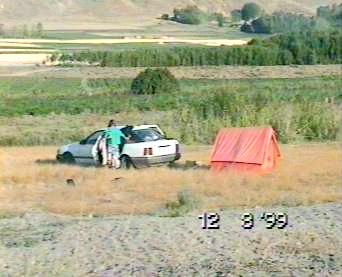
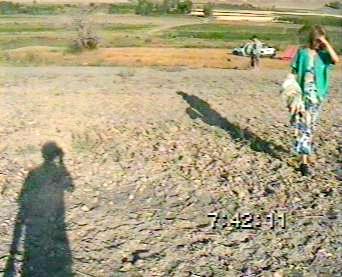
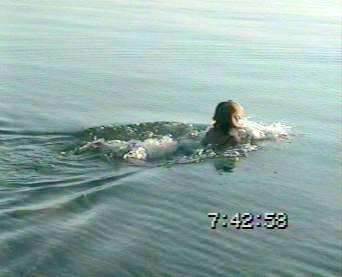
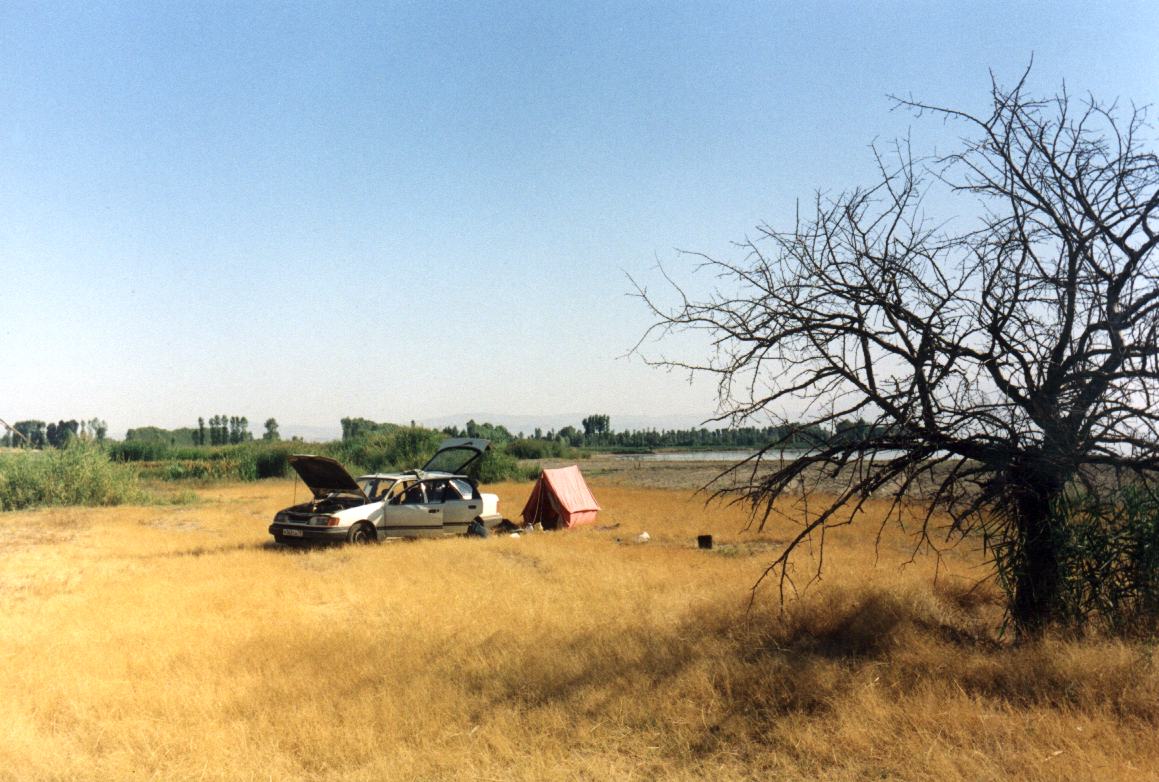
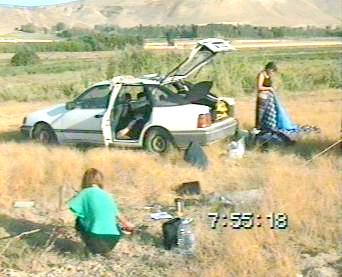
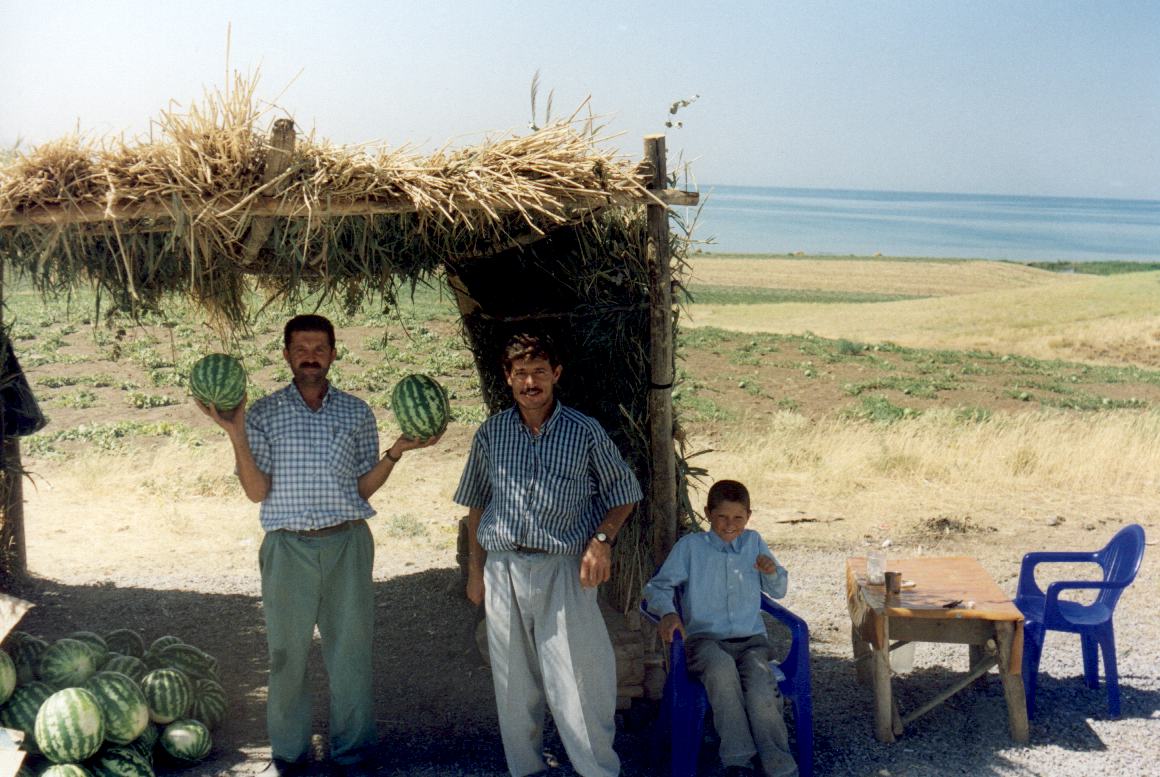
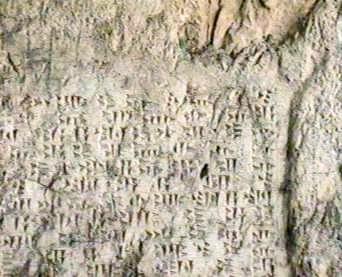
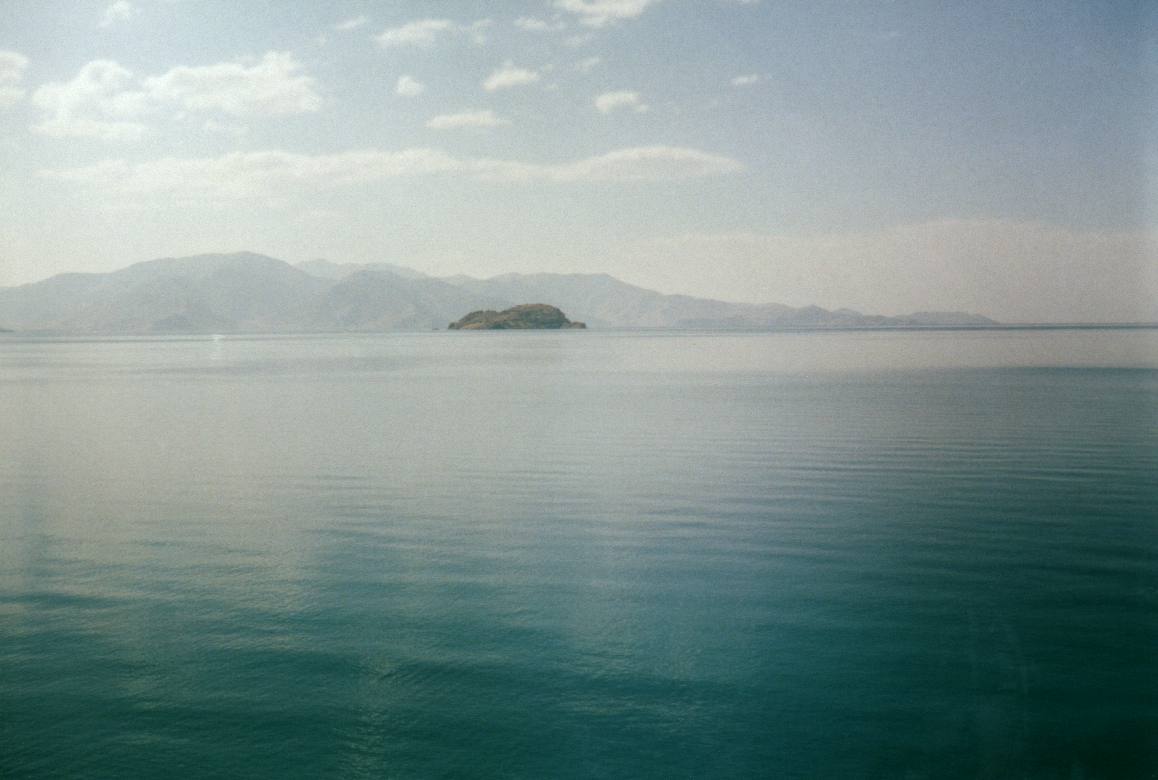
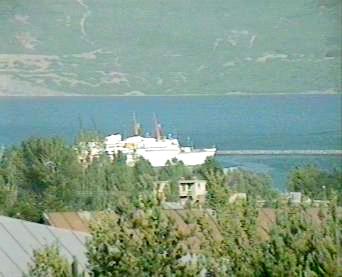
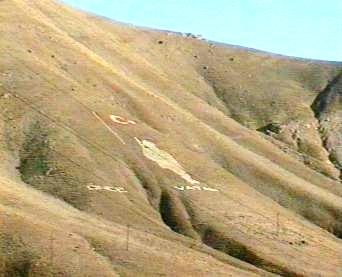
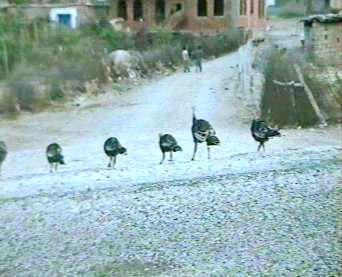
We woke in the morning and went for another swim. I rooted about under the bonnet and topped up the oil. We made breakfast. A local fellow turned up and began making offensive advances. He suggested going for a swim, to say nothing of what else he proposed. We packed in a great hurry and continued round Lake Van. We wanted to see Mount Nemrut, with a crater lake at three thousand metres, but didn't find the road. Near Erciş we bought a watermelon. The Kurdish vendors made a tremendous effort and asked us to take a picture and send it to them. At its easternmost corner the lake was overgrown with reeds. I'd never seen growth like that in salty water. There's a sign to Iran. Sad we weren't going there. The lake was turquoise. Lake Sevan looks like that. It's quite close, after all. So is Ararat. The next stop was Van, where the ruins of an Urartian fortress survive. It really is enormous. There's an entrance fee, but we got through a hole in the fence. Terribly hot. Tanya and Lena gave up quickly. I climbed a terrific height on my own. The fortress had been rebuilt many times, of course, and most of the buildings were Turkish by now. On top is an illuminated profile of Atatürk, who's like Lenin in the Soviet Union. His portrait is everywhere. There's also a minaret you can climb. I remember dragging myself up with the last of my strength. There's a fine view of the lake from the fortress. Scrambling about I found a cave with Urartian cuneiform. We found somewhere to have lunch. Farther on the road follows the shore. The locals swim, but mostly it was men. You don't see women on the street at all. If they do go in the water, it's in their clothes. We found a bit of steep bank out of sight and swam for the last time. Getting down, Tanya stepped into a puddle of bitumen and tried in vain to clean it off. The lake is deep right by the shore here. Around Vastan there are remains of an Armenian monastery on an island, four kilometres away. Within swimming distance, but we didn't have time. Farther on the cliffs come right down to the water and the road leaves for a pass in the mountains at 2,234 metres. It reaches the lake again near Tatvan. They couldn't even put a railway through here. A train ferry runs between Van and Tatvan. We saw it at Tatvan, an enormous ship. I wonder how they got it there. Along the mountain road were one military post after another. Tanya and Lena photographed them. So they stopped us and told us off. Madame photographed a soldier, Madame photographed a military installation. Spies and Kurdish terrorists, in short. They searched us carefully and asked repeatedly if we were going to Syria or Iraq. An hour later we got away, even without losing any tapes. Our mood had soured. We drove back through Bitlis. Somewhere they stopped us again, this time to scold us and demand money rather than check us. It seems I'd passed a petrol tanker over a solid line. I insisted it had been going under thirty kilometres an hour, but the local police had never heard of that rule. In the end I paid 11,300,000 lira, $26. Thoroughly depressing. Past the mountain stretch, before Silvan, we turned for Batman. At a little place called Şirit, peacocks were grazing on the road, like chickens at home. A good road, so I went fast. It was already getting dark. On the approach to Batman there's a view of the vast Mesopotamian plain, glittering with the lights of many towns. Farther south there are no mountains. Beyond Batman we drove southeast to the bridge over the Tigris and found a place to camp (37°43.362′N, 41°18.894′E). A gently shelving bank where we were, and a hundred-metre sheer cliff opposite. The river was warm, hot almost, and you could feel it teemed with life. Frogs croaked. We began a theoretical argument about whether there were crocodiles in the Tigris. The textbooks suggested not, but from the look of the river there might well have been. It was pitch dark and there was no way to tell by eye. We wanted to wash and swim. Van had been lovely, but salty. In the end Lena and I took the plunge. I even swam to the other bank. A fast, shallow river. It was only exactly in the middle that I couldn't touch the bottom. We got a good wash, hair and all. The bank was very dusty, grown over with exceptionally tough camelthorn that can even puncture a sleeping mat inside the tent. Pitching wasn't easy either. The pegs came straight out of the sand and the thorns stuck in us. Sooner or later we conquered nature. We even made a fire and cooked a meal. Here we were on the banks of another fabled river, whose waters flow to Baghdad. The Iraqi and Syrian borders quite close. We couldn't get through, alas, though we very much wanted to. Hot and humid in the tent. We slept on top of the sleeping bags with nothing on. Still hot, but we'd got used to it.
Day 14. Friday, 13 August 1999
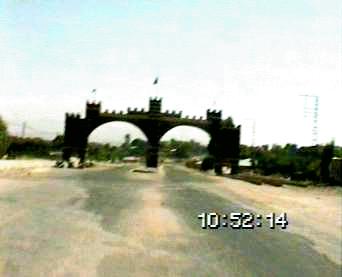
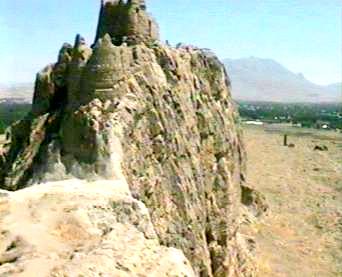
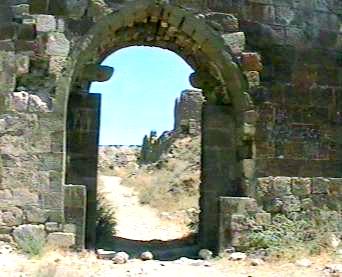
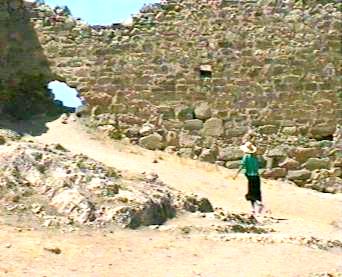
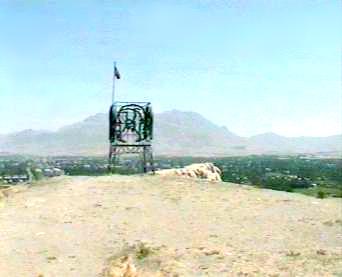
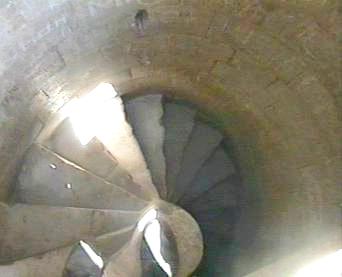
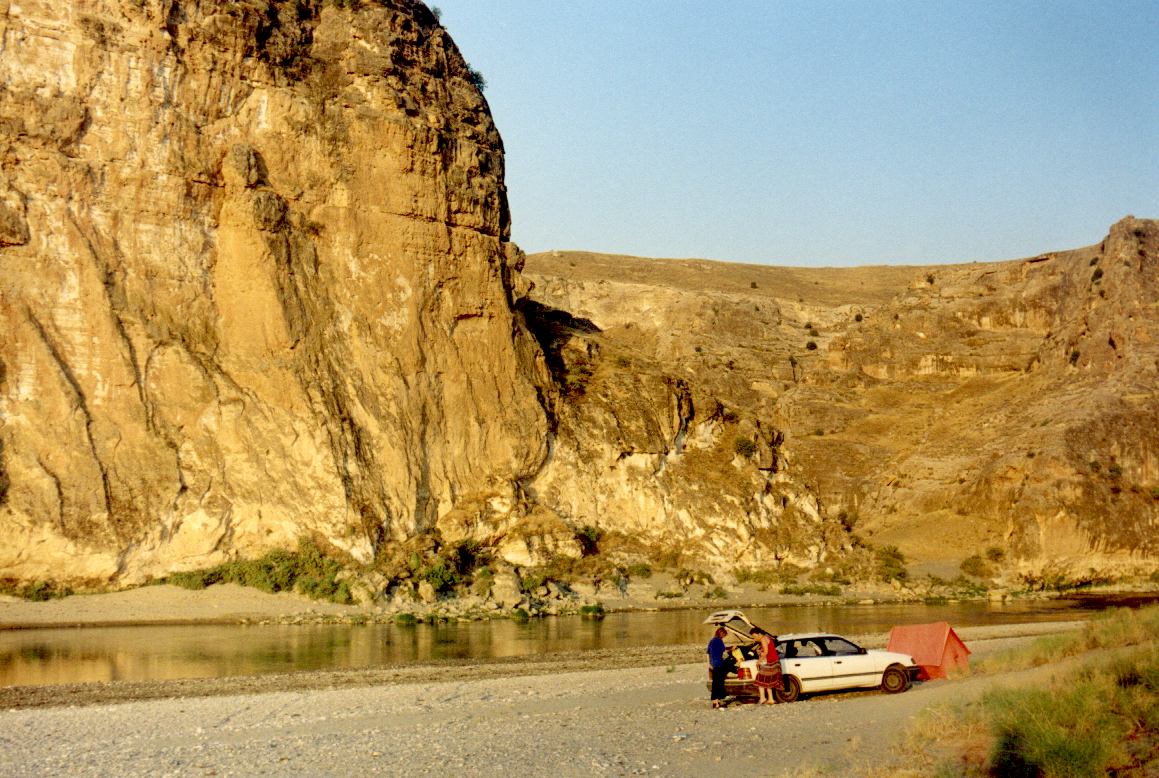
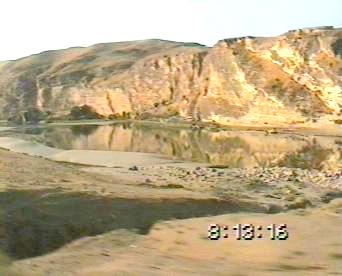
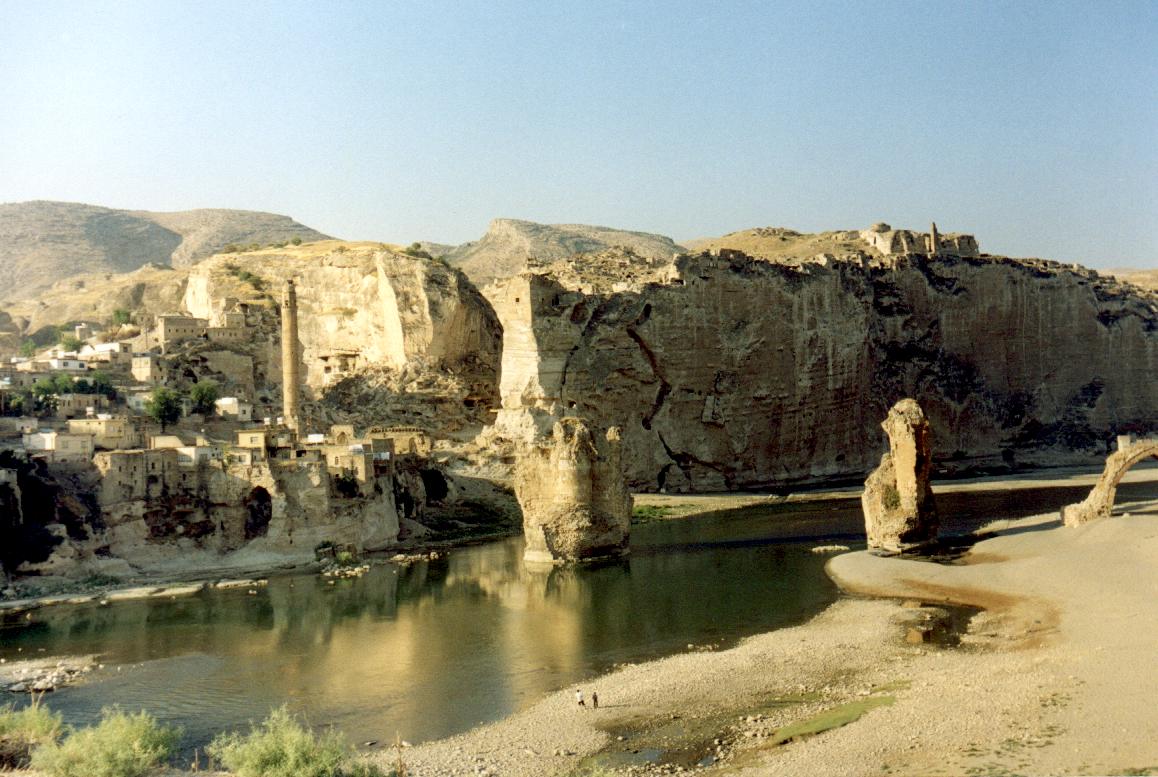
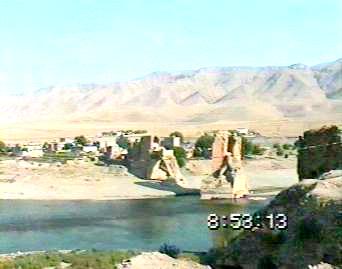
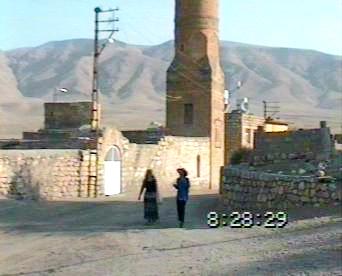
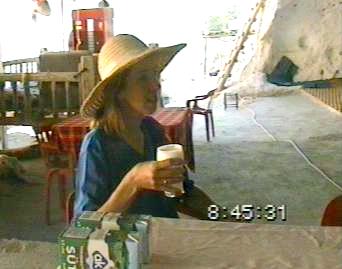
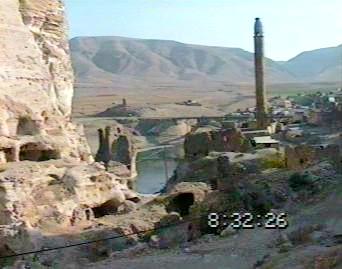
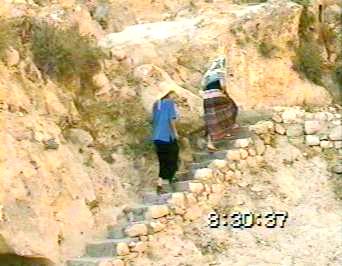
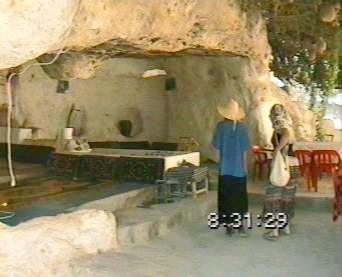
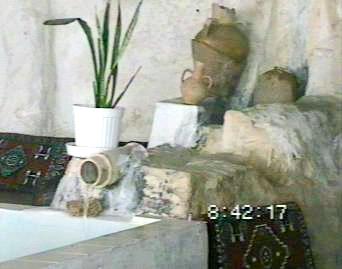
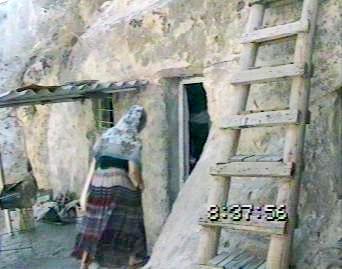
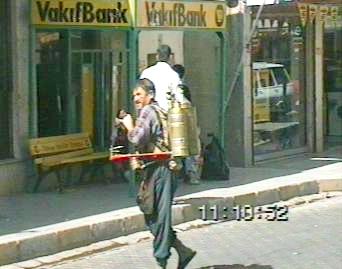
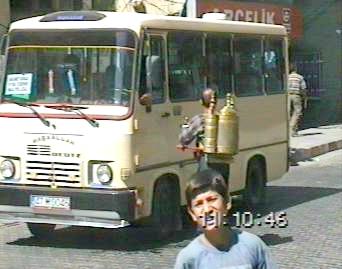
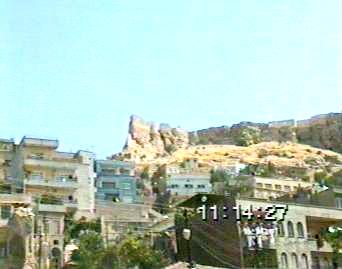
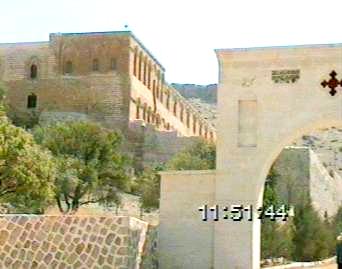
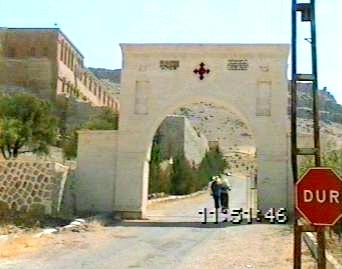
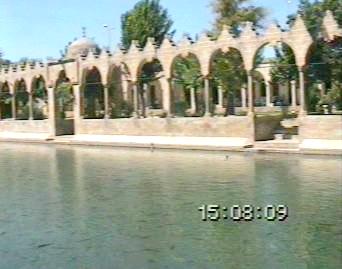
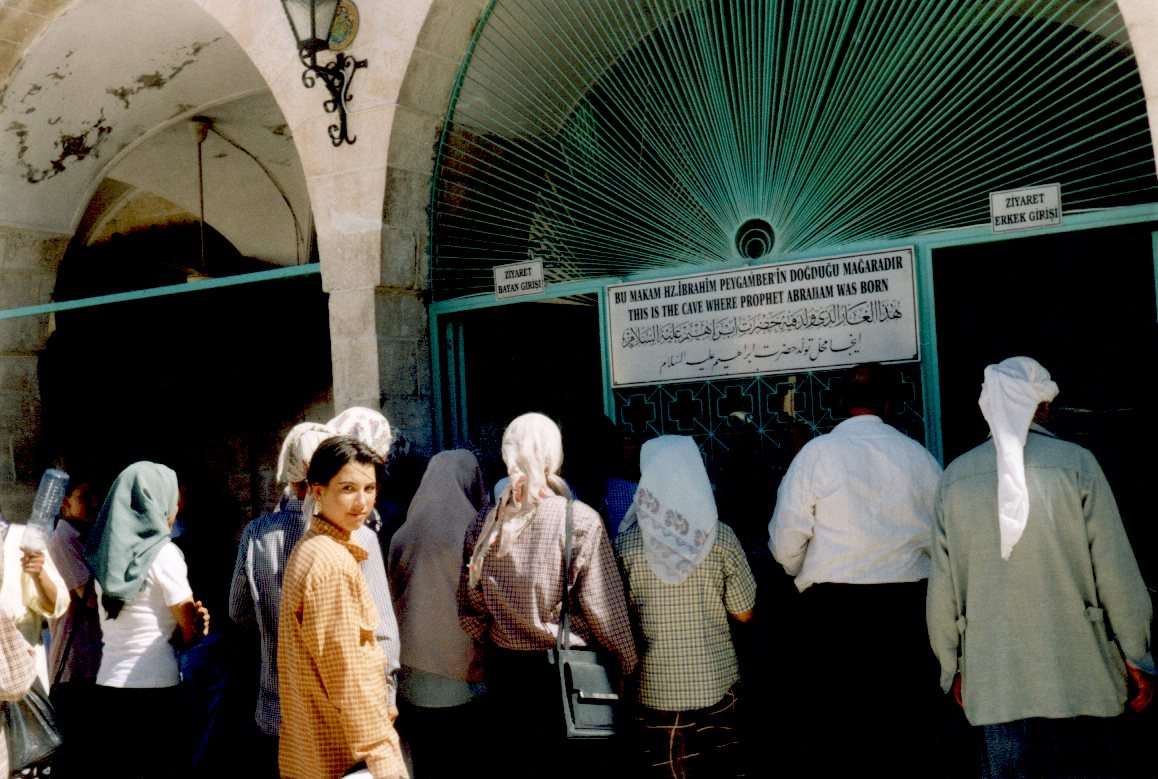
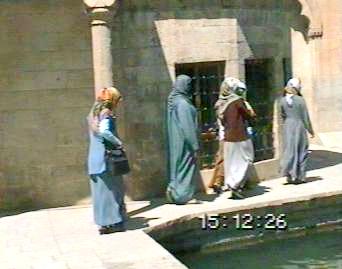
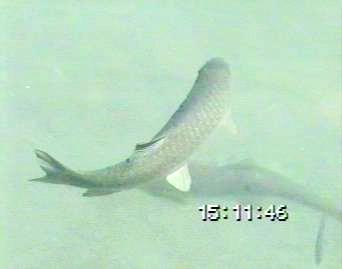
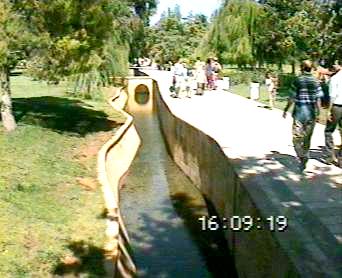
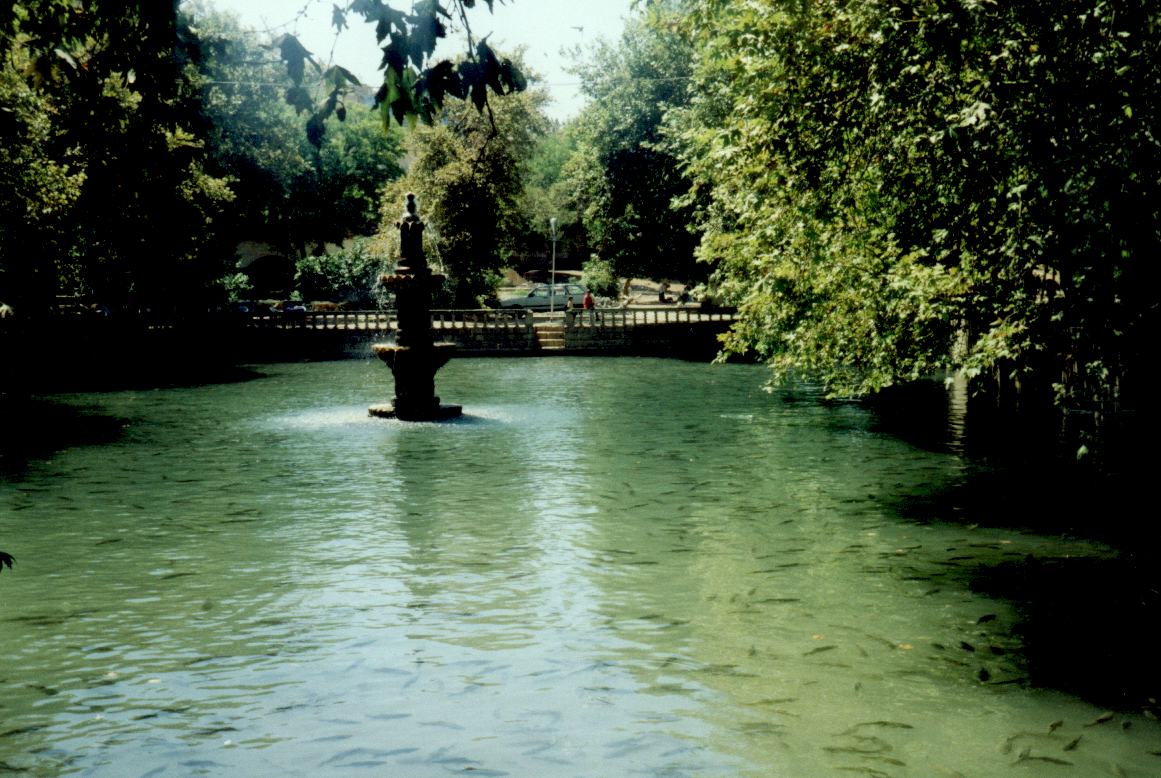
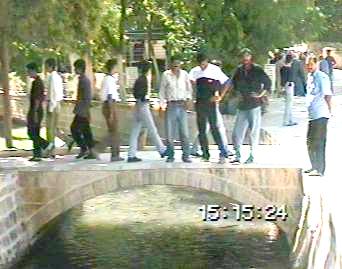
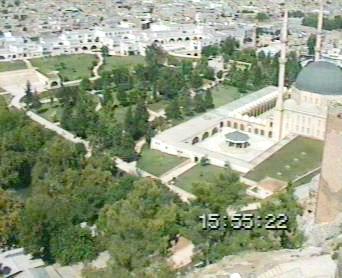
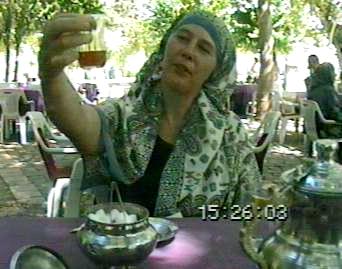
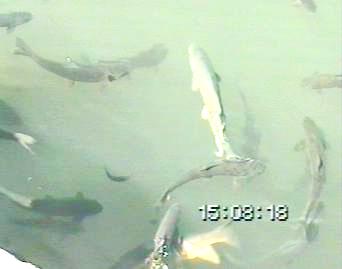
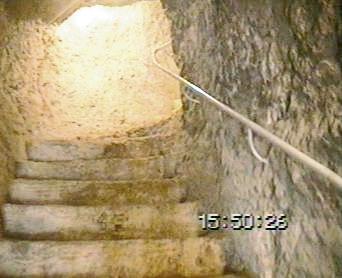
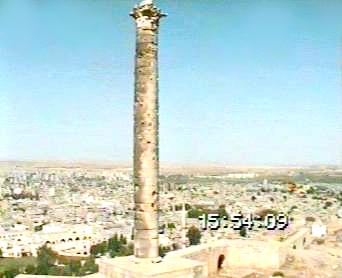
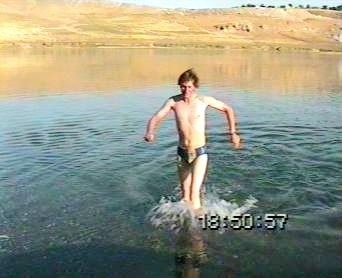
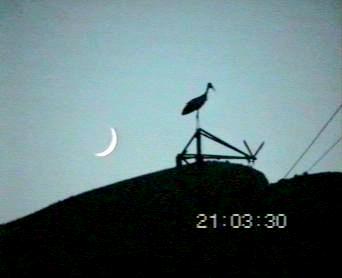
We got up early in the morning, before the locals could surround us and pester us. Soya and instant mash, then coffee and cake. We didn't get a swim that morning. People turned up and we had to be off quickly. We drove along the Tigris, with very picturesque rocks on the right bank. The bridge at the ancient town of Hasankeyf. Beside the new bridge are the remains of a Roman-era stone arch bridge. We stopped for a walk and some ayran. We'd come to a most interesting place, another cave town. We walked among the ruins and went into a café built right into a cave with a vine over the entrance. There were tables and rugs on which you could sit and eat Turkish-style. A pitcher hung on the wall pouring water into a tub with live fish. Here in the cave was even a telephone. Lena called Saint Petersburg. They even had Nescafé. We had a cosy time. Everything's laid on for tourists, but there weren't any. Few people would venture to the borders of Syria, Iraq, Turkey and Iran, right in the middle of Kurdistan. This is supposed to be where the main terrorist bases are. In general, there looked to be nothing to fear. The Kurds aren't going to blow up their own villages and don't take hostages. What did it matter to me who the man with the gun was? In such a state of contentment we drove to Mardin. A decidedly wild place. Almost all the women were dressed in black with a slit for the eyes. An ancient eastern city with a big bazaar. There were almost as many troops and gendarmes as local people, and four-wheel drives with men carrying automatic weapons stood in the streets. Meanwhile life went on as before. Nobody paid the soldiers any attention. A hawker walked the streets selling tea for a hundred thousand lira a glass from a mosque-shaped container on his back. Sometimes he even sold one to a bus driver at a stop. The town runs up the side of a steep hill, with a fortress on top. We didn't have the strength to climb it. High up, and all fortresses are alike. You can't climb them all. Civilisation had reached even here, mind you. You could buy cola and even women's tights with naked women on the packet. Business can sweep aside any religious prohibition. Near Mardin is a Syriac monastery. Tanya and Lena even tried to go in, but it was all closed. This was the farthest point of our journey. We now headed back west along the Syrian border to Urfa. On the signs it's Şanlıurfa. Mesopotamia all around, the cradle of human civilisation. A dreary cradle if you ask me. Burnt steppe, if you couldn't already call it desert. The road was smooth and straight. Going forward felt like standing still. The car hummed, the road was perfect, not a bump. The landscape outside didn't change. Forty-five degrees, and the air coming through the window felt as though it was out of a hairdryer. We poured water on ourselves, which helped a lot. About fifty grams on your head and you feel better at once. Your hair dries in a minute, but you can do it again. Tanya and I got through ten litres over our heads each day. Suddenly there was a queue of cars in the desert. I slowed down in good time but the traffic police caught me. I waited in the queue for a long while. He had a fine haul that day, waving down ninety per cent of the cars and sending them all to the line. I waited my turn for the privilege of talking to him. They said I'd been doing 93 km/h and wanted another 11,300,000 lira. I tried to haggle. They showed me the stack of receipts: everybody pays. I offered half at least, saying the fine was eight minimum wages, a lot for a poor Russian tourist. They tucked my licence at the back of the queue and started taking money from the next driver. Another half-hour waiting and I was ready to part with the money. What rotten luck. They got me every day. It seems God heard me, though. In the next four months I drove twenty-five thousand kilometres without being stopped once. Urfa is the birthplace of Abraham and seven more Muslim prophets. A holy city. Pilgrims come here. According to legend, God said stone would turn to fish and water where Abraham was born. Today the town has enormous pools in a splendid, cool park. There are lots of cafés there and we ate long and well. Countless carp swim in the pools. They're sacred and can't be caught or eaten. Children sell food for the fish. Feeding them is considered a godly act. The children are very persistent generally, hanging on to you and calling “Hello, hello…” At the holy sites there are crowds of particularly devout old women with children, trying to touch whatever it is you're meant to touch. I didn't dare push my way inside, but Tanya and Lena went in, even with the camera, and filmed the cave in which Abraham was born. The Crusaders captured the city and there are remains of a fortress. An underground passage leads into it. Only two columns remain from the Crusaders, but it's interesting to climb up through the passage. A beautiful view over the city. Parking had been hard and we'd had to leave the car in the sun. It was fifty degrees in the shade. When we returned, the car felt like a hundred degrees inside. Disposable dishes had melted into one lump. The ballpoints had curled into rings. Worst of all, my Zenit camera had broken. You couldn't touch the steering wheel, and I had to drive wearing mittens. We went towards Mount Nemrut through Adıyaman. We crossed the Euphrates just below the Atatürk reservoir and turned off to swim. One hand in the water told us it was icy, five to eight degrees. It must come from the bottom of the reservoir. Beautifully clear, though. We got in for a few seconds, as long as we could bear. In spite of the cold, frogs swam and croaked. Once again the southern night stole up on us. We looked for a camp for a long while without success and eventually stopped near the Atatürk reservoir, beside an oil well (37°49.643′N, 38°38.007′E). The crescent moon was already showing, so there'd be no more pitch-black nights. A stork was spending the night on a post beside us.
Day 15. Saturday, 14 August 1999
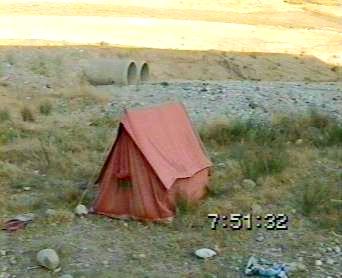
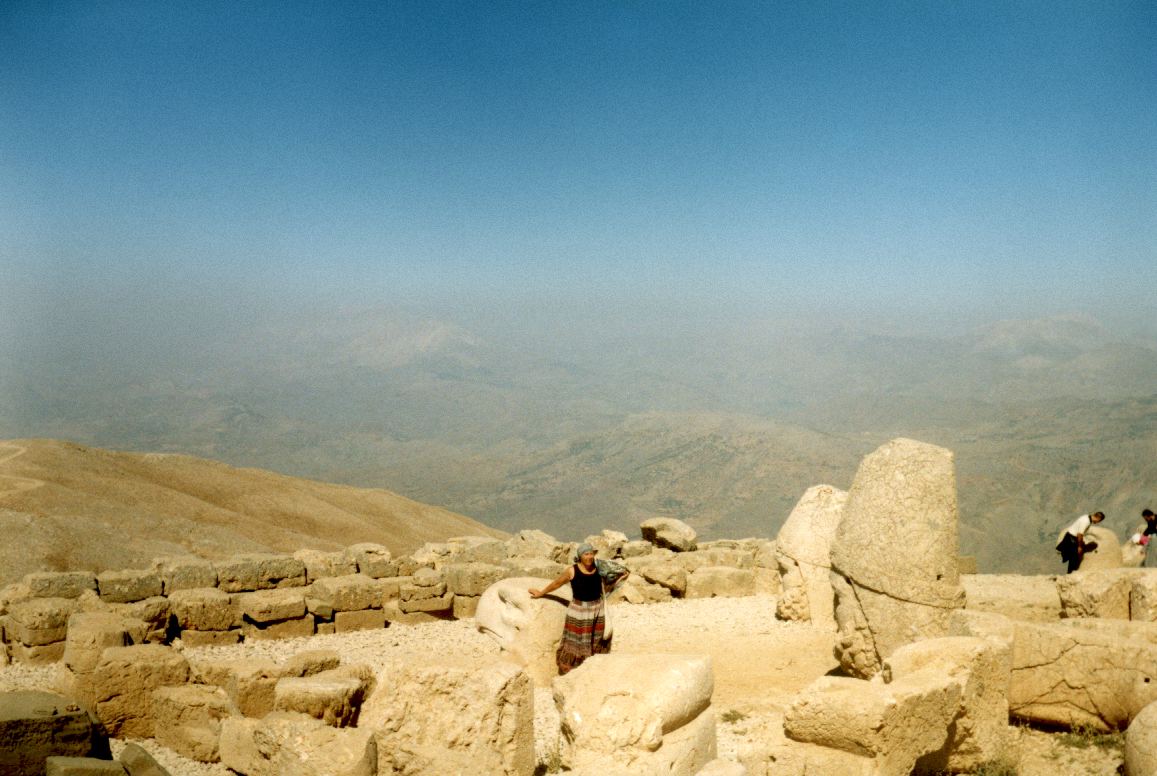
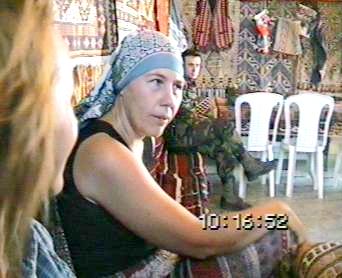
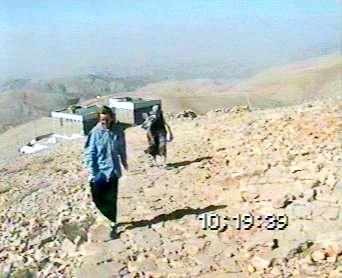
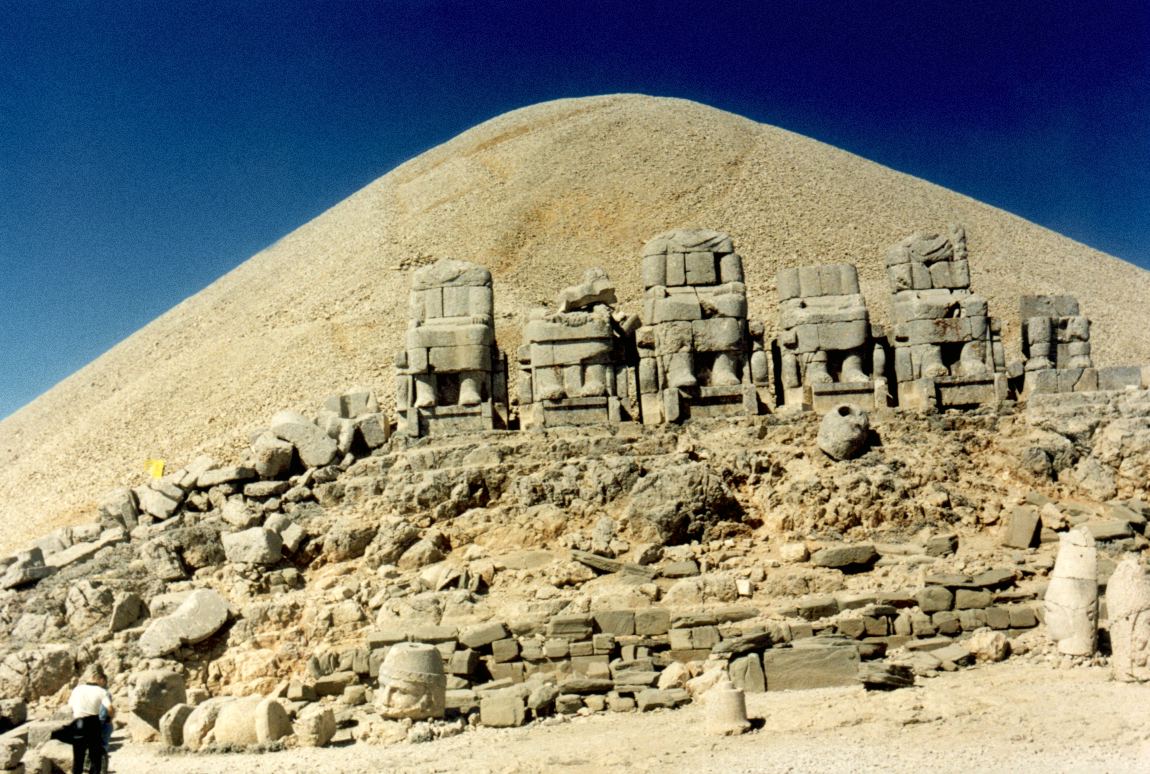
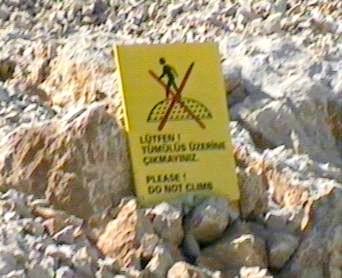
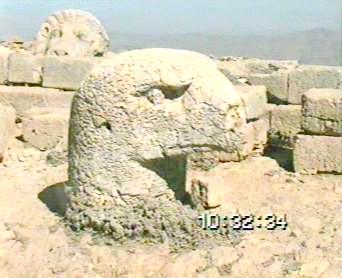
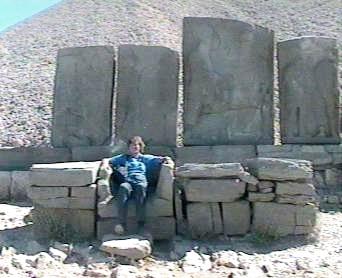
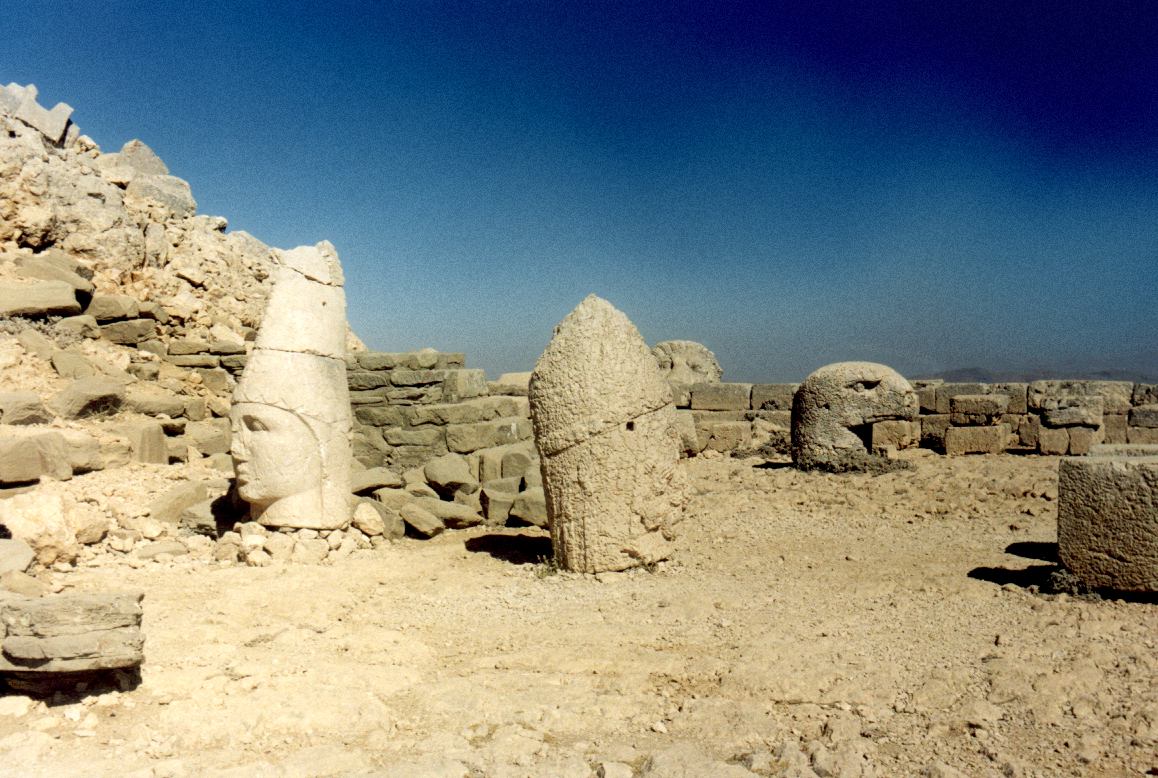
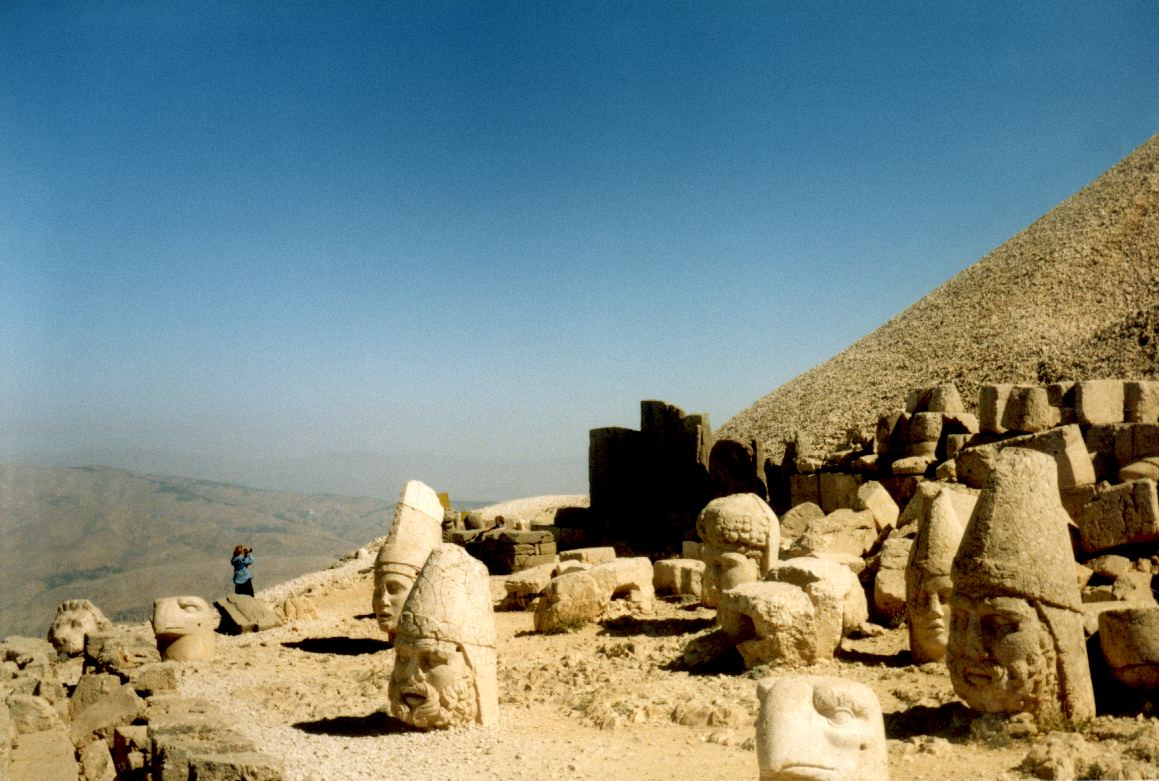
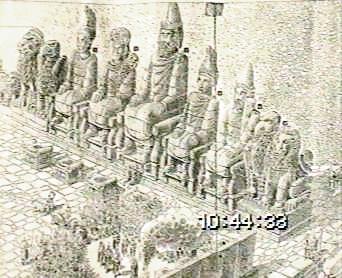
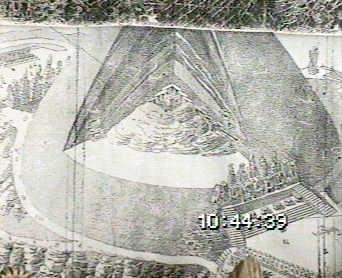
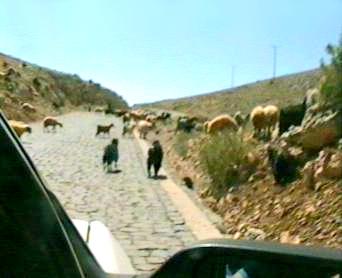
We woke, as usual, to the noise of Turks going past. They showed no particular interest, but we still wanted to clear out quickly. We did have time for breakfast. We climbed Mount Nemrut in the car. A very steep road, an unbroken thirty-per-cent grade for kilometres. It was paved in diabase, none too evenly. Driving up was frightening. It felt as though the car might slide backwards any second. I went in first gear. The road stops five hundred metres short of the summit. Perfect blue sky above us, a howling gale, and cold. A feeling we'd long forgotten. We wanted something extra to put on. The thermometer read eighteen degrees. From up there you could see in the haze an immense tract of country, including the Atatürk reservoir. At the entrance is a hut selling tickets, where you can eat and buy a few things. We drank tea and got talking to the locals. Apparently there were hardly any Russian tourists. The man said no more than ten people a year, and nobody remembered a car with Russian plates. We climbed the remaining five hundred metres. That's the length of the path, not the height gained, of course, but it was hard going all the same. The poor ancient Syrians. How did they haul all these stones, a quarter of a million tonnes in all? The summit is the tomb of Antiochus, a fifty-metre mound of marble stones about the size of a fist. They aren't local stones, as you don't find any like them lying about. It's like an Egyptian pyramid, only in the shape of a half sphere. The stones slide and you're not allowed to climb to the top. Around the mound on the four sides are seated statues of Apollo, Antiochus, the sacred eagle and Zeus, four to a side. The statues are ruined. Only the legs have stayed seated. The rest of them lie nearby. There's a small free museum with an impression of how it all would have looked. Of the ancient ruins, Mount Nemrut impressed me most. There's a grandeur to it. We must have spent an hour walking round the mound. Going down I ran into an interesting problem: engine braking in first gear wasn't enough. I began to worry about overheating the brakes. I got out and the discs were indeed very hot. We stopped at a café to eat and drink ayran. The owner said you couldn't get up the mountain in winter. Up to three metres of snow fall there. What a pity we'd spent the night down below. We could have camped near the summit. Herds of goats walking down the road made it hard to drive. The mountain coolness ended quickly and it was back to forty-five degrees outside. On to Gaziantep, a large green town, where thermometers were showing forty-eight to fifty-two. It really was hot. We stopped to eat and gather our courage for Syria, which was just across the way. There were signs for Aleppo in the streets already. It was rather frightening somehow. Turkey had become like home by now, and Syria had sterner customs and an Arabic alphabet. In Gaziantep we found a fish restaurant, very nicely decorated. It was pleasant to sit there, limp from the vicious heat. Lunch cost eight million lira. We decided that if we went on eating like that we'd be broke soon, and resolved to eat less. To finish off they gave us a free basket of fruit. The Syrian border was close, sixty-five kilometres to Kilis. It was well guarded, with barbed wire. Relations between Syria and Turkey were bad. They'd even fought, sometime in the fifties as I remembered it. And generally there was NATO on one side and terrorist, semi-dictatorial Syria on the other. The border guard was bored. Taxis waited for people who crossed on foot. I went to negotiate, apparently in Syria by then, talking with the border officials. They said there wasn't much of a problem. We could get visas without trouble at Damascus airport or the embassy in Ankara. They hadn't been trained to do that here, so we should go to Ankara. What a shame. It would have been no trouble to call at the Syrian embassy when we were there. No ruins of Palmyra or five-thousand-year-old Damascus for us. All right then, on to the Mediterranean. It was evening, so we went looking for a camp. We pitched in a planted pine grove on the shore of the Tahtaköprü reservoir (36°52.001′N, 36°41.692′E). We made a fire with cones almost the size of Pitsunda pine cones and went swimming. Fresh, warm water. You didn't want to get out, although we felt uneasy. We were hiding from the locals. It was more peaceful without them. If they saw us swimming, they'd attach themselves to the women like wet bathhouse leaves. While we were in the water, a fist-sized head suddenly stuck out and opened its jaws. We never worked out what it was, but decided to continue the debate about whether it was a snake or a swimming turtle on shore. More restful that way. We'd just put up the tent and cooked dinner when a car stopped below us. They couldn't see us, well hidden in the bushes. A man got out a gun and began firing. He was shooting at a dog that happened to be nearby, not at us, but the bullets flew right over our heads. After shooting the dog he settled down. That's how things are here. Maybe it was because we were two kilometres from Syria. Or just a Saturday evening. There was shooting around us all night. An uneasy feeling. We stayed by the fire quite a long while, though, watching a young crescent moon set behind the hills.
Day 16. Sunday, 15 August 1999
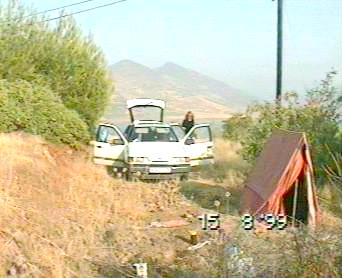
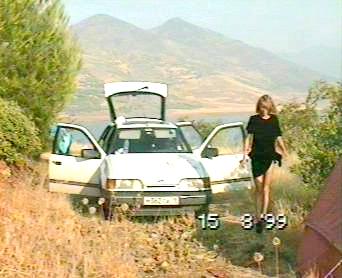
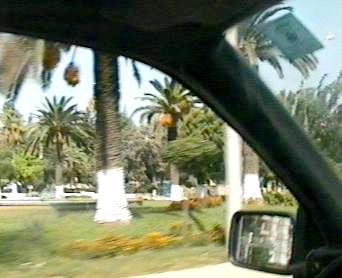
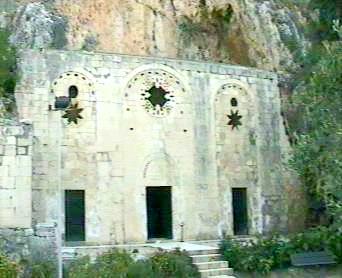
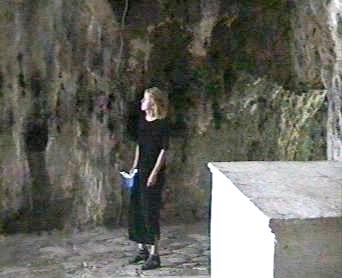
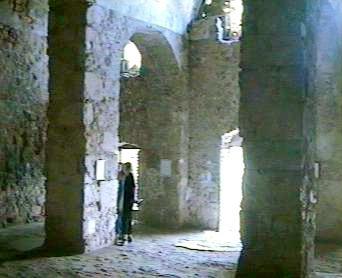
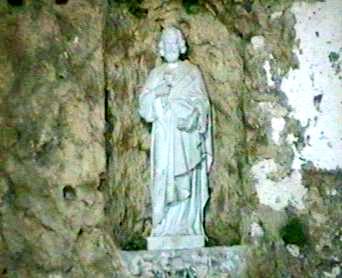
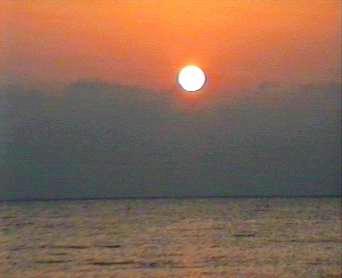
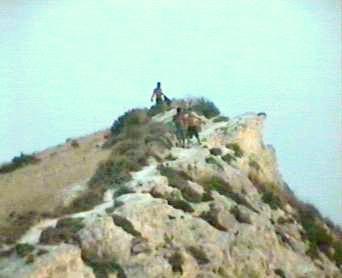
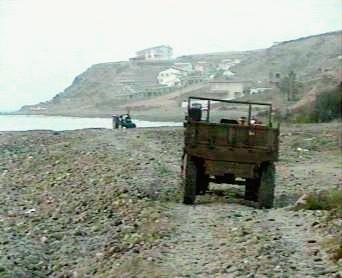
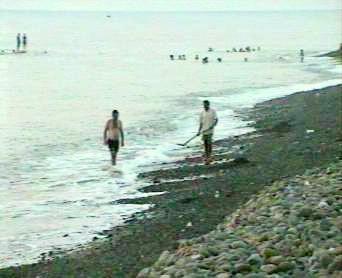
We woke, had breakfast and decided to clear out quickly. There were spent cartridge cases all over the road. On to Antakya, the former Antioch, capital of Syria and a Roman province. A big new town, with practically nothing left from Roman times. It doesn't stand on the sea, but the climate feels quite different. There is no winter here. Summer is humid but not so hot. The outside thermometer read thirty-four. Palm trees grow as matter-of-factly as any old spruce at home. The town is green and full of different tropical plants. Dates ripen on the palms, and fig trees grow along the roads. You can stop and pick them. Fountains at every turn. Plenty of water, with the big Asi River flowing through the middle of town. There are lots of shops, and people come from Syria to buy things. By now people took us for Arabs. Realising we weren't going to see any more countries and wouldn't be spending money on visas, we went shopping. Lena bought a leather coat, I got jeans and shorts, and Tanya shoes. From Roman times there remains the church of Saint Paul, held to be the fourth Christian church in the world. It's essentially a cave in the rock with a wall built across the mouth. Inside stands a statue of Paul and other, later additions. Only the cave was there in Paul's day. The rest was put up by the Crusaders and by Catholics as late as the twentieth century. There is a holy spring. There is an admission charge, but they let us in as students. It helped that they hadn't seen Russians for a long time. We had lunch and drove to the sea at Samandağ, a small resort town attached, as it were, to Antakya. An excellent beach of fine pebbles. The water was murky, but at least there were no sea urchins. It was thirty-five degrees in the water. There weren't any foreign tourists. Women no longer wore black robes. The most daring wore shorts, but they got into the water in whatever they had on. We decided we'd had enough of hiding and swam in swimsuits. No one made much of a protest, though they looked askance. I imagine that's how people would react to somebody swimming without a suit in Russia. That part of the coast was packed. We'd wanted to camp right on the beach, but there were too many people. We went looking for somewhere wilder. We tried driving north along the coast, but the road marked with a thin, lonely line on the map wasn't for our Ford. We had to go back to Antakya and then head south out of İskenderun. The road follows the shore and is very pretty. Campsites were expensive and there didn't seem to be any vacancy signs. We ate at a café and swam again. A wedding convoy came down the shore, fifty cars with flags and drums, blocking the whole road and squeezing oncoming traffic onto the verge. We drove on and came to a gendarmerie post. They seemed to be letting people through only on permits, or in any case didn't let everybody through. A military base or a restricted border zone. We decided to risk it. A Russian car caused some confusion. We said we were going to Kale, the fortress marked on the map. The gendarmes decided foreign tourists were sacred and let us through. The country got wilder. The road deteriorated sharply and took us into a village, where we lost our way in the narrow streets. Turning round was hard, but the whole neighbourhood waved their arms to show where to turn the wheel. We didn't find the promised Kale, but found a small headland and a farmer's house, where the road leaves the fields. We climbed onto a rock and saw an excellent campsite. A four-wheel drive was there getting ready to go home. It was right on the beach, ideal in every way except how to get there. I went to scout the track the four-wheel drive had taken. Barely passable, but it would do. I went on and on. Tracks met and diverged. I began to doubt whether I'd find my way there when I came back with the car. It was a hot, hard walk. Only thirty-five, but humid and I was streaming with sweat. How much easier to drive. An hour of looking and I found the way back to where we'd left the Ford. By car it took almost no time. I scraped the bottom a few times, but got there. I parked right on the beach (36°22.720′N, 35°51.543′E). The sun was setting straight into the sea. A hazy sky and a great, red sun. We got into the water. The locals came running to look, though they were less persistent here. It was the coast, after all, and they were used to tourists. Even so, the next village sat down on the rocks to watch. Two men came on a tractor and began digging up the beach with a spade. We swam for several hours and our spectators got tired and went away. In the evening the family from the house nearby came for a swim. The moon had taken the Sun's place and the crescent had grown quite a bit. After our swim we cooked a lot of good food and put on the radio. Radio waves travel splendidly over the sea. Arab stations, Cyprus and Israel on FM. You could even get stations playing European music instead of nothing but Arab and Turkish wailing. I found a station from Haifa. We went swimming again for an hour in the evening. When you moved your arms or legs the water lit up in little sparks around them. Some sort of organism gives off light. Fascinating to see. Swimming at night is lovely. No curious Turks on the shore and you can do as you like. We sat at the fire for a long time that evening. Warmth and the sea lapping. The shore twinkling with lights from nearby villages. A southern sky we never see at home. Cicadas singing. Good radio. At last we relaxed after eastern Turkey. The tent stood right on the beach, a few metres from the surf. We slept softly and sweetly.
Day 17. Monday, 16 August 1999
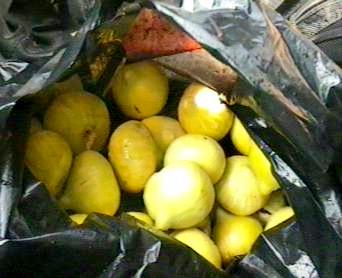
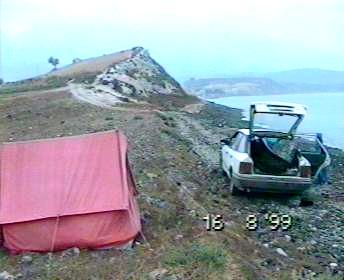
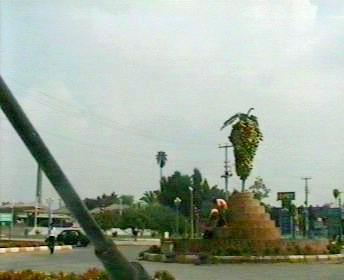
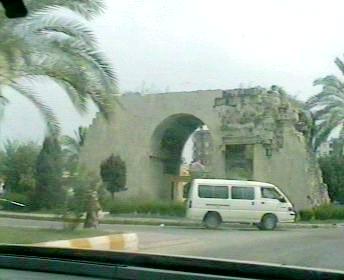
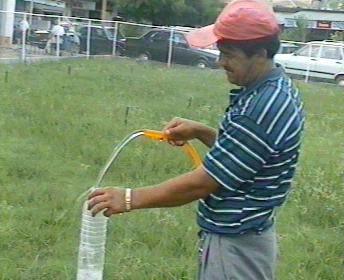
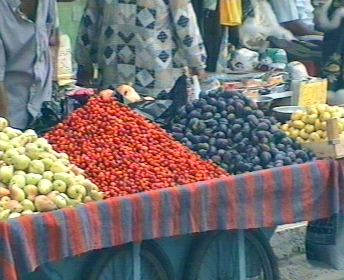
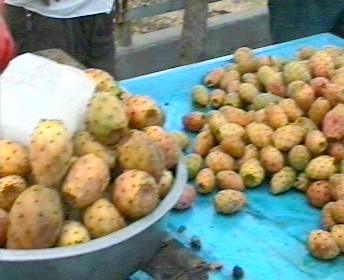
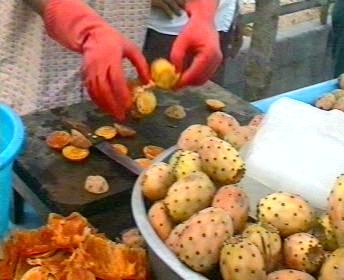
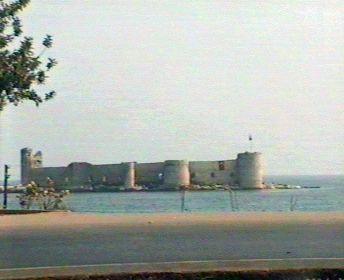
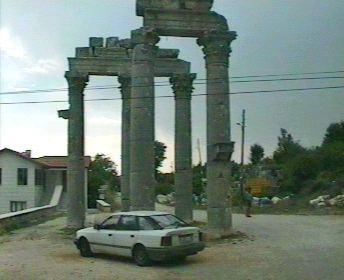
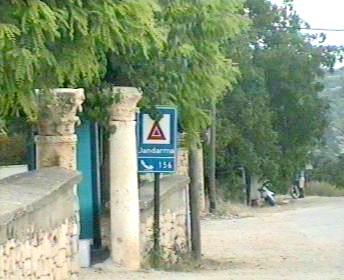
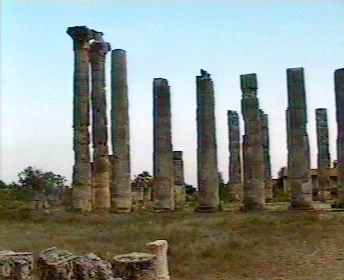
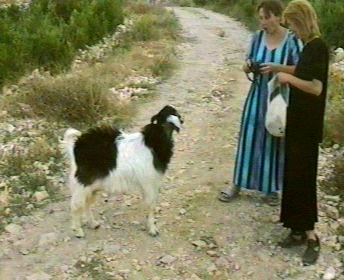
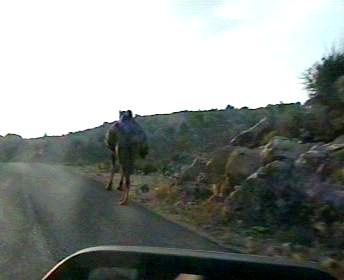
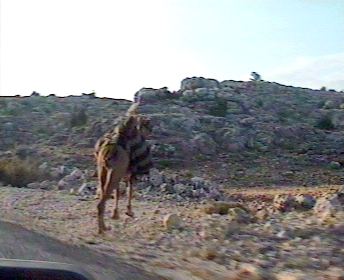
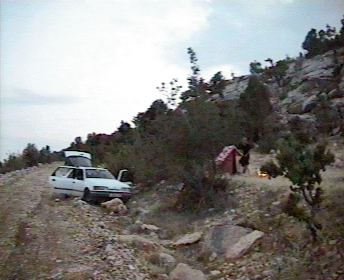
There was no sun in the morning, for the first time in many days. No rain either, though. We took our time over breakfast and had a swim. I looked over the car, topped up the oil and added distilled water to the cooling system. I checked the suspension. Everything seemed to have survived except for an oil leak I'd found. We went back to İskenderun, a handsome new city. From there the road goes along a free road alongside the motorway. The resort coast soon ends and there's a plain covered in factories. In Adana there's the Great Mosque of the sixteenth century. Enormous and worth a look, though we didn't go inside. Nothing else of interest in Adana. In Tarsus there is Cleopatra's Gate, on the way into town from the sea. This was where she met Antony after the Battle of Actium, as the story went. Nearby in the middle of a square there's a vine twig many metres high in place of an Atatürk monument. There is also Saint Paul's Well, whose water has been declared holy. It stands near the house where he was born and has a pump, so they'll draw water on request. Tanya filled a one-litre plastic bottle and took it home to Saint Petersburg as a souvenir. Cloudy, stinking water. My impression is that the Turks made the whole thing up. There are bits of foundations two metres down from that period. Paul's house and well may have been there, but they now pass off the first available ruin as the real thing. The town is also famous as the place where Frederick Barbarossa, the Holy Roman Emperor, drowned crossing a river on crusade. They don't show you where he drowned, though. The stream through town is ever so shallow. He must have had a good deal to drink to drown in it. The coast is much richer in vegetation. The town was full of strange fruit and vegetables: plums, peaches, cornelian cherries, figs and much that we didn't know. At one stall they sold something orange and prickly, like a cactus. Tanya picked one up to feel it and the sellers snatched it away in horror. They said the prickles were deadly poisonous and began looking over her hands for wounds. All was well. The vendors themselves handle them with thick rubber gloves. Apparently you're meant to peel the skin off and eat them. Fifty thousand lira each. We bought a little bag and ate them. Lovely. We never did find out what it was called. After Tarsus the road came back to the sea. The coast was mostly rocky now. There were bays with beaches, but they were built up and you couldn't get to them. The beaches were either private to campgrounds or charged admission. We swam off the rocks, which was every bit as nice. Thirty to forty degrees, but humid and sweaty. The desert was much easier to bear. Ancient ruins began to appear along the coast. At the first, Sebaste, we clambered about, surprised how little anybody guarded the place and how neglected it was. A sign said Fiat had given money for restoration. Sure enough, there were traces of a long-unfinished building job, just like home. Tourism in Turkey was at its height five years before, and since then things had run down. People had had their fill of Turkey and Westerners were afraid of the Kurds. The ruins came one after another as we drove. You could find traces of building in every bush. The next interesting place was ancient Corycus. The usual things: a theatre, temple, library, necropolis and so on. The standard town plan of the first century AD. Lena asked indignantly where they'd find enough people in this village to fill theatres with fifteen thousand seats apiece. In Corycus near the shore there is an island with a fortress on it. I liked the look of it, but we didn't swim out. The island often turns up on Turkish posters. It was hot on the coast and we turned up into the mountains to spend the night, stopping first to see the ruins of Diocaesarea. It was built in Vespasian's time and the place is now called Uzuncaburç. As soon as we'd climbed into the hills it felt pleasant and cool. We drove through forest. The local grasshoppers were so loud I thought something had broken in the car. I stopped and turned off the engine and realised it was the insects. The ruins of Diocaesarea are on a mountain, with a village right in the middle. The people put the ruins to use as best they can, building a fence out of columns, for instance. The gendarmerie had pinched two columns for their gate and lined up all the naked women they'd collected from temples beside the fire station board. The ruined Temple of Zeus. Two rows of Corinthian columns are all that's left. A sign at the entrance says “No tents in the Temple of Zeus”. The columns glowed in the setting sun. Lead-coloured clouds hung right above us and a storm was brewing. Lightning flashed, but no rain fell. It all looked majestic. Angora goats wandered about and pestered us to scratch them like cats. We drank ayran and drove off to find a camp. Suddenly a camel ran out onto the road and ran in front of the car for a kilometre, like a hare in the headlights. It could run fast. I was doing sixty. We settled on a mountainside (36°43.240′N, 33°39.616′E). We later found there was a quarry behind the hill with some terrific piece of machinery at work, but luckily it stopped at sunset. A pleasant spot with firewood. We sat by the fire for ages talking about life. I couldn't sleep for a long while afterwards. I felt some jolts. An earthquake, I thought, but a small one. I didn't wake Tanya. We learned afterwards that nearly twenty thousand people had died at that moment.
Day 18. Tuesday, 17 August 1999
In the morning we had breakfast and set off for Konya, a large city famous for the Muslim order of whirling dervishes. The dervishes whirl twice a year, around the winter solstice, so we didn't see them. There were recordings on cassette everywhere. I bought a tape of meditative music. There are two mosques, one a museum with admission of a million lira. Inside are the tombs of the dervishes, their belongings and other relics. The chief one is a hair from Muhammad's beard. It's in a casket, the casket is behind glass, and everybody is supposed to touch the glass. There's a room with stuffed dervishes, or models of them, including some drinking coffee. So there had been coffee in Turkey. Apparently the dervishes drank it all. The mosque next door is still in use. You can go inside, including women. Nearby was a display and sale of various wares, mostly ceramics. We ate at the restaurant in a hotel, which was the only place we'd been where they cooked quickly. In central Konya there are underground pay car parks and lots of bicycles. There are even bicycle stands. Driving across the city is hard, with nearly two million people and narrow streets. After Konya we headed back to the coast. On the way we bought more honey. First we went to Beyşehir, which has a large freshwater lake. The shores were overgrown with bushes. The lake is shallow, the water dirty, and the shore a rubbish tip. I cut my foot getting in. I didn't like it, in short. Farther south we took a road the map marked out for fine views and passes. The road wasn't very pretty and the passes weren't particularly steep. We saw a sign on a yellow background saying we'd never forget the sight ahead. It took us to some decidedly typical village. We swore about it for a long time and had to turn back. We camped for the night on top of a mountain, in a pine forest (37°14.894′N, 31°45.603′E). A lovely sunset that evening. We made a fire with pine cones. It was so dry around us I was afraid of setting the forest alight. On the radio we listened in English to the “Radio of the Independent Turkish Republic of Cyprus”.
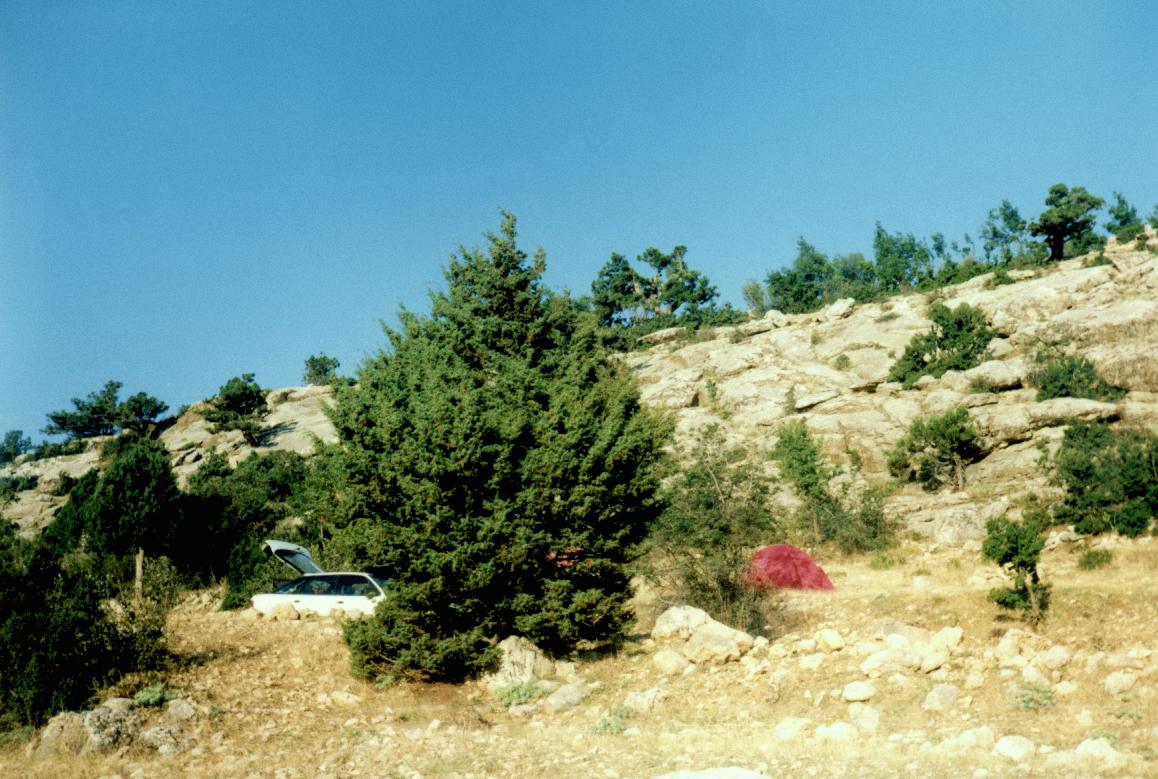
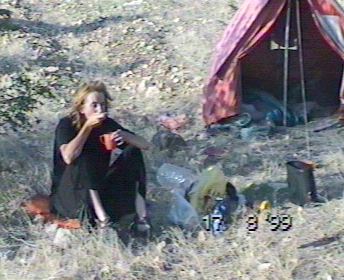
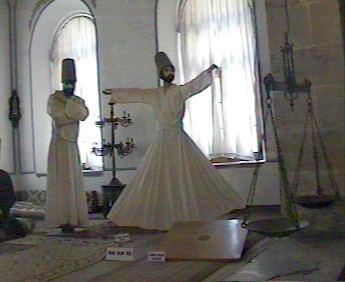
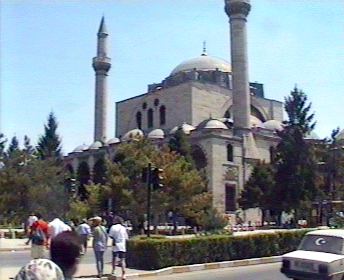
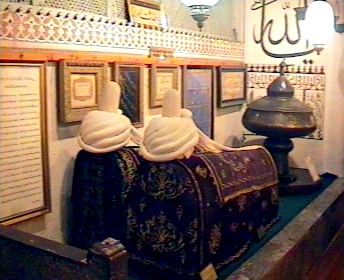
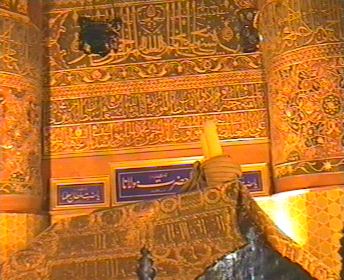
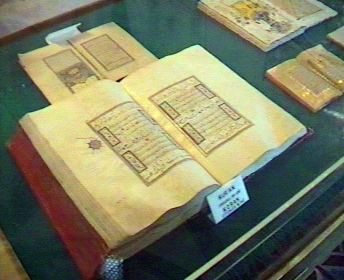
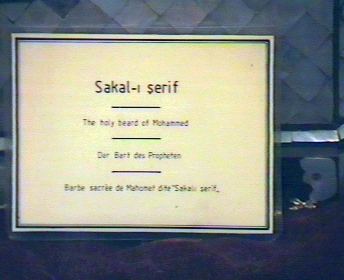
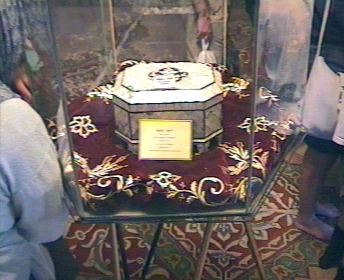
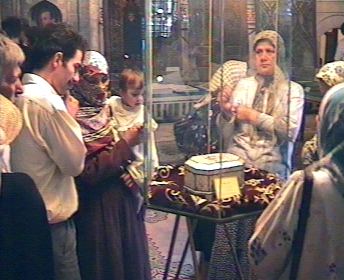
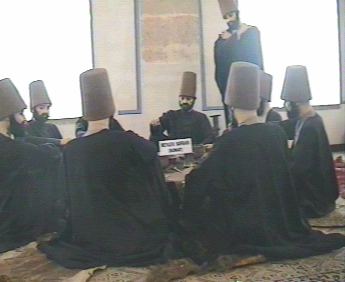
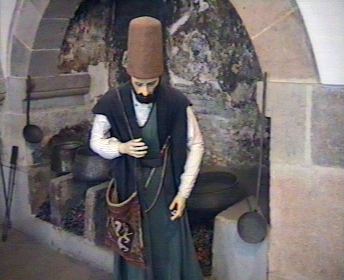
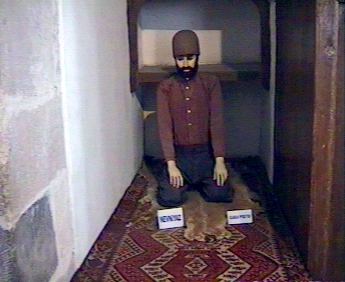
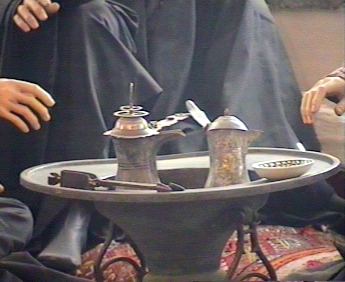
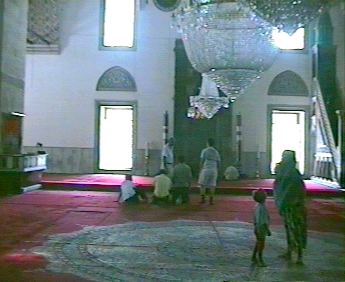
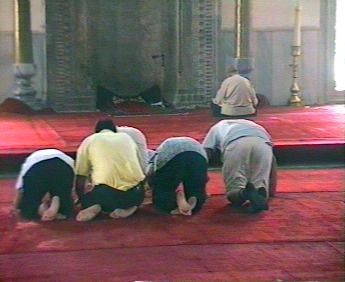
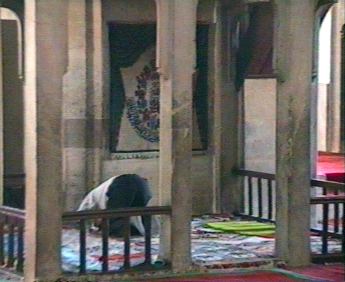
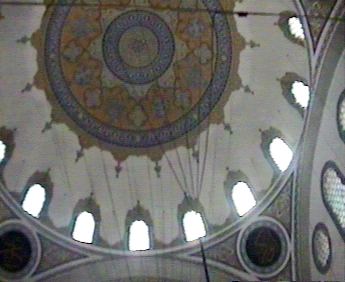
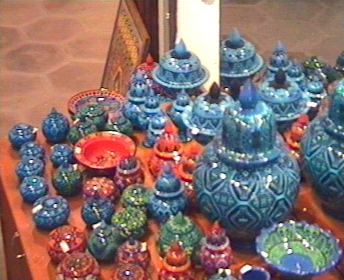
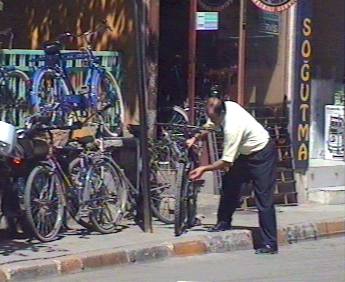
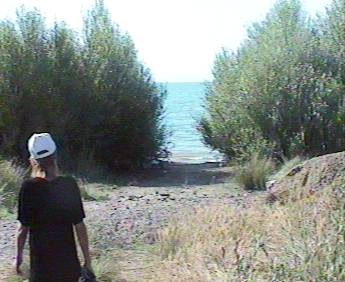
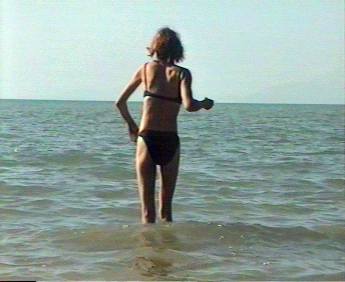
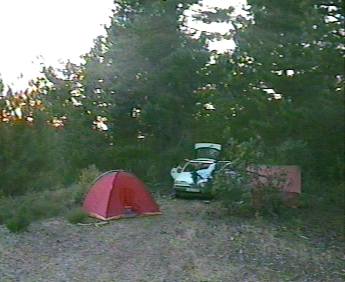
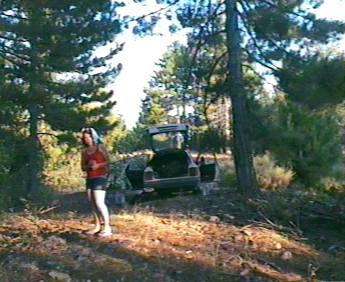
Day 19. Wednesday, 18 August 1999
In the morning we drove out to the sea again. In Manavgat, Lena rang Saint Petersburg and found out about the severe earthquake in Turkey and that everyone at home had decided we were dead. Tanya and I had to ring too. We don't like telephone calls. Something can always come up that means you've got to go home immediately, and so long as we don't know anything all is well. In Turkey, though, there's no good one-way means of communication. The post doesn't work and there's no telegraph.
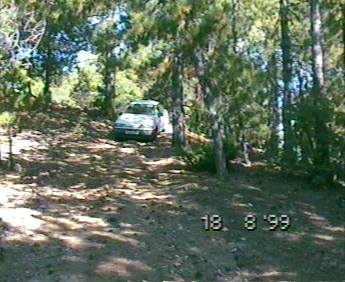
Farther west the coast was quite flat and entirely settled. We were coming to Antalya, the centre of Russian tourism. By the road is the ancient theatre at Aspendos. It was built under Marcus Aurelius in AD 161–180 and seats fifteen thousand. The theatre is extremely well preserved. If you're going to visit a theatre in Turkey, this one is probably all you need. Parking in front cost half a million lira and admission a million and a half. There's a little museum inside with examples of tickets. They used clay discs with a theatrical mask on them. There are prints of the theatre as it originally looked and scenes from performances.
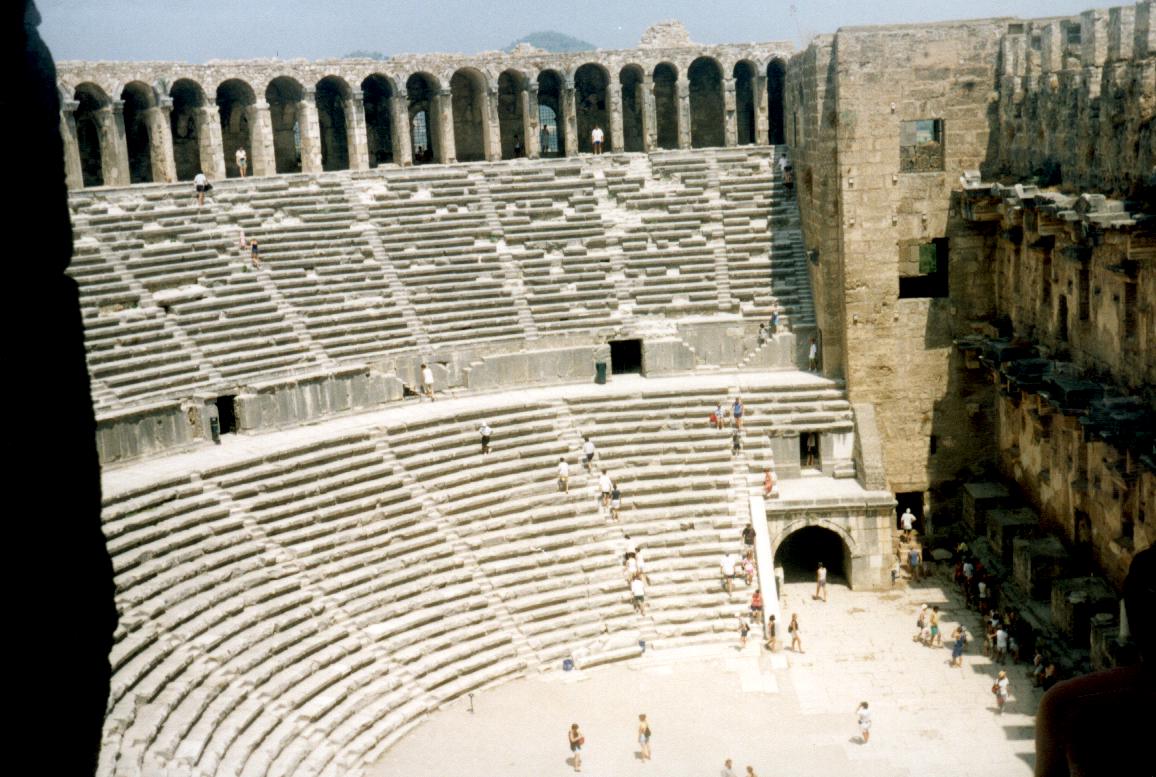
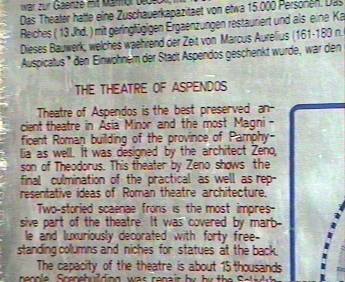
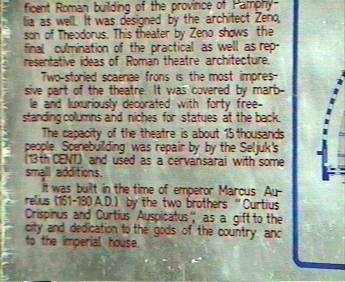
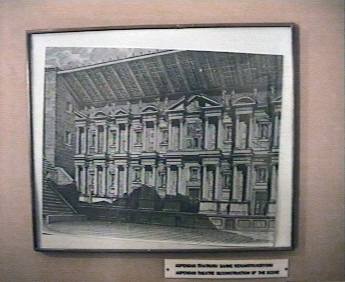
Next came Perge, founded by three men who'd fought in the Trojan War. The theatre has scenes from the life of Dionysus. There's no entrance, but we got through a hole in the fence. The theatre hasn't survived as well, but the reliefs of Dionysus's life are worth a look. There is a surviving hippodrome and plenty more ruins. Tourists everywhere, none from Russia. We went to Antalya for lunch. Parking trouble again. We found a tiny gap on a narrow street. A local taxi driver decided to help and wave me in. I ended up putting the bumper into a wall. He spread his hands in bewilderment and preferred to drive away quickly. The bumper was intact. Here people made an effort to understand Russian, but English was still better. There's nothing to see in town apart from the one minaret reproduced on every travel agency poster. I liked the banana grove along the waterfront best. The town even has a tram. One track, with passing loops at the stops. No getting down to the sea. The entire shore is divided among hotels and other tourist businesses. Hot and humid. I also liked the local statue of Atatürk on the waterfront. Statues of Atatürk stand in Turkey as statues of Lenin used to before perestroika, but the Turks have more imagination. There are profiles like Lenin's and statues with a cap in one hand, but others on horseback, with the horse rearing. In Antalya Atatürk is not only on a horse but has his arm round a naked girl. Imagine doing that with Lenin. After Antalya the mountains come right down to the sea and it becomes a mountain road. At first it's almost a motorway, with lots of tunnels. Then it narrows, twists and clings to the cliff. Driving very long on a road like that is hard. Where there are no cliffs, the beach is usually taken up by pay resorts, though you can find a gap to swim in, as we did. The next stop was Myra in Lycia. Saint Nicholas, the Wonderworker, otherwise known as Santa Claus, lived and worked here. The guidebook accordingly calls it the birthplace of Father Frost, so Lapland will have to share. Heat and humidity. Poor old Father Frost, how he must have suffered. That's probably why they made him a saint. Tombs are cut straight into the rock face for the Lycians' great men, kings included. Another theatre beside them. Climbing about in it, we heard Russian. To be precise, they were Ukrainians, but they spoke Russian. The first Russian word was something about a goat.
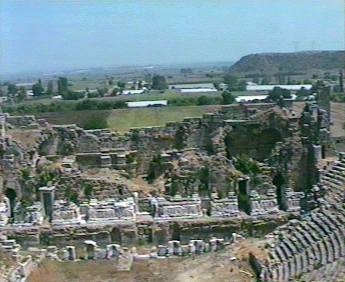
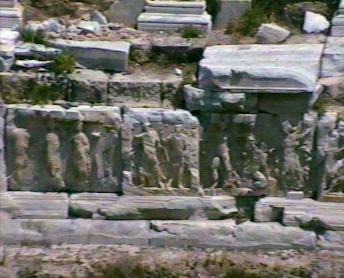
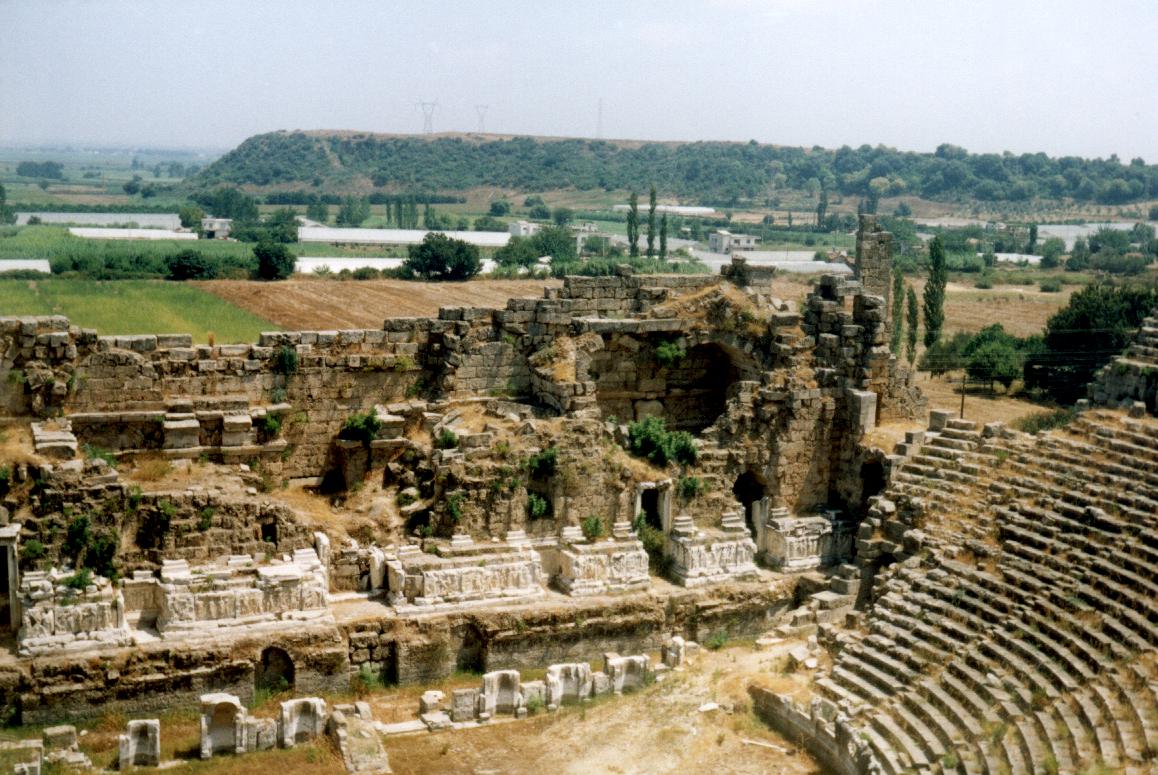
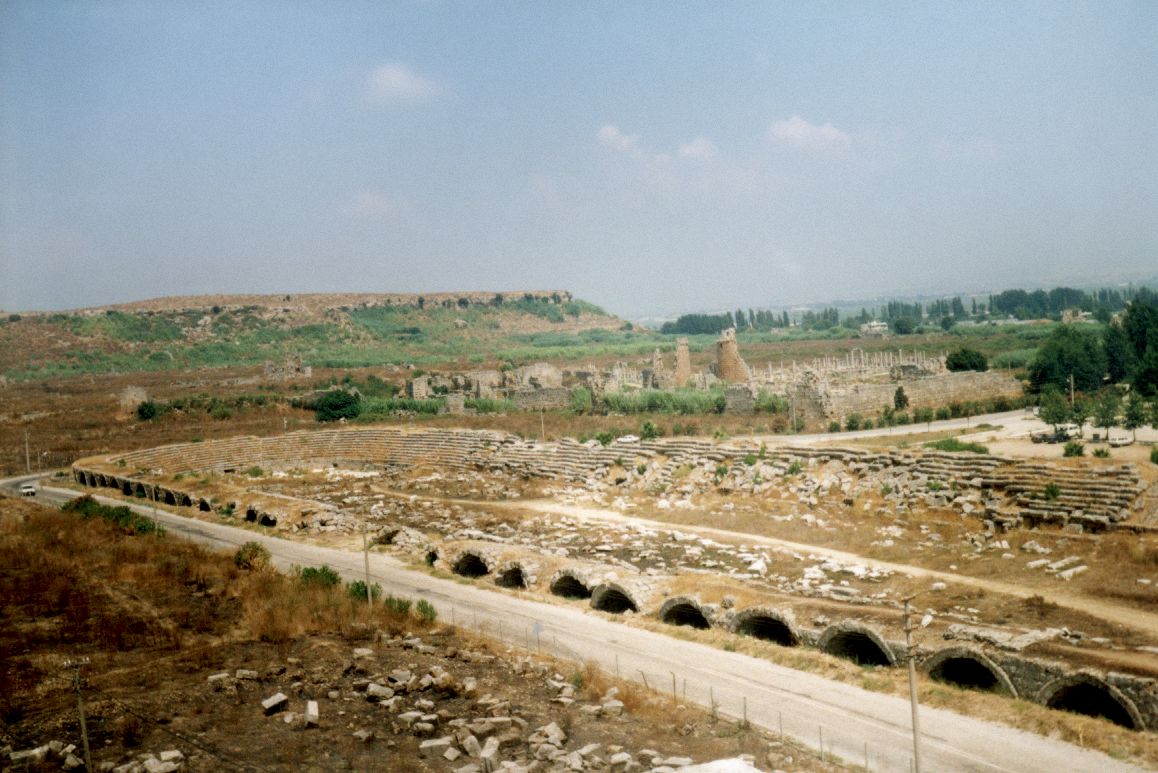
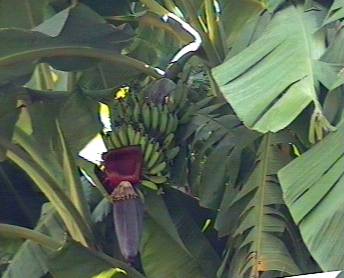
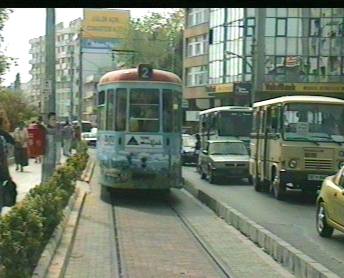
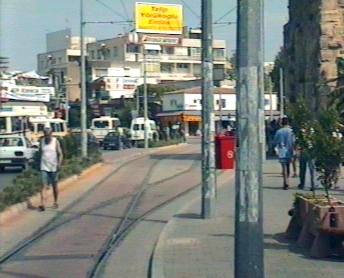
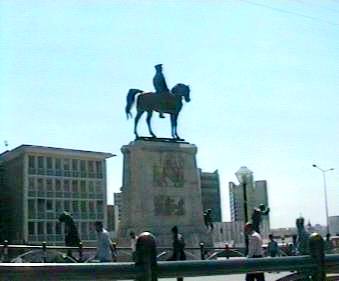
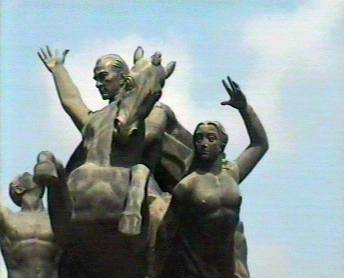
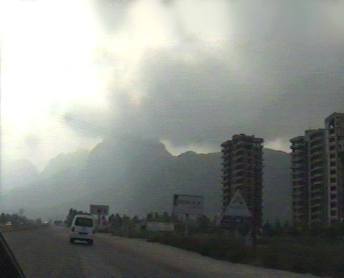
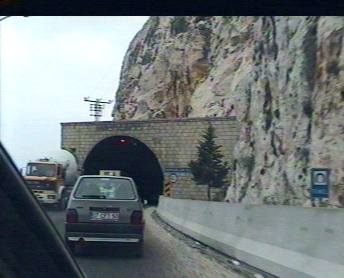
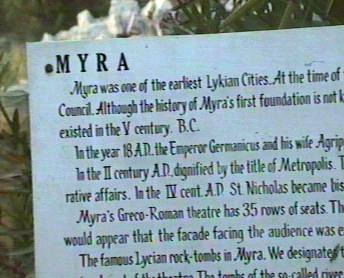
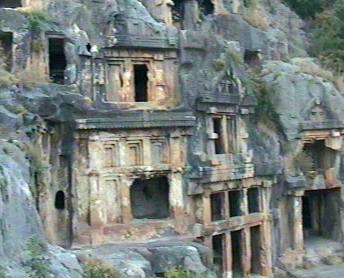
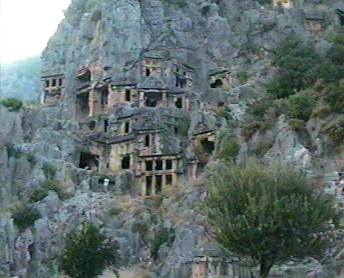
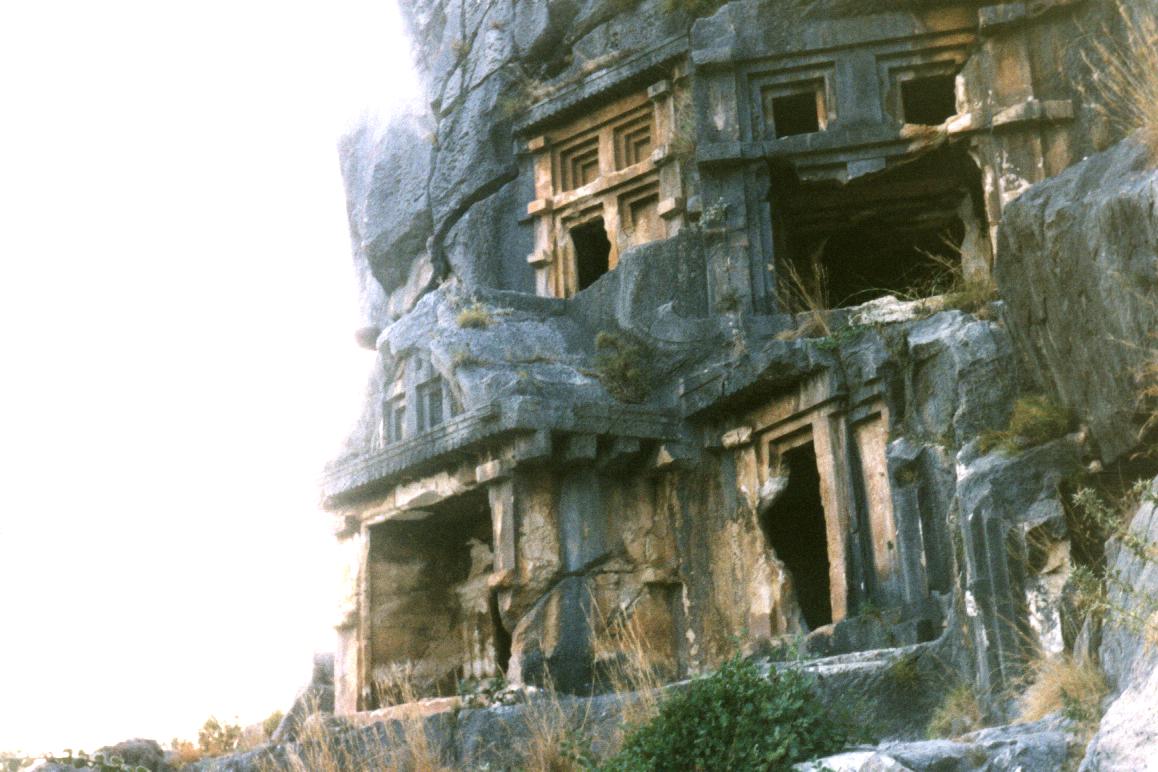
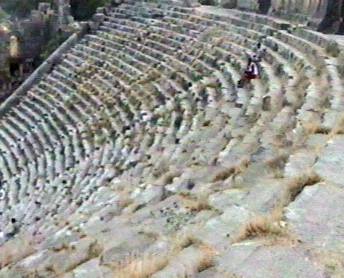
There is a church in Myra founded by Saint Nicholas, still in use today. It has been restored again and again and looks new. Father Frosts are pasted all over town. The board with a red face in a winter hat and a thermometer reading thirty-five degrees looks particularly funny. We camped for the night right by the road, hidden in the bushes (36°14.299′N, 29°48.549′E). There was an ancient ruin of some sort in the same bushes. This was our southernmost camp. I even got the telescope out in its honour, but visibility was poor. The Moon was getting in the way by then, and the sky by the sea isn't like the sky in the mountains.
Day 20. Thursday, 19 August 1999
We woke in the morning to a herd passing by, which didn't especially surprise us. We were used to everything by then and even took our time over breakfast. We swam off the rocks. The water was clear and cooler than at Antakya. Sea urchins clung to the rock, and I managed to brush one with my toe. The toe swelled, but didn't fall off. We went to Kaş and Fethiye to see the next instalment of ruins and tombs. Kaş has another theatre and a heap of Lycian tombs. Some stand right in the middle of the road, or right in the sea. Kaş is a resort, with yachts, pretty houses and well-tended palms. In Fethiye there's the big tomb of King Amyntas. Tanya had had enough and, instead of visiting it, drank a glass of freshly squeezed orange juice at a cost of $5. We resolved once more to save money. Near Fethiye there's a pretty inlet, a sort of crack in the rock with a path for tourists. We didn't walk it. It was all much the same and we were tired after twenty days. Today's aim was to get to the baths at Pamukkale. It had been yesterday's aim too, but we hadn't made it. The Fethiye road went up into the mountains. After a few dozen kilometres came the rockfalls, great slabs that the earthquake had dropped across the road. The bypass clearly wasn't meant for a Ford. We kept scraping the underside, including, worst of all, the delicate and expensive fuel pump. The road we'd chosen wasn't one of the best in general. It crosses the Boncuk Range on dirt, although it was being worked on and would be sealed soon. It took us four hours to reach the E87 from Antalya to Denizli. We made better progress there and reached Denizli at about two. The town lies in a valley, so naturally it was hot. The thermometer showed fifty. Tanya saw a sign for McDonald's and we began looking. The signs pointed different ways and we couldn't find the place. We drove round for half an hour before finding the proper free car park. Inside, air-conditioned paradise. You could wash in the loo, and we did. The staff understood English, which meant we could relax. Tanya ordered an apple pie. Nobody in Turkey eats them and you have to explain over and over. Then they cook one just for you and you have to wait. Knowing it was fifty degrees outside rather took away any inclination to leave in a hurry. The hamburgers were the standard range, with local ayran as well. Pamukkale is close to Denizli, a spa since Roman times. Hot mineral springs rise on the slope of a volcano. The water is cloudy, like a lime solution. On the hillside the minerals settle out, forming pools in the shape of shells. You're meant to bathe in them. In the film The Odyssey, Calypso seduces Odysseus in these baths. Admission was one and a half million lira per car. There is a huge necropolis beside the baths. All the old Romans came here in their dotage to be cured, and died when they weren't. A kilometre of road has been cut straight through the tombs. The pools are there, but they don't all have water in them. For free you can walk only in the imitation concrete baths. In many years' time the concrete may grow over with limestone and you won't be able to tell the difference. At the moment it's a sorry sight. Sometimes you can get into the real pools for a large sum, but they weren't letting anyone in when we were there. In fact all the pools are filled from hoses. Nature is plainly being helped to grow a tourist attraction. Apart from the baths there's a pool of fizzy mineral water that you can swim in. Five million lira to get in and another five million for a locker. A lot of money, but the pleasure was worth it. The water fills a space among ancient ruins, and you can swim around and dive under fallen columns. About forty degrees. The water is clear and fizzy, with bubbles everywhere. They carbonate it deliberately. Mostly the pool isn't deep, but there is a spot about six metres down. I only just managed to dive to the bottom. The water pours in from pipes and you can swim up and put your head under. There were plenty of swimmers, mostly Russians. We splashed about for three hours. It was wonderful. We got out at sunset around six and had to find a place for the night. We looked over the ruins before leaving. Vendors stand in the theatre trying to sell antiques. Fake coins were especially common. They cost a few cents in the shop nearby, but here they were passed off as ancient. Men took pieces of ancient statues from under their coats to show us. They too were fakes. I'd seen the workshop turning them out as we drove past. We took the wrong road out, drove high into the mountains on a steep road and found a comfortable place to camp in the scrub (38°02.613′N, 29°03.874′E). We'd climbed almost a kilometre and could see the valley below as if from a plane. Dozens of towns large and small, thousands of flickering lights. The green glass tops of the minarets carried the light of Islam into the surrounding space. It wasn't hot in the mountains and a strong wind was blowing. I opened the bonnet to check the oil and saw the exhaust manifold glowing red from the heat. That alarmed me. I'd never seen it before. We had a theoretical debate about whether that was to be expected after climbing a kilometre up a steep slope.
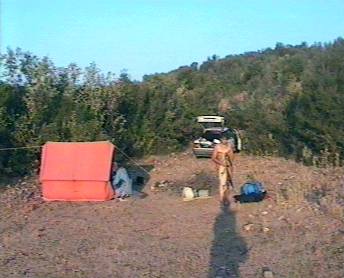
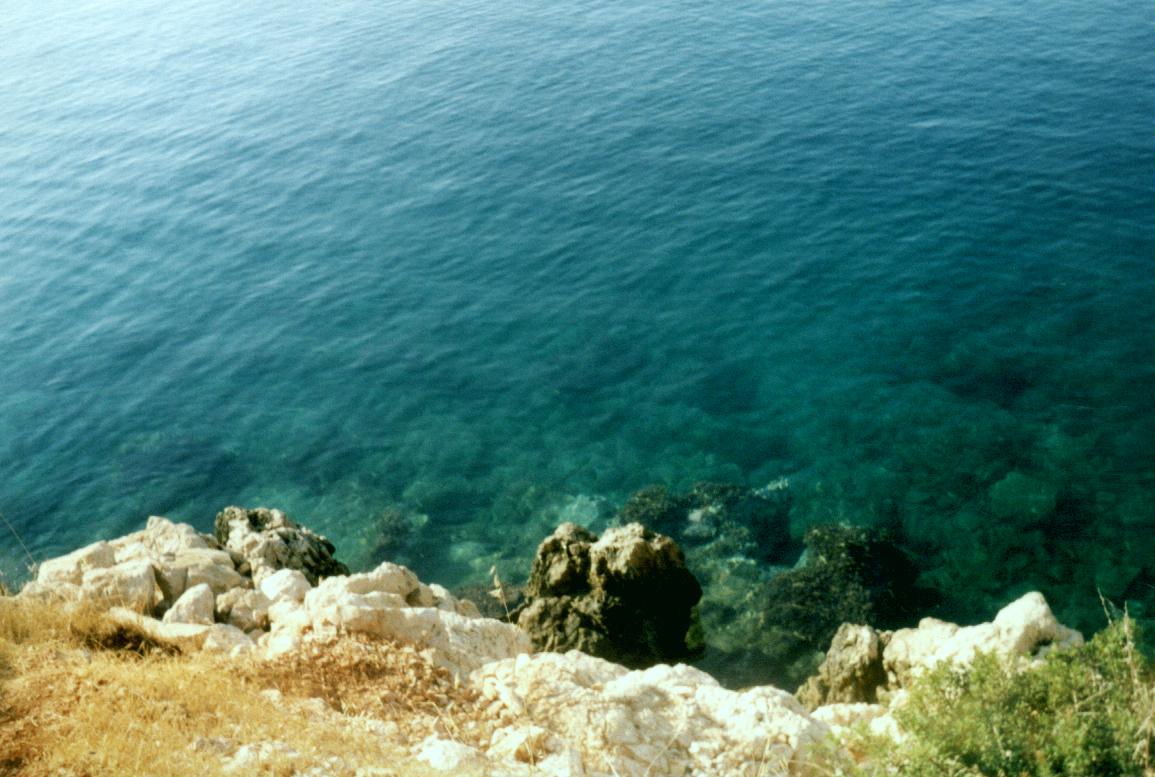
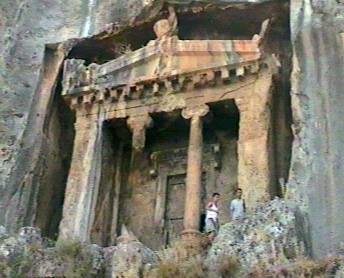
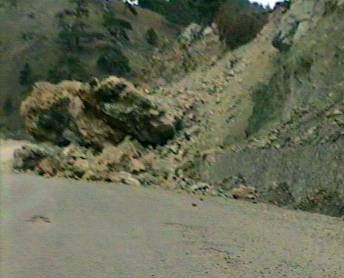
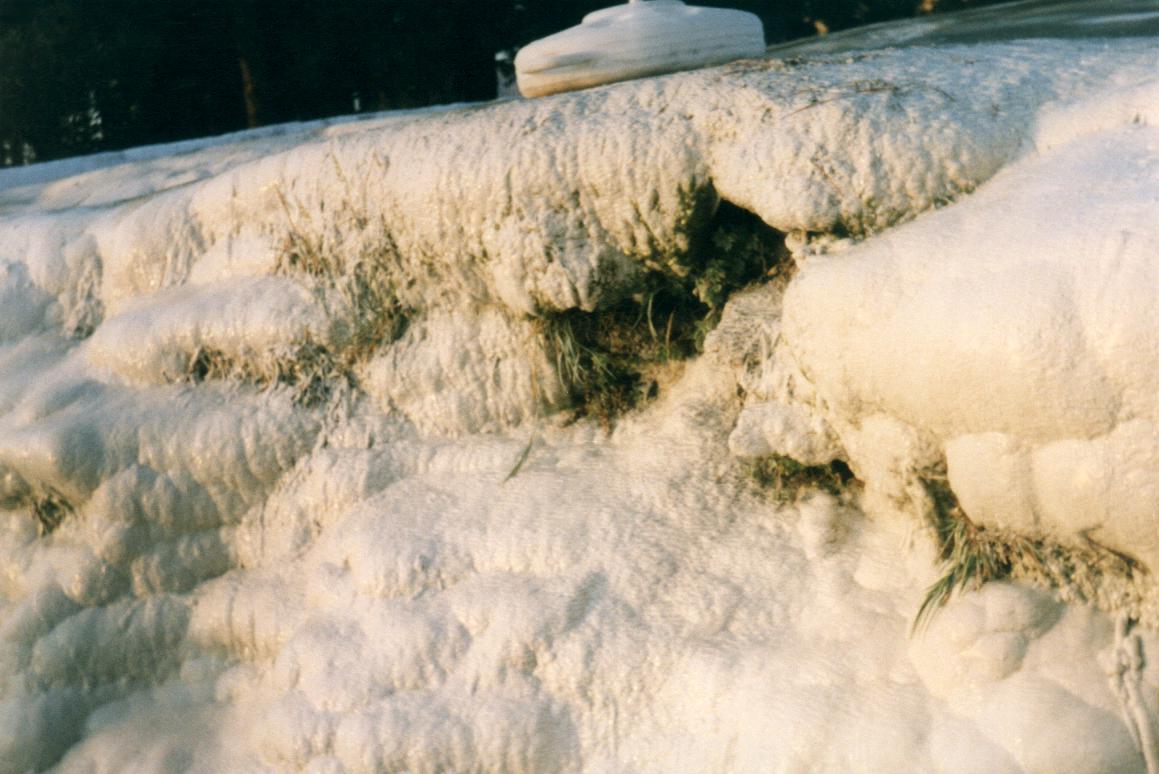
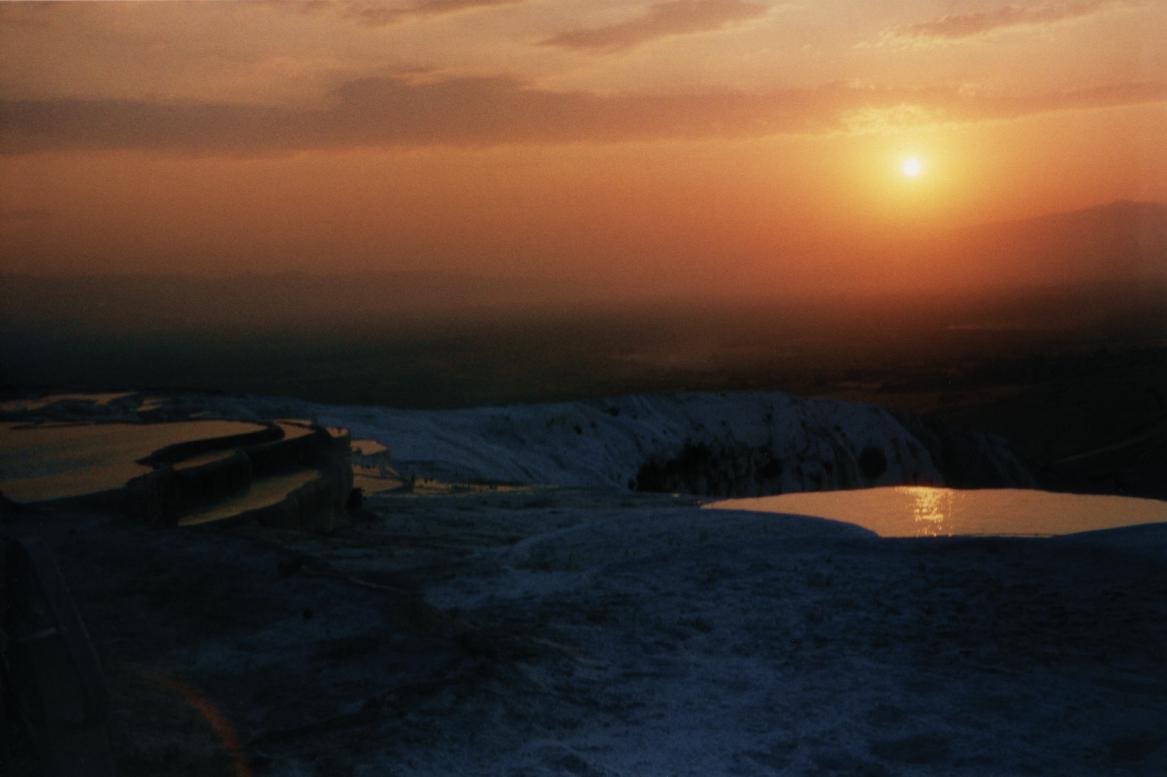
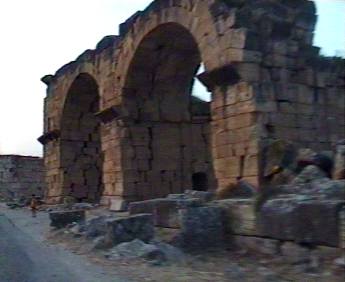
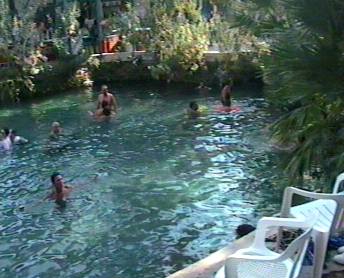
We lit a fire and cooked plenty to eat. We washed our hair. We carried bottled water every day, and towards evening it would have heated up to about forty degrees, warm enough for a hair wash. After the pool and our final wash on the mountain we felt human at last. A strong wind almost blew Lena's tent over the precipice. We shared a bottle and celebrated eight years since the end of communism.
Day 21. Friday, 20 August 1999
We ate in the morning and wandered a little before finding the road to Sarayköy. We were lucky we'd driven up into the mountains. The whole valley is ploughed and there's nowhere to camp. The road to İzmir is good. We were out of oil and needed to buy some. Lots of Shell stations, but no 10W-40. They had 20W-50, but the local men said you couldn't mix them. After much worrying I decided to do it and poured in the 20W-50. We reached Ephesus. First we called at the house where the Virgin Mary died, to which Saint John brought her. There's no historical evidence for it. There are records that John went to Ephesus and that he was charged with looking after the Virgin Mary. In the previous century some nun had a vision in which she knew where Mary had died. She pointed to a spot and said to dig there. They really did find foundations. Anywhere you dig round Ephesus you could unearth Troy, never mind the Virgin Mary's house. They built a church and Polish nuns are in charge. Lots of Protestants as well. In fact church people of all sorts come there. There are benches all over, loudspeakers nailed to the trees and edifying posters hung up. The year 2000 had been proclaimed the Year of the Virgin Mary. We went into the church and took some film on the sly. They charge to drive in.
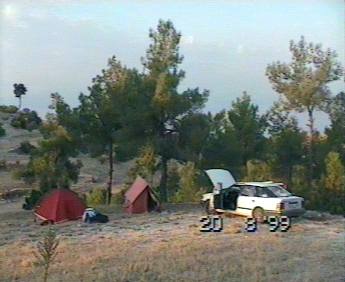
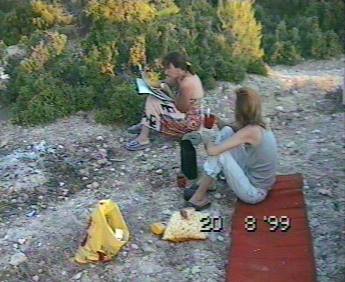
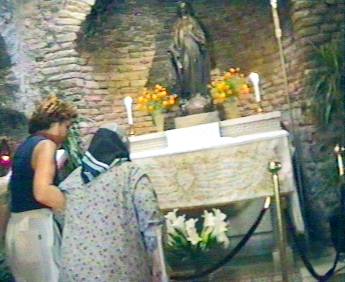
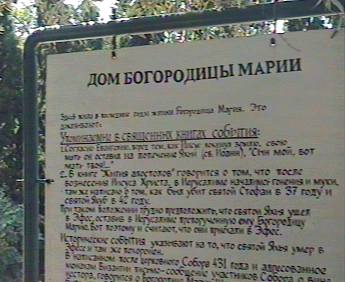
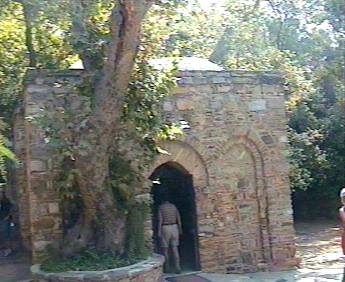
Ephesus itself is an enormous ancient city. You could walk round it for hours, though it isn't easy in the heat. Tanya and Lena installed themselves under a palm before long. The wonder of the world, the Temple of Artemis, didn't make much of an impression. Too little is left. Quite a lot survives from the first and second centuries AD, particularly the Library of Celsus. Two theatres. The one by the library has splendid acoustics. You really can hear somebody on the stage from a long way away.
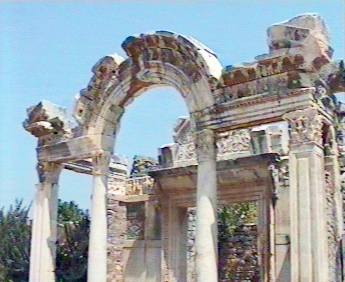
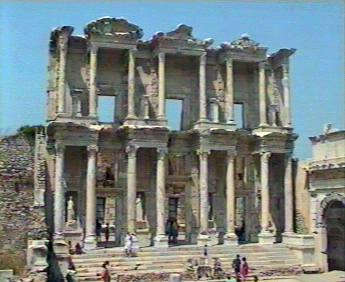
The biggest trap is that the entrance and exit are in different places. Leave your car, follow the signposted route, and you come out several kilometres away. That doesn't matter to the people who arrive in a tour bus, but I had to walk back. I hadn't imagined a five-kilometre walk in the hills in the heat. Peaches and mandarins were ripening everywhere, but out in fields that were guarded. I was terribly thirsty. Figs grew by the side of the road, so I had to make do with those. I reached the car on my last breath. It took me a long time to recover and I even asked Lena to take the wheel. She'd bought a newspaper in English. We read about the earthquake. After Ephesus came İzmir, an enormous modern city with interchanges in three dimensions. Hardly any sights, so we went straight through. We reached the sea, the Aegean now. The island of Lesbos lay quite close offshore and on our side was Gömeç. There it was. Lesbos was already Greece, but you couldn't go there. Greece and Turkey aren't friends and even fight from time to time, especially over the islands. There was a lot of Greek music on the radio, though. We got in for a swim in the Aegean. By the time we got out it was almost dark, and we turned into the hills looking for a camp. We drove into a field along a dried-up streambed and put the tent among thorns (39°36.660′N, 26°32.469′E). Washed our hair and ate a watermelon. At ten the muezzins began to howl. Friday is the holy day. The Turks are out enjoying themselves. Friday, incidentally, is the only day men are supposedly allowed to be with their wives. We'd only just fallen asleep when we heard cheerful grunting and stamping around the tent. Tanya was frightened and took refuge in the middle of the tent, so nothing could bite her through the sides. She'd been jumpy since meeting a mother bear in the spring. I stuck my head out but couldn't see anything I recognised. For simplicity I declared it was a herd of hippopotamuses. Another theory was that the Turks were grazing pigs at night so Allah wouldn't see such an unseemly animal in daylight. One thing we did establish for certain: our watermelon rinds had been devoured.
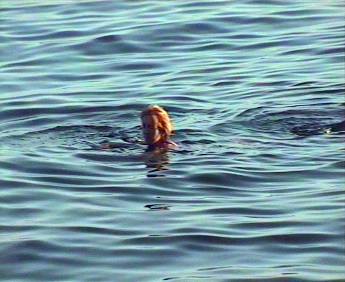
Day 22. Saturday, 21 August 1999
In the morning we woke to a flock of sheep with bells, which jingled quite melodiously round their necks. No hippopotamuses were found nearby. As soon as we drove away the engine cut out completely. Horror ran all the way through me to the tip of my tail. I got down to investigate and found the fuel pump wasn't working. That's what comes of driving in the mountains in a motorway car. The pump had been badly bashed and fuel was leaking. The worst forebodings, but I found that the connector was broken and had left the wiring disconnected. I pushed it in and tried to start the engine. Hooray, it worked! I got back under to mend it some more. An awkward spot. Curious Turks began to gather. I tied up the connector with a shoelace and tightened all the clamps. If the pump itself was leaking, there was no fixing it. If it was just the hoses, that was nothing. We drove on, but after each bump I'd catch the pump and the connector would fall out. At least the petrol no longer leaked. I didn't dare force the pump back into its proper place in case it broke off. Once we reached the highway there were no more problems. We went to see Troy. Not much left of it. They destroyed it thoroughly and Schliemann took what remained. There's an enormous two-storey wooden horse you can climb about on. At all the excavations there are handsome boards with reconstructions of what stood there in different periods. There isn't really much to see. It's something you're meant to visit for your general education. It was Lena's turn to climb all over and take video. Tanya and I stuck to a look at the country and coffee with the proprietor of the local café. Our car from Russia was such a wonder to him that he treated us.
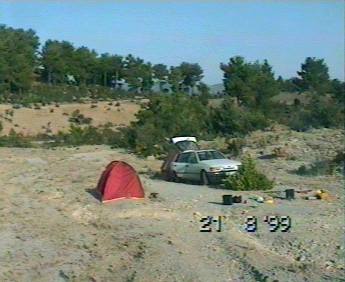
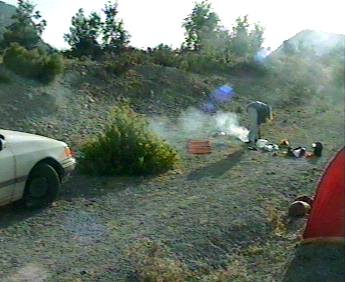
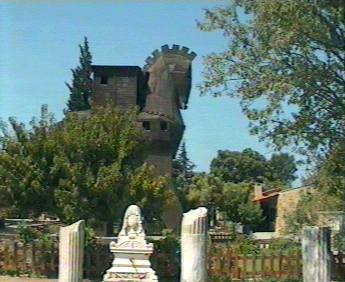
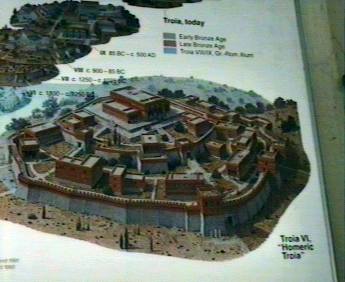
Then we stopped to walk in Çanakkale, which is to say the Dardanelles. The straits are a heavy sight for a Russian. Thoughts crowd in of how we let them slip, how we didn't get there to save Constantinople. Now you can barely get through. The town is full of military men. On the far shore there's a soldier's figure picked out in stone, with the words “The enemy shall not pass”. On our side stand the guns with which the Turks held the straits. Thoughts of Zhirinovsky and the Indian Ocean come unbidden. On the other hand, here we were and there was no need to fight anybody. We drank tea on the shore of the Dardanelles. Better to think of yourself as a citizen of the world than go to war over every stone.
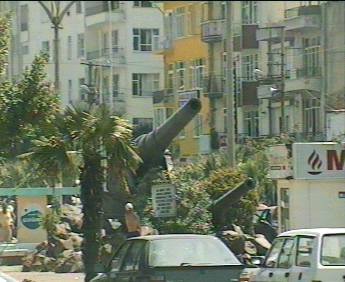
There is a ferry. It costs 400,000 lira to take a car across. A glass of beer is twice as dear. Ferries run one after another. Afraid they'll build a bridge here as well, I suppose. Even horses wait in the ferry queue. There's a lovely park in town and a fortress on the far shore. There isn't anything else to see. The road goes along the strait after that. The Dardanelles are long, eighty kilometres, and then the Sea of Marmara begins. We found somewhere to swim. The shore was a rubbish tip, the water murky and not as warm as we'd have liked. The saltiness is like the Black Sea. You can't float as freely as in the Mediterranean and have to paddle arms and legs. Then Bursa, former capital of the Ottoman Empire, now a large city of one and a half million. We looked from outside without going in anywhere. The fifteenth-century Green Mosque is interesting. By then it was getting dark. We had to find a camp and wanted to stop on the peninsula between Yalova and Gemlik, before İzmit, which had been wrecked by the earthquake. Ambulances passed in the other direction one after another. We couldn't see any damage yet. We drove into Yalova to find a wrecked city. Ambulance sirens, crowds of terrified people on the streets, tent settlements. Before we could even take in that we'd arrived at the centre of the earthquake, the clutch cable snapped right in the middle of the main square. I had a spare, and wanted to thank myself for thinking to bring it. Not a convenient spot to work on a car. There'd just been another tremor. Vehicles raced about with sirens going. They took us for quake victims and offered humanitarian aid. We didn't need it, but we must have looked the part by now. Local people had more on their minds than us. A thick smell of dead bodies hung over the city. Several thousand bodies under the rubble for five days. People walked around in gauze masks. Clouds of dust everywhere. We had to get out quickly. I made the repair in half an hour. We tried going along the coast to find a quiet spot, but the farther we went the worse it got. The whole shore is one long resort town and rubble was everywhere. We had to drive round it. Here and there there were buildings they were still digging out. While we watched they put a living person in an ambulance. The place was full of journalists. It turned out he was practically the last survivor. We saw the report about it on television later in Istanbul. The road was jammed with ambulances, troops, rescuers and bulldozers. It grew quite dark. Bright floodlights shone over the digging. Desperate people were working away. They were trying to dig out their own, but the smell of bodies killed hope. An image you can't forget. The road was buckled. The fuel pump scraped and the connector kept coming loose. I had to get under the car in complete darkness and push it back in. No power in town. People were afraid to go indoors. Tremors of four to five were still recurring daily. Eventually we came to holes we simply couldn't drive across and had to give up the idea of getting out of town that way. Opinions differed. Lena suggested passing for quake victims and pitching in the tent camp. Tanya flatly refused. I had to issue a decree: back towards Bursa. I remembered a poor but dependable place to pull off. We spent a long time finding our way and fixing things among the ruins. At one in the morning we got out and found a very good spot right at the pass over the Samanlı Range (40°32.902′N, 29°18.309′E). A level patch out of sight of the road. We started washing. After that filth, I washed from head to foot. We had a drink to settle our nerves and put the bottle on the car. The next tremor knocked it over onto my trousers. Red wine. I had to wash them. Lena complained all night that the car was rocking. If you put your ear to the ground in the tent you could hear a low rumble from time to time. In spite of everything we slept well.
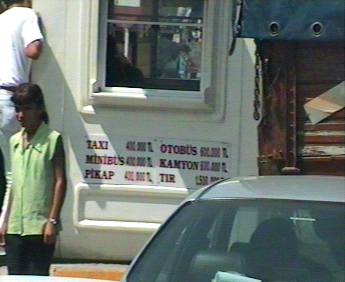
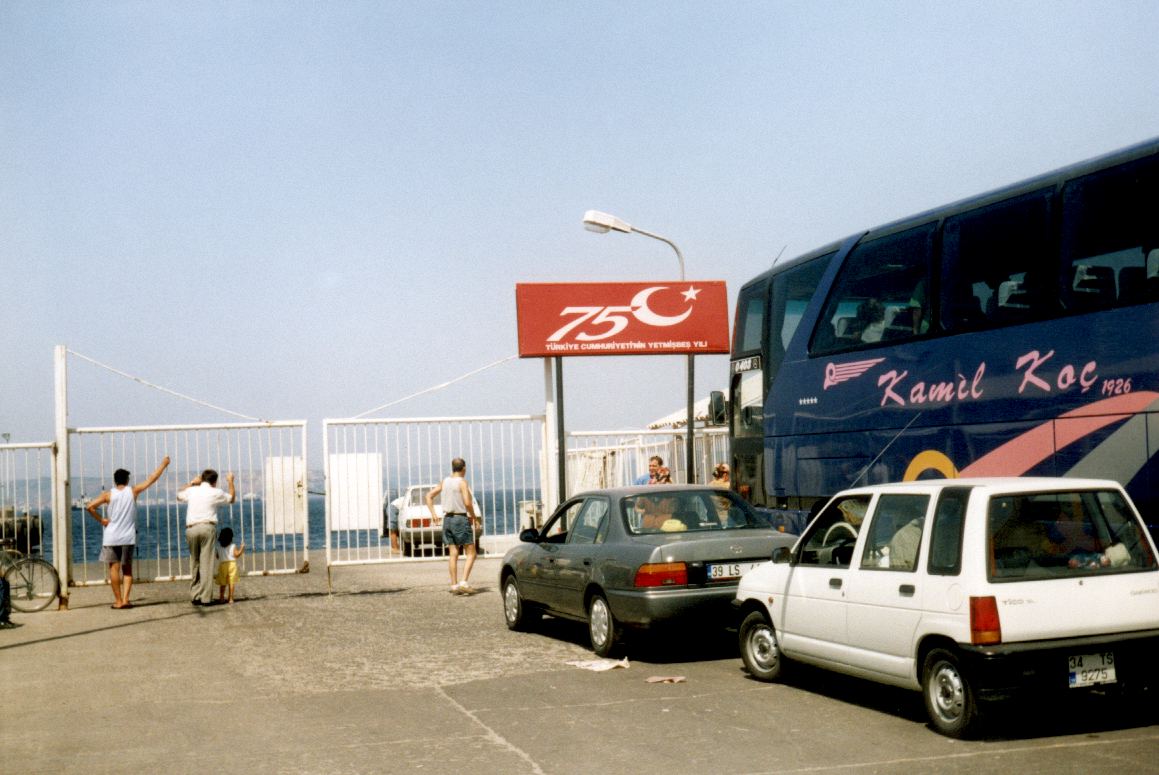
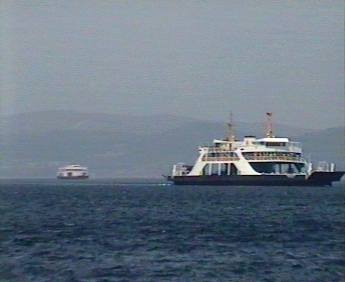
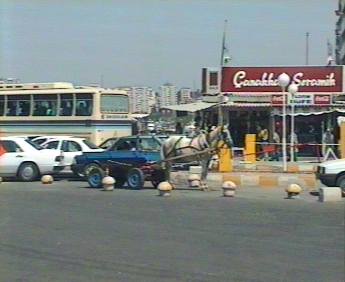
Day 23. Sunday, 22 August 1999
We didn't wake early in the morning. No sun and no heat either. I got under the car to fix the fuel pump. After an hour I had managed to lift it a fair way back towards its proper position and secure the electrical connector firmly. (I still haven't touched it again, twenty thousand kilometres later.) We drove back into Yalova. In daylight you could see more. Most of the houses were damaged but hadn't fallen. One building in five had been reduced to little bricks. Some had no sign of damage at all. Shops occupy the ground floor in Turkey, with the whole house standing on slender legs, and these had given way almost everywhere. A house dropped by one storey, flattening everything in the shops. Cars were squashed into twenty-centimetre pancakes. The engines stuck up slightly, otherwise they were flat. People were handing out relief supplies everywhere. We moved very slowly. Everything was jammed. The entire shore as far as Gölcük is a continuous town. In places whole blocks had collapsed. It was hard to imagine anyone still alive under them. Rescuers were still digging, but most of the buildings were being pulled apart with bulldozers. Everywhere policemen waved their batons in desperation, trying to untangle the endless traffic. For many people all they had left was their car, and now they were all driving back and forth. The striking thing was that there were no prohibitions. Drive in, climb into your half-ruined flat, and take responsibility for whatever happens to you. Back home the police would have forbidden everything. We took several hours from Yalova to Gölcük. İzmit lay ahead, where the radio said the epicentre was. To our surprise the city looked whole and undamaged. You could see only the burnt refinery, and even that wasn't too bad. Whole quarters of twelve- to twenty-storey buildings stood without a crack. The motorway from İzmit to Istanbul was in perfect condition. On account of the earthquake they'd even made it free. A lovely motorway with tunnels and viaducts a hundred metres high. I drove at almost two hundred. Half an hour later we were on a bridge across the Bosphorus. From the roadway it looks immense and you can't even see the drop at the sides. Four lanes each way. From the side it looks like a slender thread a kilometre long and two hundred metres in the air.
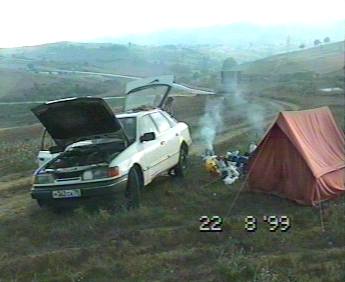
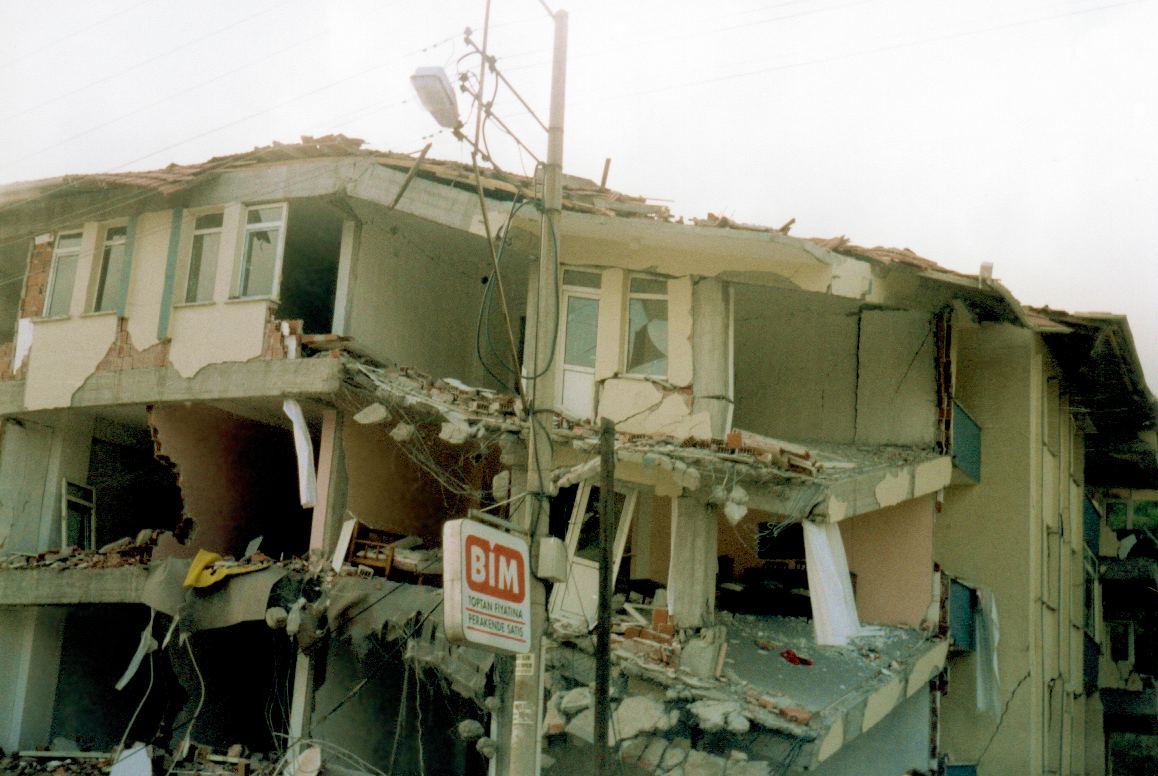
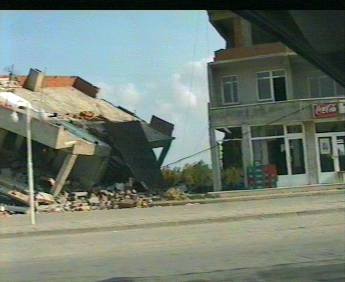
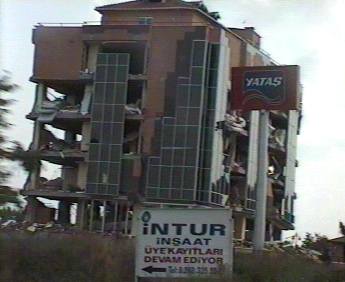
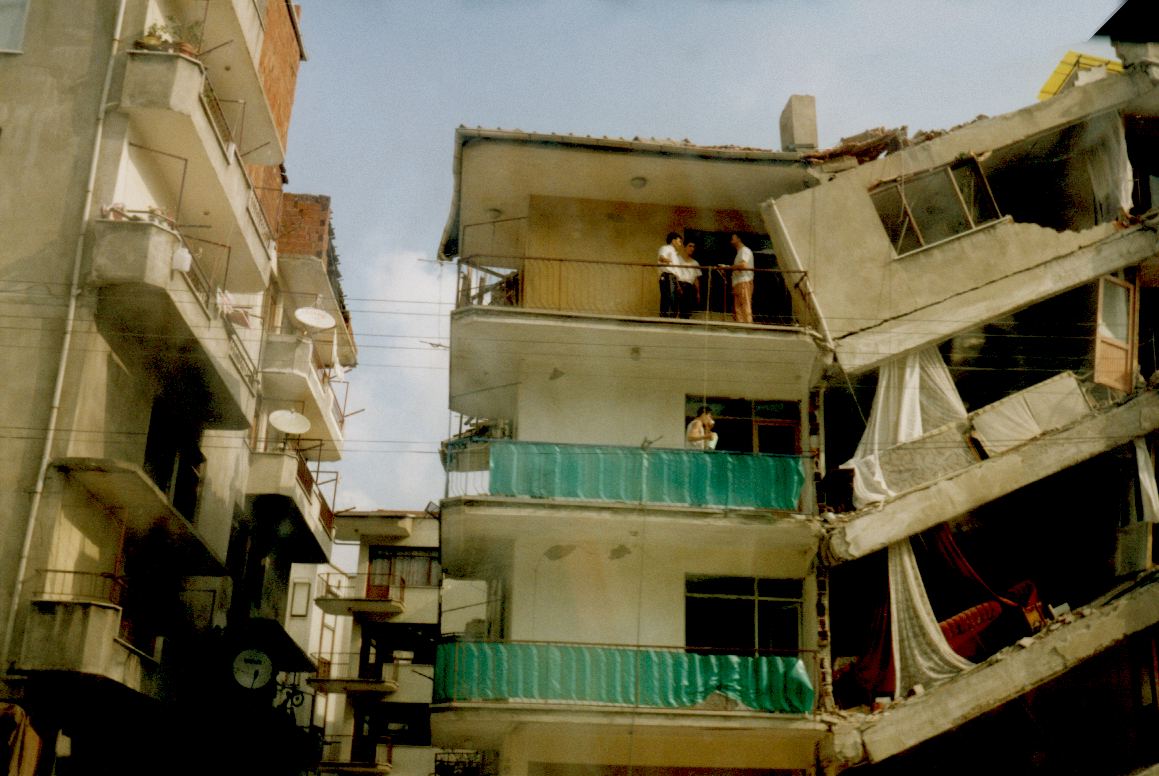
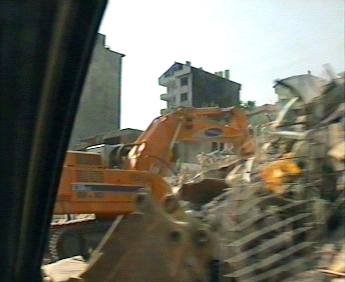
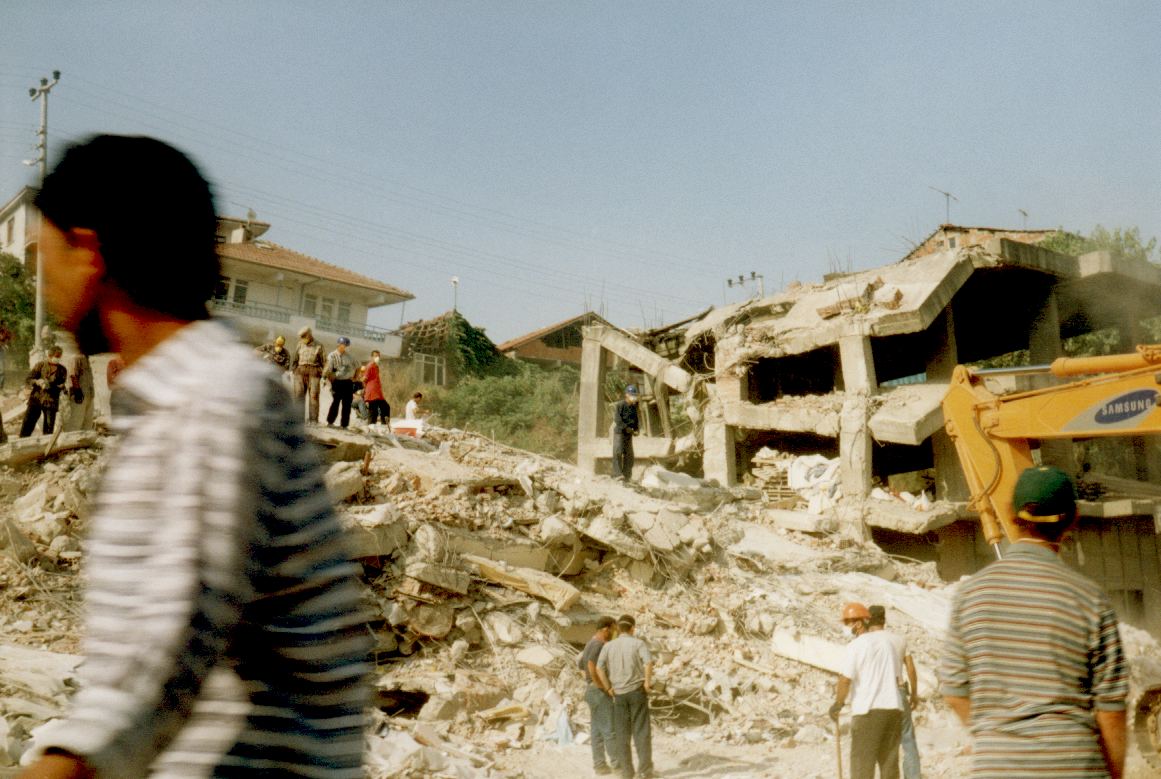
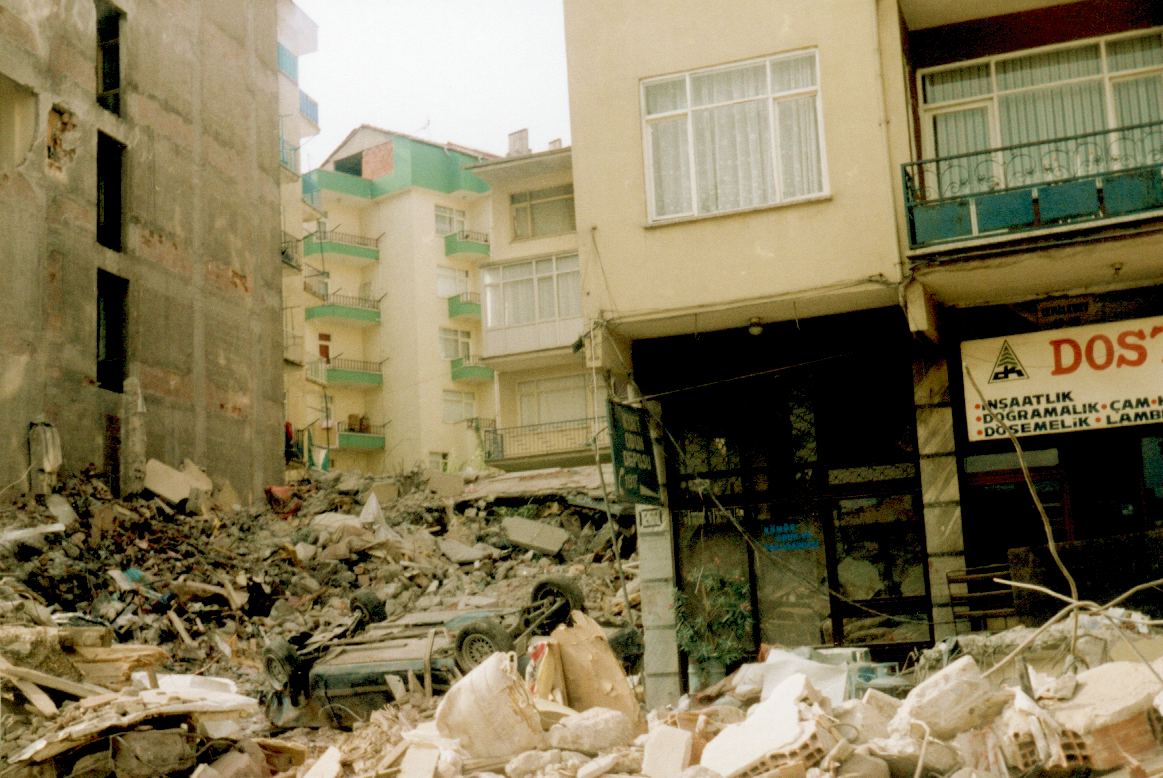
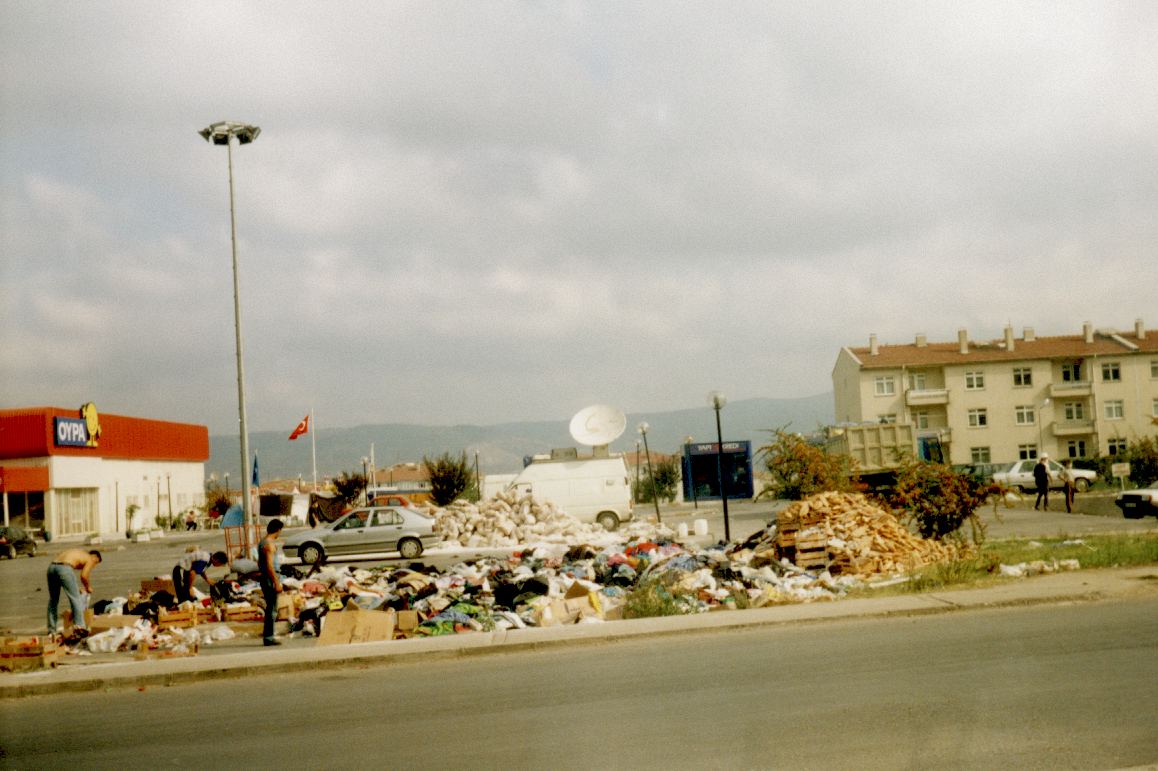
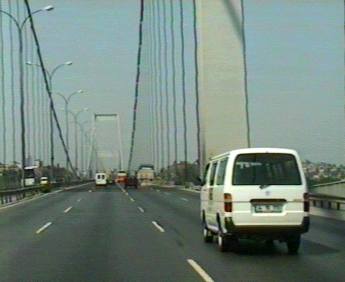
Crossing the Bosphorus, Tanya's hat blew off. :) Over the bridge we turned left for the city centre and passed through a district of tall skyscrapers. No sign of the earthquake in Istanbul either. We parked a fair way from the centre, near a McDonald's and the Turkmen consulate. A cheeseburger apiece, then into town. On the way we passed the representative office of the Patriarch of All Russia. It wasn't too hot to walk. About thirty degrees, but we'd grown used to it. We crossed a bridge over the Golden Horn. The centre of town is one continuous flea market. You can hardly move. Finding anything you'd actually buy is another matter. Either it's expensive or you couldn't wear it back home. Istanbul has trams which you board from high platforms. They sell the ticket as you go onto the platform. The tracks generally run away from road traffic, so the trams go fast.
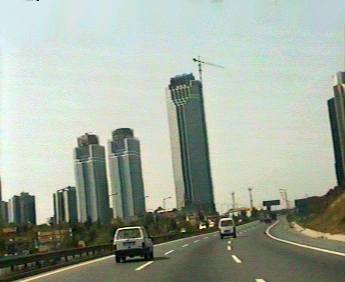
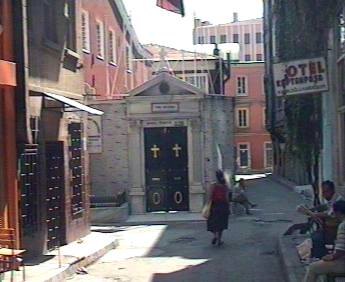
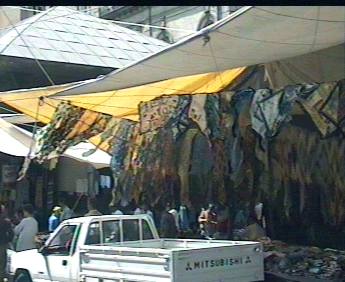
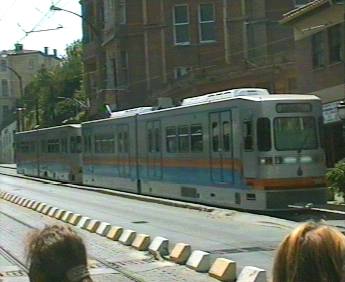
We went to Hagia Sophia. Luckily it was open, though the guidebook said Sundays were a day off. Admission two million lira. From outside it doesn't seem gigantic, and looks like a jumble of buildings, but the interior makes a colossal impression. After taking Constantinople the Turks looted it and made it a mosque. The mosaics were to have been destroyed, but were simply painted over. When Atatürk came to power he made it a museum and the mosaics were cleaned of paint. Round panels with Arabic letters remain from the mosque. They look very out of place. There was scaffolding in the middle of the hall, but a good deal was still accessible. Hagia Sophia overwhelms you with its size. It feels as though you could build Saint Isaac's Cathedral inside, though Saint Isaac's is taller. You get a sense of unearthly energy gathered here. It is astonishing that Hagia Sophia is little younger than the ancient theatres of which scarcely anything survives. In the column left of the door there's a hole. Put your thumb in after making a wish and turn your hand a full circle round it. The wish is supposed to come true, of course, and I'm willing to believe it. I've never seen a more majestic place of worship. The mingling with a mosque and the absence of crowded icons only reinforce the idea of a temple to one God beyond depiction. A worthy echo of the Temple in Jerusalem. Justinian did indeed build it intending to surpass Solomon.
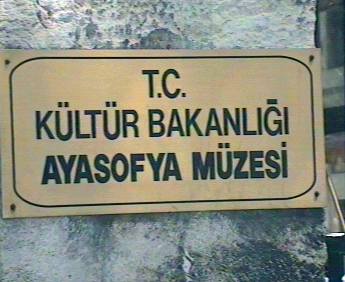
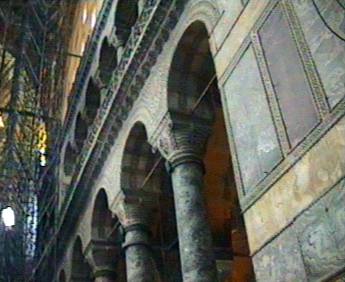
After Hagia Sophia we went to the Blue Mosque, or Sultan Ahmed Mosque. It was meant to surpass Hagia Sophia in every way, but the architect disobeyed the sultan and made it a metre lower. Inside it is in good order and beautiful, with mosaics and stained glass, but quite a different spirit. It makes you want to rest and relax after the heat rather than ponder eternity. Women and tourists can go into the Blue Mosque. They give you as many little blue scarves as are needed to cover the legs, arms and head. We went in and sat for a long time on the soft carpet. Then past the Hippodrome and its columns, round the flea market and the little streets of Istanbul. It takes days to see Istanbul. We didn't have them, and drove out at seven. First we went back to the Asian shore on the first bridge, the one nearest town. That cost half a million lira, dearer than the ferry. Then back into Europe over the bridge on the E80 Ankara–Edirne motorway, and on down the motorway. That stretch is tolled. Istanbul to Edirne costs a million lira, quite cheap. The thought of camping in Bulgaria was daunting, so we went looking for one last Turkish camp. Fields all round and absolutely nowhere to stop. First we settled next to the road in a little park with an Atatürk-with-children sort of monument. A car pulled up and began watching us, so we took fright and left. We tried to stop in a field, but some local guards came running and waved us off in horror, hinting that something awful might happen. Whether it was a military base, a minefield or sprayed with poison, they drove us out. We had to go thirty kilometres back to the monument (41°17.336′N, 27°38.210′E). A Turkish man arrived in a minibus again and started pestering us. Madame was alone in the car and going to waste, he seemed to think. He was prepared to pay a lot and in hard currency. He had a dollar and two marks. Lena, by now used to it, waved him in my direction: “Pay at the desk over there.” An endless conversation began. He said he was a decent fellow, earned plenty and was quite worthy. He asked me to name a price. I said a million dollars. He was surprised and asked why it was so expensive. It took an hour and an enormous effort to send him away. We slept uneasily anyway.
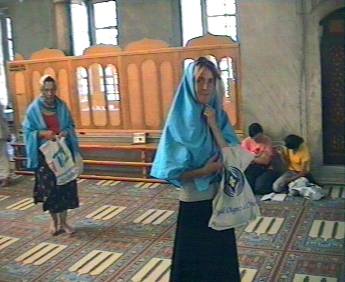
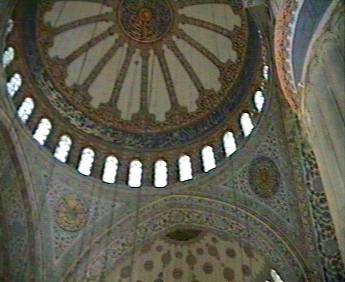
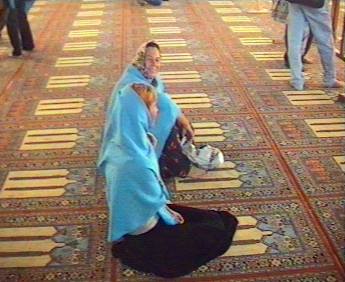
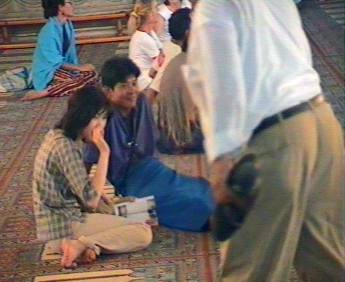
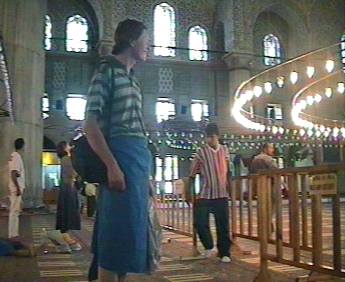
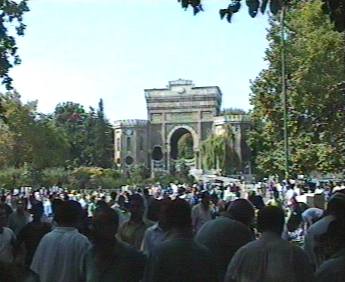
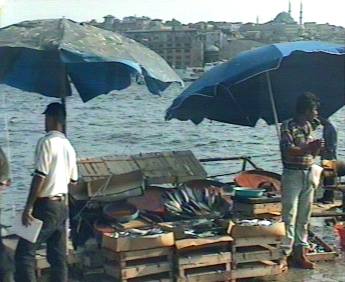
Day 24. Monday, 23 August 1999
In the morning we packed quickly and got back on the motorway. At two hundred we were in Edirne in no time. Another capital of the Ottoman Empire, with a beautiful mosque. We didn't make it to the mosque. The women dashed to the shops to finish off the Turkish money. They bought toys for the children and six kilos of Ariel washing powder, the one thing that costs more at home.
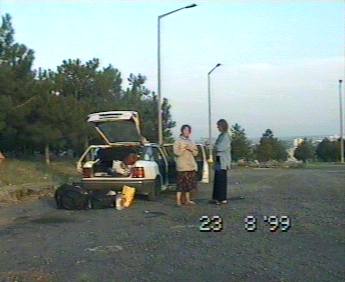
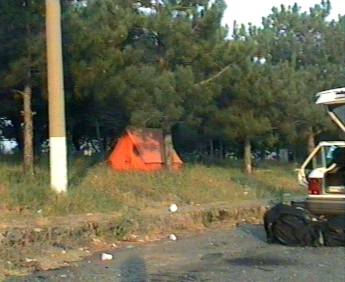
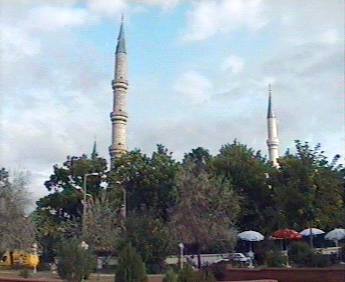
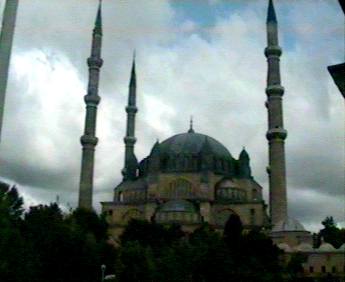
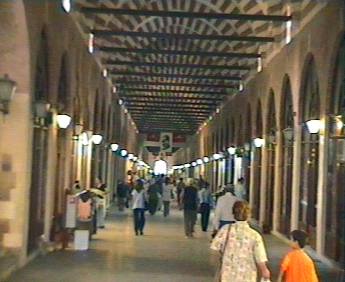
The Edirne–Svilengrad border post was quick and well organised. The Turks work very well in general. The customs officer was having tea, but when he saw us waiting he ran over, filling in the papers with one hand and finishing the tea with the other. The Bulgarians took two lots of four dollars for disinfection and the roads, and worked quickly as well. After entering Bulgaria you feel at home immediately. The language is easier to understand than Ukrainian. People are considerate and smiling. Unlike in Turkey you don't see anybody working. They live poorly and walk about looking intellectual. People steal, so you have to be careful. I suddenly noticed girls paying attention to me and stealing looks. In Turkey everyone is trained to walk with their eyes down. When you're always in our surroundings, you don't notice little signs of attention like that. You can understand men from the south turning up at home and throwing themselves at every young woman they meet.
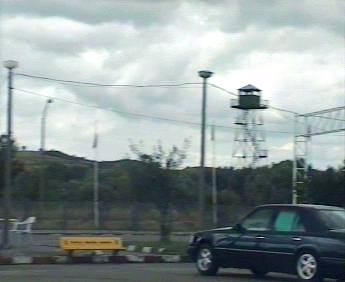
Lots of funny names, such as “Sofia Hotel Balkan”. It wasn't a militaristic slogan about Sofia wanting the Balkans; it was simply the Balkan Hotel. I also liked “Day and night we guard the parking”. The roads in Bulgaria are good. Petrol costs about half a dollar a litre. We drove past Plovdiv, which was a mistake. We also got paths crossed at several junctions. Bulgarian signs are much worse than Turkish ones. The Plovdiv–Sofia motorway is very decent and, best of all, free. We stopped to walk and eat in Sofia. It's mostly new. The postwar centre was plainly modelled on Moscow. There's a central department store that's a copy of Detsky Mir. We parked in the pay car park in front of it. Bulgaria has changed the denomination of its currency as we did. There's a new lev, with the old one still accepted. They understand us in Russian perfectly, just as we understand their Bulgarian. They have their own church of Saint Sophia, with Orthodox splendour inside. Beautiful, but it didn't make a great impression. There's a charge for the Church of Saint Peter. A synagogue and mosque stand next to each other. We ate at McDonald's. It wasn't hot any more. From Sofia we headed towards Montana and lovely rocky mountains appeared. Yugoslavia was close, only a few kilometres away. We couldn't cross Romania in a single day, so we decided to spend the night in Bulgaria. We found a road into the woods, hid the car in the bushes and, pleased with our spot, pitched the tent (43°31.640′N, 23°07.860′E). They say it's unsafe to camp in Bulgaria. A red sunset as the sun sank behind the mountains, which were already in Yugoslavia. We wondered whether it might be safer there now than in Romania. The war seemed to be over. A rustling came from the woods. Tanya was frightened and I told her the locals were surrounding us. We never did find the source. It was everywhere, probably some mice. We ate another Turkish watermelon and built a good fire. You wanted to get warm beside it now. At bedtime we finally got into our sleeping bags. After a sleepless night, we slept well.
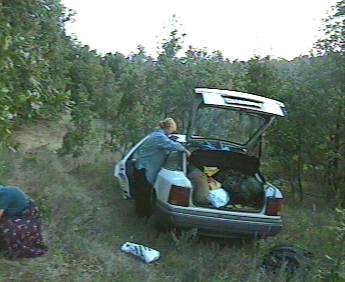
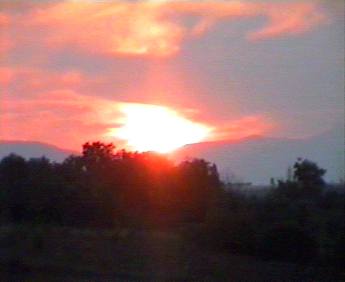
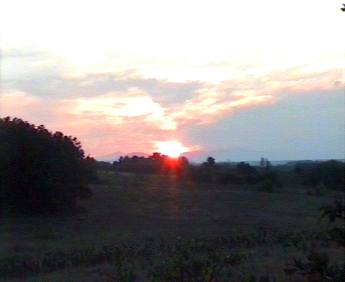
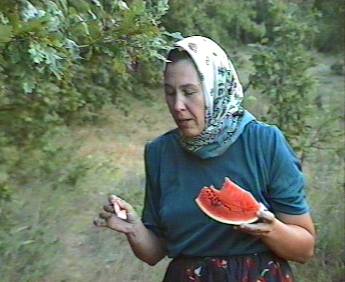
Day 25. Tuesday, 24 August 1999
Up at six in the morning. We wanted to get through Romania quickly and spend the night in Budapest. We were also a bit scared of Bulgarian farm workers, for no good reason. They don't like getting up early and the population is a tenth as dense anyway. In the morning we realised we were driving towards Lom instead of following the E79 towards Vidin. We had a GPS but no map with a grid, so navigation was harder. Lom would do anyway. An early, misty morning. The road followed the Danube. The other side was Romania already. There were signs saying to keep away from the water, apparently left over from communist times. There was no restricted border zone. Before Vidin we converted all our remaining money into petrol. Bulgarian filling stations are quite good, with free toilets and even showers for a price. Beyond Vidin we saw a sign for the FERRYBOAT. Even after reading the word we didn't understand there was no bridge. We realised we'd have to cross on a boat at the last moment. The gate was closed. Finally they let us in. Customs wasn't in a hurry, and it turned out they had reason. Nobody knew when the ferry would come. In the end we waited five hours. They asked us for a hundred marks for the roads, saying that if we'd gone through Ruse they wouldn't have taken anything, but here we'd have to pay. I bargained, with some result. They came down to fifty, then put it at $20. Still cheaper than driving back to Ruse. The ferry cost another $23. In short, don't cross from Bulgaria into Romania at Vidin.
There weren't many cars, so we got to know the neighbours. A Turkish man was driving to Germany with his family without stopping. There were a lot of little children in the car, including babies. I felt sorry for him. A Black American serviceman from Yugoslavia was carrying the mail. He behaved like he owned the place, looking down his nose at the natives. Then a Hungarian lorry driver, a very agreeable and sociable man. Everybody spoke in a mixture of German, English, Hungarian and all the Slavic languages. They kept trying until they understood one another. “Red? Krasny? Roten? Chervonyi? Oh!” Everybody agreed Romania was dangerous. Don't spend the night, don't drive in the dark, better not stop at all. The road left out of Calafat along the Danube turned out to be impassable, so we'd have to go via Craiova. At last a ferry came, two vessels of the Volgo-Balt sort with a platform between them for the cars to drive onto.
The crossing took about twenty minutes. The water in the Danube was cloudy and white. No urge to swim. There were kilometre posts along the banks and double-decker trains on the Romanian side. We docked on the Romanian shore. First you have to drive through a muddy puddle, which is called disinfection. They take $6 for it. We got it down to $4 without a receipt. We filmed the whole extortion process, which nearly got us into serious trouble. We were declared spies who'd exposed a Romanian state secret. Our argument with the authorities lasted another two hours. We prevailed. I threatened to hand the footage to the Romanian government if they didn't let us through. Our conclusion: Romania was a rough country and you couldn't just film whatever you liked. On the Bulgarian side they'd tried to sell us a carton of Marlboros for the customs officers. On the Romanian side they take the cartons away, since you're not allowed to bring in alcohol or cigarettes. We had quite a lot of wine by then, but the cooking pots saved us. Once we'd explained what they were, there were no more questions. The Romanians didn't know Russian and their English wasn't good. The exit was surrounded by barbed wire. Half-naked children raged behind it like monkeys in a cage, insisting I change money with them rather than at the counter. I took no notice and changed fifty dollars. Obscene curses came from behind the wire. At the exit they took another four dollars for the roads. There was poverty everywhere, and the magnificent houses of the new rich Romanians looked like Japanese pagodas. Oil in the country must produce this result, I thought. Sad associations with Russia. Before Craiova a man stepped in front of the car. I only just stopped. It looked deliberate. I decided to frighten him and pretended to talk on a car phone. He vanished as if blown away. Craiova should be bypassed on the ring road, but there are no signs. We were lucky to get behind the Hungarian lorry driver. The road was broken cobblestones, quite murderous. Farther on it wasn't that bad. Handy kilometre posts give the distance to the nearest town and say which town on every one of them. At another junction a child, dirty and half naked, ran out and smeared the dirt across the windscreen with a dry rag. He demanded money, and when he saw we wouldn't give him any he spat into the window. People seemed rather embittered, though of course not all of them. We stopped for a meal and found the other customers and staff at the roadside café friendly. The three of us ate heartily for $9. After lunch the car suddenly wouldn't start. For a minute I couldn't make it do anything and a curious crowd began to form. Then it started and went off as if nothing had happened. A few hundred metres farther on we saw a car that had just fallen from a bridge onto the road. Maybe the clever Ford had saved us. The road came down to the bank of the Danube. Yugoslavia was on the other side and looked quite peaceful. There was busy traffic and signs for Belgrade. A sculpture famous in Romania stands beside the road on the bank. Then the road goes up into the Carpathians. The country grew wilder and cars were few. The main traffic was horses. Travelling wagons out of the Wild West, with number plates and marker lights. The locals passed one another as they tried out the speed of their horses. The mountains were steeper and lovelier all the time. Transylvania, Dracula's home. I tried to frighten Tanya with that, but she wasn't frightened. It grew quite dark after the pass. The horses are even more in the way in the dark. We approached Timișoara. The people here seemed mostly Hungarian. Couples were out taking evening walks. A higher standard of living. A country like any other, with quiet European towns. No longer the same tension in the air. After Arad I converted all our remaining money into fuel, forty-three litres for $27. The border post is called Nădlac on the Romanian side. No complaints or demands from the Romanians. The Hungarians were more difficult. They were big fish now, in NATO. We explained at length that Russia didn't border Romania and it was safer to cross Hungary than Ukraine. Their chief objection was to the cracked windscreen. The year before, ten dollars would have solved the problem. Fancy that, the Hungarians. Full of importance, strutting like turkeys, but taking bribes. It was only a little crack, but the young woman wouldn't budge. She checked the lights, tyre treads and other odds and ends. Everything seemed to be in order. She pointed to a spot and told us to wait. We parked and promptly fell asleep. Realising they wouldn't wear us down and we might even put up the tent, they came to wake us. A male customs officer understood what we were doing. He was interested in the GPS and said the crack was nothing. They let us through. The border crossing was completely free. In Hungary you're meant to drive with your lights on all the time, ninety kilometres an hour out of town and fifty in town. I was especially worried I'd forget the lights. A little way from the border we met a man driving at night with no lights at all. We laughed that he'd read the sign as meaning lights were only allowed in daylight.
It was already three in the morning. We looked for a camp. Sleeping in a tent is tricky in Hungary. Everything is tended and ploughed. No “Zimmer frei” signs either. We didn't find a place to spend the night until after Szeged, a two-room bungalow for the three of us at $20. There was a shower. We washed to our hearts' content and slept like the dead.
Day 26. Wednesday, 25 August 1999
We got up in the morning and drove to Budapest. We wound up on the motorway and had to pay 1,800 forints, nearly $10. Annoying, but we got there quickly. First impression: Hungary is so clean it's almost revolting. Perfect road markings, lights with arrows of all sorts. People drive sleepily. The citizens are respectable and never break any rules whatever. I particularly like the parking meter. Put in coins and it gives you a timed ticket to put in the windscreen. I keep imagining how that would look in Russia. Dull and dreary, all in all, although it gets a hold on you. Life is easy and nothing is asked of you. Do your work and keep to the rules. No thinking on your feet or turning yourself inside out. So we relaxed. We ate the most expensive pastries with real coffee, drank beer and walked round town. You can have a rest here. We went into the cathedral by the Fisherman's Bastion, with beautiful stained glass inside. We looked round the shops and bought Tanya a bag. It was autumn in Budapest already and yellow leaves were falling. We sat in the sun instead of the shade to warm our bones for the long winter. We bought genuine Tokaj wine. Finally, at a new glass supermarket shaped like a cone intersecting a cylinder, we ate in a Greek restaurant. By the end of the day the three of us had eaten our way through $100. Our last chance to relax.
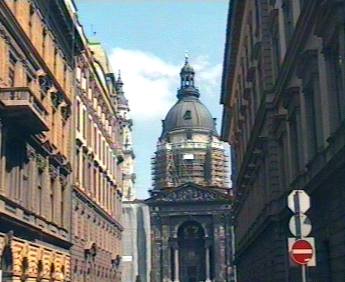
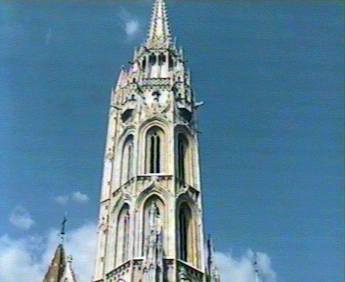
Towards evening we drove on to Slovakia and crossed the border without being charged or having any trouble. Slovakia is poor and mountainous, with plenty of places to spend the night under canvas. That's what we did. We found no campground and pitched in bushes at the edge of a maize field. We didn't make a fire, now that we were in Europe, though there was such a rubbish tip around us that we'd have been hard pressed to dirty it any further.
Day 27. Thursday, 26 August 1999
Up in the morning. Poland lay ahead with its bad roads. I put the wheels back on and secured the fuel pump some more. We planned to drive round the clock from here. Without a good map we got a little lost again before coming to Zvolen. There we ate very well and went for a walk. Zvolen is a small town with no particular sights. In Slovak towns they put pots of flowers on the lampposts. A special vehicle goes round in the morning to water them. The Slovaks live with a little heart. You can see it in the flowers, the houses and the cats. There's a well-kept, thoroughly cuddled cat on every doorstep. We filled up. Petrol in Slovakia is cheaper than in Poland or Hungary. Then we went on to Banská Bystrica. We had to use the motorway. In Slovakia you're supposed to buy a pass for the motorways, nearly $100 for a two-litre car, so we tried to go round them. The important thing is to avoid border posts approached by motorway. In the middle of the country, it isn't much of a worry. From Banská Bystrica we went round the High Tatras on the east. The High Tatras stand like a pimple in the middle of a plain. A little place for a quiet holiday in old age. The foothills are full of hotels and cafés. We had coffee and beer. There is a cable car to the very top. The summit was in cloud when we passed, so there was no point going up. A little narrow-gauge tram runs around the mountains. Strange to see a tram in the woods. We spent what remained of our money on more petrol.
The Polish border doesn't look very imposing. The Poles and Slovaks sit on neighbouring chairs in the same hut. When one steps out the other answers his telephone. Even our Polish stamp was put in by a Slovak. The customs men share a hut too, and only one comes out to inspect. He must have been hungry, as he decided to try all the food we were carrying. Whatever he didn't eat, he'd take a bite out of. We didn't have to pay anything there either. The first large town was Kraków. Polish roads are narrow and broken, with ruts after the hot summer. Slow going. We stopped in Kraków for a meal and a walk. An old, pleasant city and former capital of Poland. The main difficulty is finding a parking space. On an earlier visit they tried to fine Lena $200 for parking on the pavement less than sixty centimetres from a building. Then they smiled and told her that if she didn't pay, they'd remember it when she next brought the car for its inspection in Kraków. There's a cathedral in the centre with the tombs of the kings. We missed it, as it closed early at four. But it's never too late for a pleasant walk. We ate lunch, after a long search for somewhere to do it.
On to Warsaw. The road was still crowded and narrow. Lena drove while I caught up on sleep. I woke near Radom and took the wheel. We had supper at a McDonald's in Warsaw. We didn't walk round the city. Too late and we were too lazy. We drove about instead. The Poles drive fast, with as little space between cars as possible. Much like Moscow. I'd grown rather relaxed after Hungary and Slovakia. The fines in Poland are enormous, hundreds of dollars, but nothing puts people off. There are traffic police with radar along the roads and they get a good haul. I drove carefully. No money to spare.
Day 28. Friday, 27 August 1999
We drove for Białystok along a straight, deserted road, with lots of forest all around. You could find somewhere to pitch a tent, but we were going on to the bitter end. We planned to cross the border at Grodno towards dawn, which turned out to be a good choice. No queue at all. They wanted our road-fee receipt, which cost nine złoty. Nothing in itself, but we had to go back a few kilometres to the kiosk selling the slips. We tried to bargain, but the man said it was a very important little ticket and we had to turn back. They let us through and we drove to a post and a Belarusian border guard. Where were the Poles? He waved us on into Belarusian territory. Well, open the barrier then. Wait, he said. We waited. Suddenly a hare ran out onto the road. No wonder the Belarusians draw them on their money. They opened the barrier once a few cars had gathered and we drove up to the checkpoint. The Poles couldn't have cared less about us. They stamped the passports without looking, handing Tanya's to Lena and Lena's to Tanya. They were quite embarrassed when we told them. The Belarusians said to fill out a declaration. It was a new form. We diligently counted the small amounts left in seven currencies, for nothing as it turned out. There was a heap of declarations on the table and the man tossed ours on it without looking. They sent us to pay $20 for road use and the environment but we drove straight on. There they immediately suggested we wrap $10 in the slip and go in peace. So that's what the slip was for. We looked for a filling station at once. There was no petrol in Belarus, only 95, which was dearer than in Poland. I filled the tank, needlessly. Thirty litres would have got us to the border, and I still had a can of Bulgarian petrol along. I let Lena drive and fell asleep. I woke to find us stopped. A policeman had caught Lena doing ninety past a roadside post instead of the fifty on the sign. He threatened a terrible fine and, in a trembling voice, said five hundred thousand hares. How much was that in dollars? One or two, he said. He wouldn't take dollars, even when we offered five. No arranging anything. We went in search of local currency, no easy matter at five in the morning. At the nearest filling station they said they didn't have petrol, still less that kind of money. After a struggle we found a man who sold us half a million hares. We went back, redeemed the driving licence and carried on. We followed the Grodno–Lida–Valozhyn–Maladzyechna–Polotsk road. It was quite empty and of good quality. On their wages, Belarusians couldn't afford petrol. At Valozhyn Lena got lost and I took over. We stopped to eat in Polotsk and decided to change ten dollars. The savings bank rate was 300,000 to the dollar; five to seven hundred thousand on the black market, but where would we find it? And Belarus had a criminal offence for foreign currency dealings. We went into a buffet and stepped as if through a time machine into a classic Soviet cafeteria twenty years earlier. Coffee with milk from a big dispenser and cabbage pies. Two of us ate for $1. In the shops, nothing. Empty shelves, with expensive Russian goods like Lianozovo milk gathering dust. If they had anything made locally it was very cheap. Tanya wanted a sauce for one and a half million hares. The woman at the counter said, yes, but it was a million and a half. Tanya said she'd take it. The queue fell silent in astonishment. It's hard to spend ten dollars' worth of hares in Belarus. We brought half of it home. The border is just after Polotsk. There isn't supposed to be one, but the Belarusians look for food. They made us pour the petrol into the tank, then let us through. On the Russian side the traffic police checked our papers and some unidentifiable people tried to take sixty roubles for the environment. We began filming them and saying we'd give the tape to the prosecutor, and that what they were doing came under “extortion”. They let us go before long. Lena drove from the border towards Pskov. We filled up before Pskov and I drove the rest of the way, though I was very tired. We made it to Lena's home in Pushkin before dark. Nineteen hours from Warsaw. We sat a while at Lena's, ate, and went home to Saint Petersburg. And that was the end of it.